Pho Bo: Vietnam's National Dish and the Art of the Hanoi Breakfast Bowl
March 14, 2026
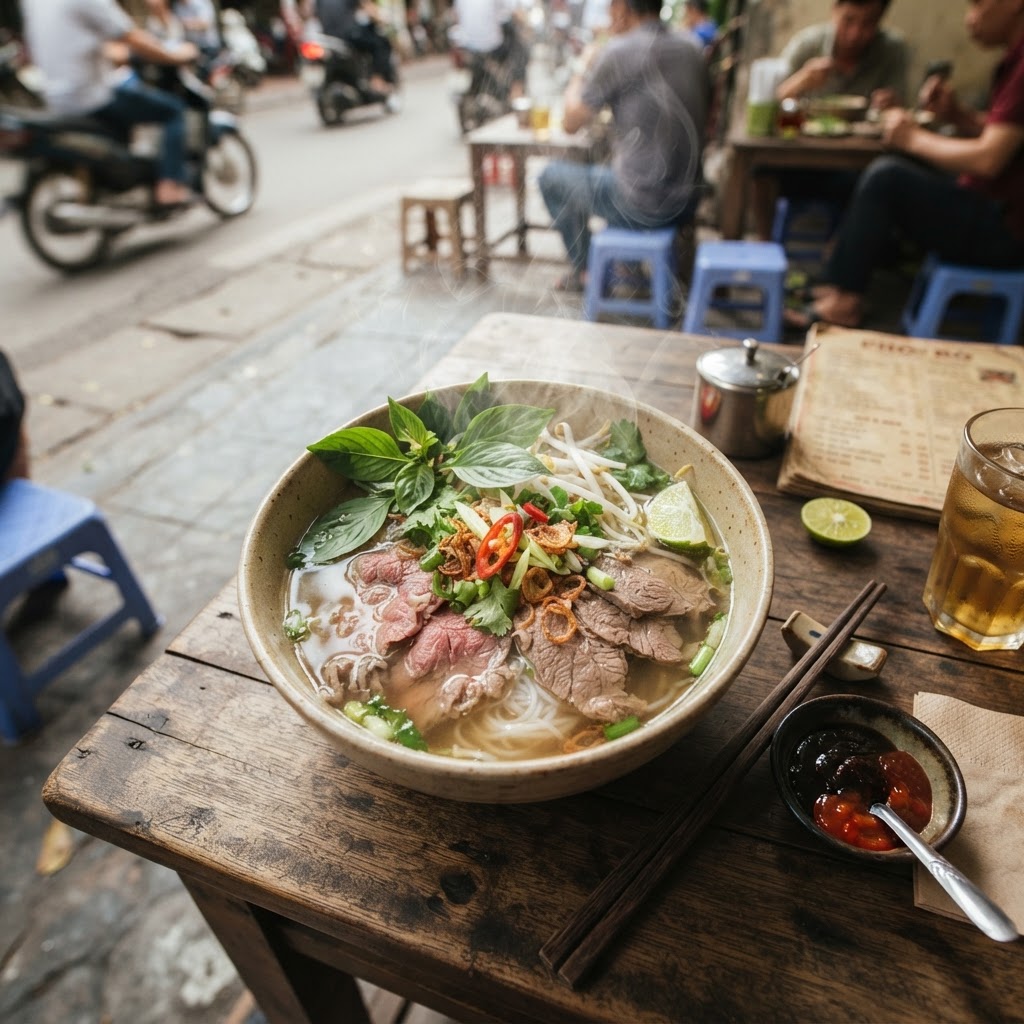
Pho bo — Vietnamese beef noodle soup — is Vietnam's national dish and one of the most widely known noodle soups in the world. A steaming bowl of clear, fragrant beef broth, thin rice noodles, thinly sliced beef, and a generous handful of fresh herbs and garnishes, pho is the classic Vietnamese breakfast. In the streets of Hanoi, from the early hours of the morning, pho stalls set up along the sidewalks, shrouded in clouds of steam, serving bowl after bowl to a city that has started its day with pho for over a century.
The history of pho begins in northern Vietnam at the end of the 19th century, during the period of French colonialism. The modern form of pho emerged between 1900 and 1907 in northern Vietnam, southeast of Hanoi in Nam Dinh Province, which was then a substantial textile market. The traditional home of pho is reputed to be the villages of Van Cu and Dao Cu in Dong Xuan commune, Nam Truc District, Nam Dinh Province. Residents of Nam Dinh were the first to create Vietnamese traditional pho.
The origins of pho reflect the intersection of several cultural influences. The French colonial period (1887–1954) brought a demand for beef to Vietnam — the French introduced pot-au-feu, a slow-cooked beef stew, and the use of beef bones for broth mirrors French consommé techniques. The Chinese workers from Yunnan and Guangdong provinces contributed their own beef noodle soup traditions. The rice noodles (banh pho) and the spices used in the broth (star anise, cinnamon, cloves, cardamom) have connections with Chinese culinary traditions. The Vietnamese adapted and refined all of these influences into something uniquely their own — pho.
The word "pho" itself may derive from the French "pot-au-feu" (fire pot), or from the Chinese "fen" (rice noodles), or from the Vietnamese word for flat rice noodles. The exact etymology is debated, but the dish itself is unmistakably Vietnamese. The evolution of pho from a simple noodle soup called "xao trau" — made with water buffalo meat — into the delicate, balanced creation we know today involved swapping buffalo meat for beef, adding round rice noodles, and refining the flavor of the broth.
After the partition of Vietnam in 1954, pho moved south along with millions of northerners. In the southern land of plenty, chefs began sweetening the broth and adding a wider array of herbs and sauces like hoisin and chili sauce. The Hanoi (northern) style of pho is simpler, with a clearer, more delicate broth and fewer garnishes. The Saigon (southern) style is sweeter and more heavily garnished. Both versions are delicious, and pho purists swear by the simpler Hanoi style.
In Vietnam, pho is traditionally eaten for breakfast. From the early hours, pho stalls set up shop along the sidewalks of Hanoi's Old Quarter. By the 1930s, "ganh pho" — roaming vendors shouldering mobile kitchens on bamboo poles — had become a common sight. Today, pho is served in households, street stalls, and restaurants nationwide. In 2017, Vietnam made December 12 the "Day of Pho." The dish has also become a global phenomenon, popularized by Vietnamese refugees after the Vietnam War.
The key to a great pho is the broth. The broth should be clear, fragrant, and deeply flavorful, simmered for hours (traditionally up to 65 hours in Hanoi) with beef bones, charred onion, charred ginger, and a blend of spices including star anise, cinnamon, cloves, black cardamom, and coriander seeds. The rice noodles should be thin and fresh. The beef should be sliced paper-thin and added raw to the hot broth (for rare beef, "tai") or cooked (for well-done beef). And the garnishes — Thai basil, cilantro, bean sprouts, lime, chili, hoisin sauce, and sriracha — should be added at the table to each diner's taste.
Our Mimosavated version makes a classic Hanoi-style pho bo with a clear, fragrant broth simmered with bones and spices, served with thin rice noodles, rare beef, and traditional garnishes.
Ingredients (serves 6):
The Broth: - 3 ⅓ lb beef bones (marrow bones, knuckle bones, or oxtail) - 1 lb 2 oz beef chuck or brisket (for the cooked meat) - 2 large onions, halved - 1 large piece fresh ginger (about 3 ½ oz), halved - 1 cinnamon stick - 4 whole star anise - 4 whole cloves - 1 black cardamom pod - 1 tablespoon coriander seeds - 1 tablespoon fennel seeds (optional) - 1 tablespoon salt - 1 tablespoon sugar (or rock sugar) - 2 tablespoons fish sauce - 3 ⅛ qt water
The Noodles and Beef: - 14 ⅛ oz fresh or dried banh pho (flat rice noodles) - 10.6 oz beef eye of round or sirloin, sliced paper-thin (partially freeze for 30 minutes for easier slicing) - The cooked beef from the broth, sliced
The Garnishes (serve at the table): - 1 large bunch Thai basil - 1 bunch cilantro, chopped - 7 oz bean sprouts - 2 limes, cut into wedges - 2–3 red chili peppers, sliced - Hoisin sauce - Sriracha or chili garlic sauce - 4 spring onions (scallions), sliced - 1 small red onion, thinly sliced (soaked in water for 10 minutes to mellow)
Preparing the Broth: Parboil the bones: Place the beef bones in a large pot, cover with cold water, and bring to a boil. Boil for 5–10 minutes to release the impurities. Drain and rinse the bones under cold water. Clean the pot.
Char the onion and ginger: Place the onion halves and ginger halves directly over an open flame (gas burner or grill) or under a broiler, turning occasionally, until charred and blackened on all sides — about 10 minutes. Rinse under water to remove the loose charred skins.
Toast the spices: Place the cinnamon stick, star anise, cloves, cardamom, coriander seeds, and fennel seeds in a dry skillet over medium heat. Toast for 2–3 minutes, shaking the pan, until fragrant. Tie the spices in a piece of cheesecloth for easy removal.
Make the broth: Place the cleaned bones, charred onion, charred ginger, beef chuck or brisket, toasted spices (in cheesecloth), salt, sugar, and water in the clean pot. Bring to a boil, then reduce heat to low and simmer gently for at least 4 hours (6–8 hours is better, and traditional Hanoi broth simmers for up to 65 hours). Skim the surface regularly to remove foam and fat — this keeps the broth clear. After 2 hours, remove the beef chuck or brisket (it's cooked), let it cool, and slice it into thin pieces for serving. After the broth is done, strain it through a fine sieve into a clean pot. Add the fish sauce and adjust the salt and sugar to taste. The broth should be clear, fragrant, and deeply flavorful.
Preparing the Noodles: If using dried banh pho, soak in warm water for 30–60 minutes until pliable, then cook in boiling water for 1–2 minutes, until just tender. If using fresh banh pho, cook in boiling water for 10–20 seconds, until just heated through. Drain and rinse briefly under warm water.
Assembling the Bowls: Divide the cooked noodles among 6 large bowls. Add slices of the cooked beef (from the broth) on top. Add a few slices of raw, paper-thin beef on top of the cooked beef — the raw beef will cook in the hot broth. Place a few slices of scallion and red onion on top.
Ladle the boiling hot broth over the noodles and beef — the broth must be at a rolling boil to cook the raw beef. The raw beef slices should turn pink and cook in the hot broth. Serve immediately.
Serving: Serve each bowl with a plate of garnishes: Thai basil, cilantro, bean sprouts, lime wedges, sliced chili, hoisin sauce, and sriracha. Each diner customizes their bowl to taste — add herbs, a squeeze of lime, a few slices of chili, and sauces as desired. Stir everything together and eat hot with chopsticks and a soup spoon.
The Mimosa Pairing Logic: Pho bo is fragrant, savory, and aromatic with spices. The ideal mimosa pairing is a classic Prosecco mimosa — orange juice and Prosecco. The bright, acidic citrus provides a refreshing contrast to the warm, aromatic broth, while the Prosecco's effervescence cleanses the palate between spoonfuls. A grapefruit mimosa is also excellent — the slight bitterness of grapefruit complements the star anise and cinnamon in the broth. Avoid heavy or sweet mimosas — pho is a delicate, fragrant dish, and you need something bright and clean to balance it.
Reference Links: - Pho on Wikipedia (Vietnamese noodle soup, Nam Dinh, early 20th century): Wikipedia - The story of Vietnamese pho (Nam Dinh, Hanoi, French colonial): Vietnam Tourism - Authentic Vietnamese Beef Pho Noodle Soup (Pho Bo) recipe: Delightful Plate
Make-Ahead: The broth can be made up to 3 days ahead and refrigerated — the flavor actually improves overnight. Reheat to a rolling boil before serving. The broth can also be frozen for up to 3 months — thaw overnight in the refrigerator. The cooked beef can be refrigerated for up to 3 days. The noodles should be cooked just before serving — they lose their texture if made too far ahead. The raw beef should be sliced just before serving. The garnishes should be prepared fresh. Assemble the bowls at the last minute — the broth must be boiling hot to cook the raw beef properly. Leftover pho broth can be used as a base for other soups or frozen for future use.
Pro Tips: Parboil and rinse the bones — this is the single most important step for a clear broth; the initial boil removes the impurities and foam that would cloud the broth. Simmer gently, never boil — a rolling boil emulsifies the fat and makes the broth cloudy; a gentle simmer keeps it clear and clean. Skim regularly — removing the foam and fat from the surface throughout cooking keeps the broth clear and clean-tasting. Char the onion and ginger — the charring adds a smoky depth and sweetness to the broth that can't be achieved any other way. Toast the spices — toasting the star anise, cinnamon, cloves, and cardamom releases their essential oils and deepens their flavor. Simmer long enough — a proper pho broth needs at least 4 hours, and 6–8 hours is better; the long, slow simmer extracts the maximum flavor from the bones and the gelatin that gives the broth its body. Slice the raw beef paper-thin — partially freeze the beef for 30 minutes, then slice across the grain as thinly as possible; the thin slices cook in the hot broth in seconds. The broth must be boiling hot when ladled — if the broth isn't hot enough, the raw beef won't cook properly. Serve immediately — pho is at its best when the broth is steaming, the noodles are hot, and the beef is freshly cooked. Let each person customize their garnishes — the joy of pho is in the personalization, and everyone has their favorite combination of herbs, lime, chili, and sauces.
Rate this recipe
Be the first to rate this recipe
to submit your rating.
Recent Posts

Couscous Royale: North Africa's Grand Platter of Lamb, Chicken, and Merguez
October 14, 2026

Seattle Cream Cheese Dog Bites: Hadley Long's 1989 Pioneer Square Invention
October 14, 2026

Khao Soi: Chiang Mai's Northern Thai Coconut Curry Noodles
October 13, 2026

Korean Bibimbap: Jeonju's Joseon Dynasty Mixed Rice
October 11, 2026

Spaghetti alla Carbonara: Rome's World War II Pasta of Eggs, Guanciale, and Pecorino
October 9, 2026