New York Black and White Cookie al Moscato
March 29, 2026
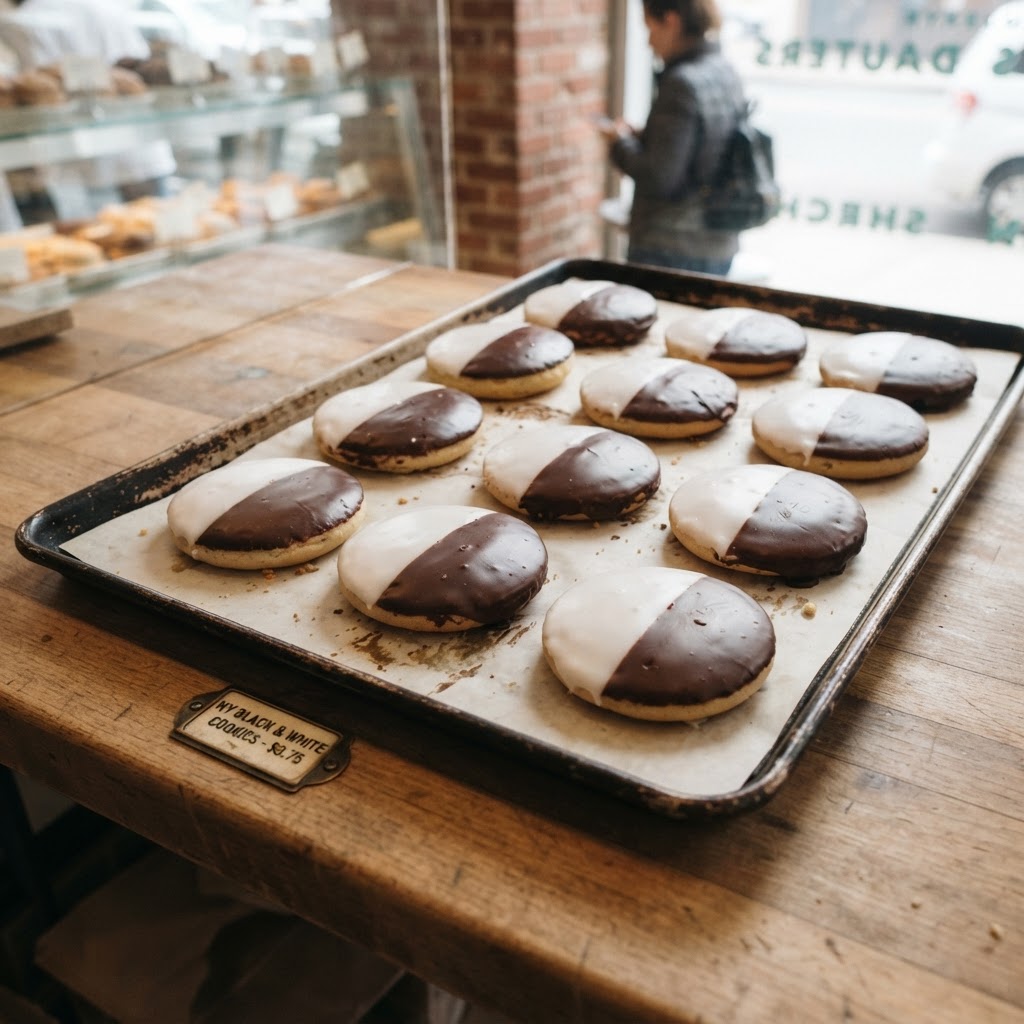
The black and white cookie — a flat, cake-like cookie half-dipped in white vanilla fondant and half in dark chocolate fondant — is one of the most famous treats of New York City, a fixture of Jewish bakeries and deli counters across the metropolitan area. Jerry Seinfeld made it famous in a 1994 episode of Seinfeld, using it as a metaphor for racial harmony ("Look to the cookie!"), but the cookie's history predates the show by nearly a century.
According to Wikipedia, the black-and-white cookie is commonly traced to Glaser's Bake Shop in the Yorkville neighborhood of Manhattan, founded in 1902 by Jewish Bavarian immigrants John and Justine Glaser. The black-and-white cookie was among the original recipes used by Glaser's Bake Shop when it opened. By the post-war period, black-and-white cookies had become part of American Ashkenazi Jewish culinary repertoire, deeply rooted in the Jewish communities of New York City and elsewhere around the United States. As Eater NY recounts, the cookie's curious history ties it to Bavarian baking traditions brought to New York by immigrant bakers at the turn of the 20th century.
The cookie is not really a cookie — it is a small cake. The base is a dense, soft sponge (often called a "half-moon" in Central New York, where a domed version is common), and the icings are a fondant or royal icing rather than a buttercream. The vanilla half is traditionally a simple powdered sugar and milk glaze, while the chocolate half is made with melted chocolate or cocoa added to the same base. The cookie is eaten with the two icings side by side, and the pleasure is in the contrast between the sweet, clean vanilla and the rich, slightly bitter chocolate. In Italian-American bakeries in New York City, a thin layer of apricot jam is sometimes spread beneath the fondant for extra flavor and to help the icing adhere.
Our Mimosavated version adds a splash of Moscato d'Asti to the cookie batter — the fragrant, lightly sparkling sweet wine with aromas of peach, orange blossom, and honeysuckle adds a delicate floral note to the sponge base.
Ingredients (makes 12 large cookies):
The Moscato Sponge Base: - 8 ⅞ oz all-purpose flour - 1 teaspoon baking powder - ½ teaspoon salt - 4 ¼ oz unsalted butter, room temperature - 5 ¼ oz granulated sugar - 2 large eggs, room temperature - ½ cup whole milk - 3 ⅓ tbsp Moscato d'Asti - 1 teaspoon vanilla extract - ½ teaspoon almond extract - 1 teaspoon lemon zest
The White Vanilla Icing: - 7 oz powdered sugar - 2–3 tablespoons boiling water - ½ teaspoon vanilla extract - A pinch of salt
The Dark Chocolate Icing: - 7 oz powdered sugar - 2 ⅛ oz unsweetened cocoa powder - 2–3 tablespoons boiling water - ½ teaspoon vanilla extract - A pinch of salt - 1 oz dark chocolate, melted (optional, for a richer color and flavor)
Making the Cookie Base: Preheat the oven to 347°F (350°F). Line two baking sheets with parchment paper.
In a medium bowl, whisk together the flour, baking powder, and salt. In a large bowl, beat the butter and sugar until light and fluffy. Add the eggs one at a time, beating well after each. Stir in the vanilla extract, almond extract, and lemon zest. Gradually add the dry ingredients, alternating with the milk and Moscato, beginning and ending with the dry ingredients. Mix just until combined — don't overmix.
Drop ¼-cup portions of batter onto the prepared baking sheets, leaving plenty of space between them (the cookies will spread). Use the back of a spoon to flatten each mound into a smooth round, about 3 inches across.
Bake for 12–15 minutes, until the cookies are set and just beginning to turn golden at the edges — they should remain pale on top. Let cool on the baking sheet for 5 minutes, then transfer to a wire rack to cool completely before icing.
Making the Icings: For the white vanilla icing: in a bowl, whisk together the powdered sugar, 2 tablespoons of boiling water, vanilla, and salt. Add more water, a few drops at a time, until the icing is smooth and spreadable but not runny — it should hold its shape when spread.
For the dark chocolate icing: in another bowl, whisk together the powdered sugar, cocoa powder, 2 tablespoons of boiling water, vanilla, and salt. Stir in the melted chocolate (if using). Add more water, a few drops at a time, until the icing is the same consistency as the white icing.
Icing the Cookies: Turn each cookie upside down (the flat bottom is the icing surface). Spread the white vanilla icing over half of each cookie, using an offset spatula to create a clean straight line down the center. Spread the dark chocolate icing over the other half. Let the icing set for at least 1 hour at room temperature before serving.
Serving: Serve at room temperature. The cookies are best the day they are iced, but they keep well for 2–3 days in an airtight container.
The Mimosa Pairing Logic: Since the batter contains Moscato d'Asti, pair with a peach bellini mimosa — peach purée and Prosecco. The peach echoes the Moscato and complements the vanilla and almond in the cookie. A strawberry mimosa is also excellent — the strawberry and the chocolate icing are a beautiful pairing. Avoid heavy or dry mimosas — the black and white cookie is a soft, sweet, cake-like treat, and you need something light and fruity to complement it.
Reference Links: - Black and white cookie on Wikipedia (Glaser's Bake Shop, 1902, Yorkville): Wikipedia - The Black-and-White Cookie's Curious History (Bavarian immigrants, Glaser's): Eater NY - Moscato d'Asti wine guide: Wine Folly
Make-Ahead: The cookie bases can be baked up to 2 days ahead and stored in an airtight container at room temperature, or frozen for up to 1 month (freeze unfrosted). The icings can be made up to 2 days ahead and stored, covered, at room temperature (re-whisk before using). Once iced, the cookies keep for 2–3 days in an airtight container — do not stack them, or the icings will stick. The cookies are best eaten the day they are iced, while the icings are fresh and the sponge is soft.
Pro Tips: The cookie base is a sponge, not a typical cookie dough — it should be soft and cake-like, so don't overbake or it will dry out. Flatten the batter mounds before baking — the cookies should be flat rounds, not domes, to hold the icing properly. Ice the flat bottoms of the cookies (turn them upside down) — this gives a smoother, more even surface for the fondant. The two icings should have the same consistency — if one is runnier than the other, they will bleed into each other. Use a clean offset spatula and a steady hand to create the crisp dividing line down the center — this is what makes a black and white cookie look professional. Let the icing set fully before storing — wet icing will smear and stick. The lemon zest and almond extract are traditional — they give the sponge a subtle, bakery-style complexity that a plain vanilla base lacks.
Rate this recipe
Be the first to rate this recipe
to submit your rating.
Perfect Mimosa Pairings
Mimosas that pair perfectly with this dish
Recent Posts

Couscous Royale: North Africa's Grand Platter of Lamb, Chicken, and Merguez
October 14, 2026

Seattle Cream Cheese Dog Bites: Hadley Long's 1989 Pioneer Square Invention
October 14, 2026

Khao Soi: Chiang Mai's Northern Thai Coconut Curry Noodles
October 13, 2026

Korean Bibimbap: Jeonju's Joseon Dynasty Mixed Rice
October 11, 2026

Spaghetti alla Carbonara: Rome's World War II Pasta of Eggs, Guanciale, and Pecorino
October 9, 2026