New England Boiled Dinner: The Irish-American Corned Beef and Cabbage That Became a Tradition
August 10, 2026
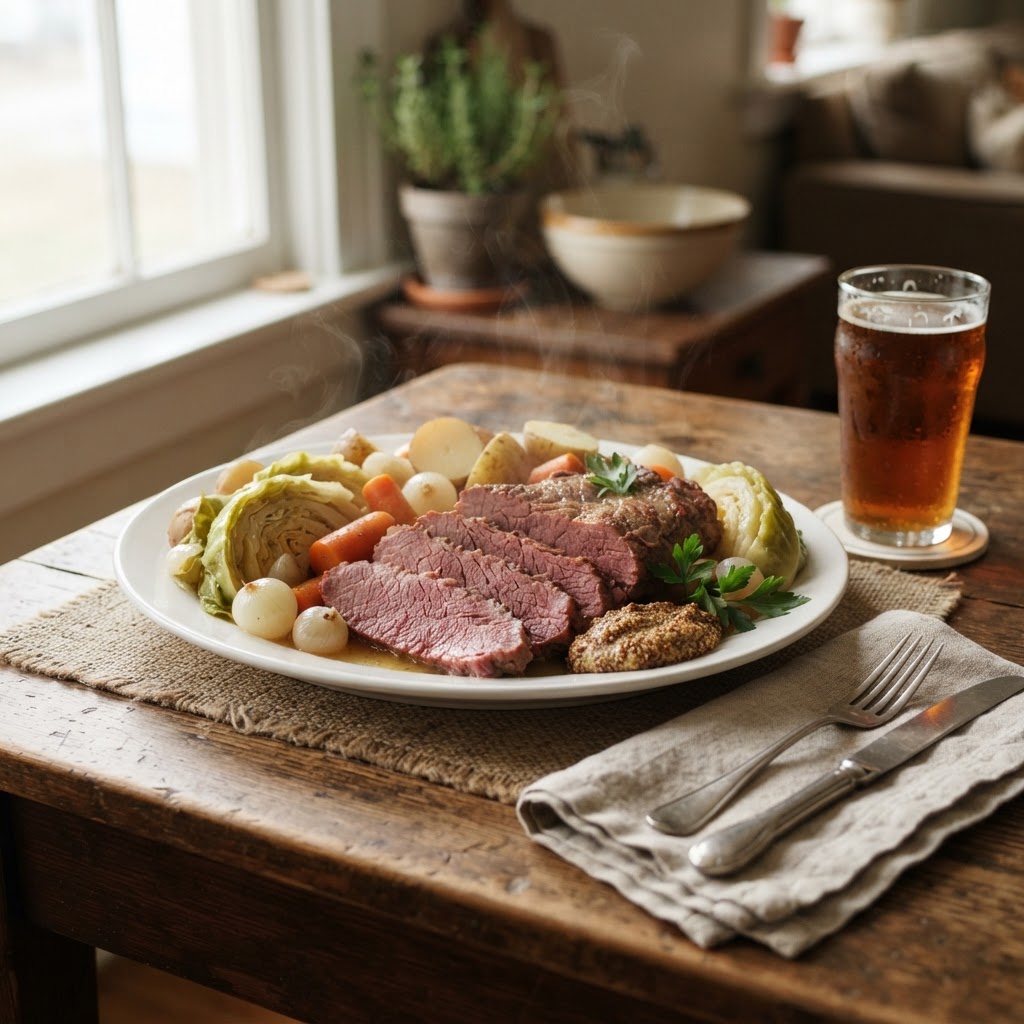
In the nineteenth century, Irish immigrants arrived in the cities of the American Northeast by the hundreds of thousands, fleeing the famine, and they brought with them a dish of bacon and cabbage — a smoked pork shoulder boiled with cabbage and root vegetables. In America, however, bacon was expensive, and the cheap, salt-cured beef sold at the kosher butchers of New York's Lower East Side was close enough. Irish immigrants substituted corned beef, and the New England boiled dinner — corned beef brisket simmered with cabbage, potatoes, carrots, and turnips — was born. The dish became, over generations, the quintessential Irish-American meal, served on St. Patrick's Day and at family gatherings across New England (Wikipedia — New England Boiled Dinner; Reddit r/AskFoodHistorians — Corned Beef and Cabbage).
The boiled dinner is, in truth, neither boiled nor Irish. The meat is simmered, not boiled, in a single pot with the vegetables added in stages, and the dish is an American adaptation of an Irish original. Corned beef itself — beef cured in a brine of salt "corns" — has been made for centuries, but its association with Irish-American cooking dates only to the late nineteenth century, when Irish and Jewish immigrants lived as neighbors on the Lower East Side. The corned beef brisket, cabbage, and potato dinner became a fixture of New England home cooking, simple, hearty, and built to feed a large family from one pot.
Ingredients (serves 6): - 1 corned beef brisket (about 3 lb), with spice packet - 8 small new potatoes, halved - 4 carrots, cut into chunks - 1 small head of green cabbage, cut into wedges - 1 large onion, quartered - 2 turnips or rutabagas, peeled and cubed - 2 bay leaves - 1 tablespoon whole black peppercorns - Whole-grain mustard, for serving
Instructions: Place the corned beef in a large pot and add the spice packet, bay leaves, and peppercorns. Cover with water by 2 inches. Bring to a boil, then reduce to a low simmer, cover, and cook for 2½ to 3 hours, until the beef is fork-tender, skimming any foam. Add the onion, turnips, and potatoes; cook 20 minutes. Add the carrots and cabbage; cook another 20 minutes, until all the vegetables are tender. Remove the beef to a cutting board and rest 10 minutes, then slice against the grain. Arrange the beef and vegetables on a large platter and serve with whole-grain mustard and a ladle of the broth.
For a Crowd (serves 12): - Use two briskets and a larger pot, or two pots; double the vegetables. The dish scales naturally and is the rare meal that is just as good reheated.
Variations: - Classic Irish Bacon and Cabbage: Substitute a smoked pork shoulder (picnic ham) for the corned beef for the original Irish version. - New England with Smoked Shoulder: Use a smoked ham shoulder, a common New England variant. - One-Pot St. Patrick's Day: Add a handful of pearl onions and a few parsnips, and serve with Irish soda bread.
Pairing: A boiled dinner pairs with a malty Irish stout such as Guinness, or with a cold American lager. For a brunch gathering, a bloody mary or a sparkling mimosa works. Serve with whole-grain mustard, horseradish, and a loaf of Irish soda bread.
Reference Links: - New England Boiled Dinner (Irish immigrants, corned beef substitution): Wikipedia - Corned Beef and Cabbage: Historically Irish or Jewish-American? (Lower East Side butchers): Reddit r/AskFoodHistorians - New England Boiled Dinner — A History (corned beef, Irish immigrants, 19th century): Substack
Pro Tips: Simmer, never boil — a hard boil turns the brisket tough and the broth cloudy. Skim the foam in the first hour for a cleaner broth. Add the vegetables in order of cooking time, the roots first, the cabbage last, so nothing turns to mush. Let the brisket rest before slicing so the juices redistribute, and always slice against the grain. Save the leftover broth; it makes an excellent base for a split-pea or vegetable soup the next day.
Rate this recipe
Be the first to rate this recipe
to submit your rating.
Recent Posts

Couscous Royale: North Africa's Grand Platter of Lamb, Chicken, and Merguez
October 14, 2026

Seattle Cream Cheese Dog Bites: Hadley Long's 1989 Pioneer Square Invention
October 14, 2026

Khao Soi: Chiang Mai's Northern Thai Coconut Curry Noodles
October 13, 2026

Korean Bibimbap: Jeonju's Joseon Dynasty Mixed Rice
October 11, 2026

Spaghetti alla Carbonara: Rome's World War II Pasta of Eggs, Guanciale, and Pecorino
October 9, 2026