Mini Beef Wellingtons with Dijon Cream
June 28, 2026
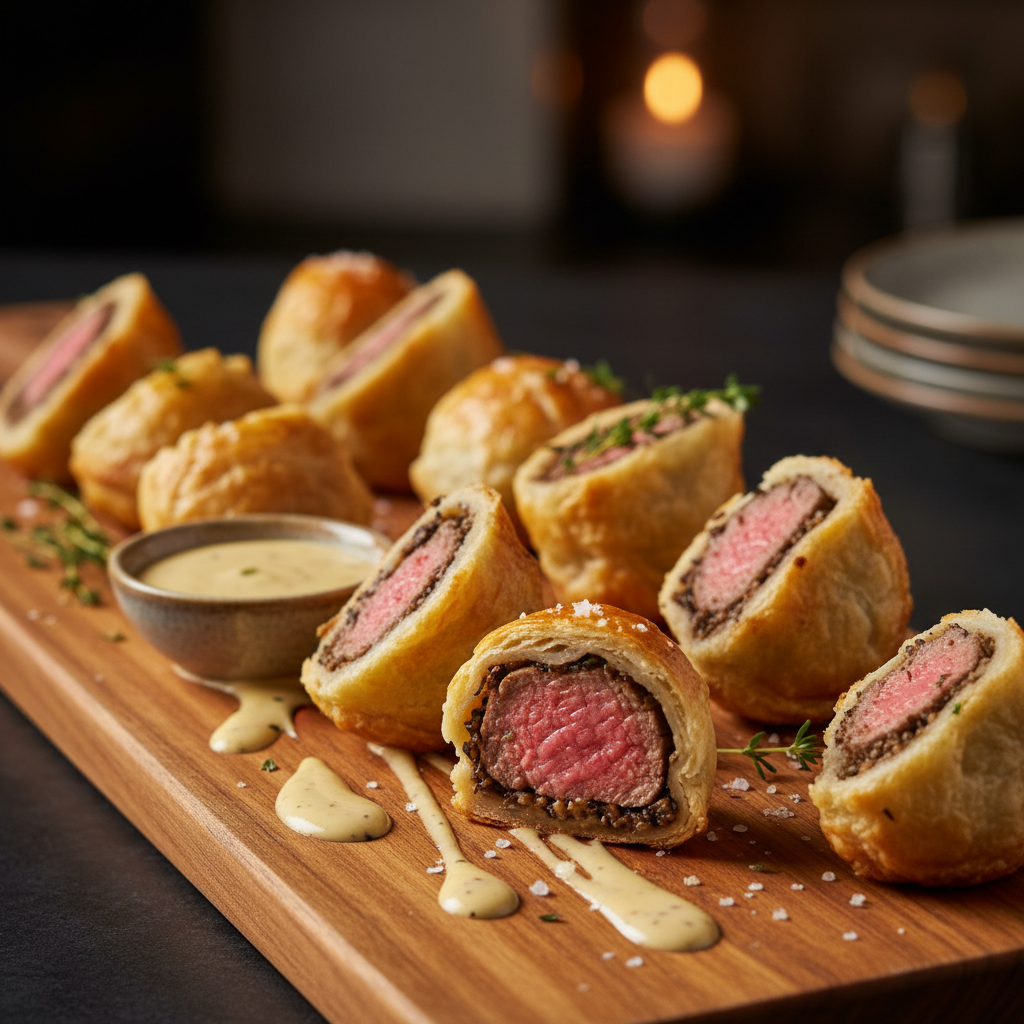
Beef Wellington — beef tenderloin wrapped in mushroom duxelles and puff pastry — is the dish that signals a celebration in the British culinary canon. Named in honor of Arthur Wellesley, the 1st Duke of Wellington and commander at the Battle of Waterloo (1815), it has appeared on formal menus for over two centuries and shows no sign of diminishing in prestige. The individual party version — each a perfect golden parcel containing a disc of beef tenderloin in a mushroom duxelles-and-Parma ham case — delivers the full drama of the original in a format that can be passed on a silver tray.
The technique is methodical rather than difficult. The challenge of a full beef Wellington (keeping the beef at the correct doneness while the pastry bakes through) is significantly reduced in the individual miniature version: smaller parcels require less time in the oven, and the beef's compact size means the temperature differential between the center and exterior is minimal.
The Duxelles — the Critical Component
Mushroom duxelles — the classic French preparation of finely minced mushrooms cooked down with shallots, garlic, and herbs until all moisture has evaporated and the mixture is a dark, intensely concentrated paste — is the flavor core of any Wellington. Raw or undercooked duxelles releases steam during baking, making the pastry soggy from the inside. Properly made duxelles is bone-dry and so concentrated it resembles a very dark paste. This step cannot be rushed.
Ingredients (makes 24 mini Wellingtons): - 1.5 lbs beef tenderloin (the center-cut "chateaubriand" section), trimmed of all sinew and silverskin, at room temperature - 2 tablespoons neutral oil for searing - 2 tablespoons Dijon mustard - 8 thin slices Parma ham or prosciutto di Parma - 2 sheets all-butter puff pastry (Dufour or Pepperidge Farm), thawed and cold - 1 egg, beaten with 1 tablespoon water (egg wash) - Flaky sea salt and cracked black pepper
Mushroom Duxelles: - 1 lb 2 oz cremini or portobello mushrooms, very finely minced in a food processor (or by hand) - 2 shallots, very finely minced - 3 garlic cloves, minced - 2 tablespoons unsalted butter - 1 tablespoon fresh thyme leaves - 2 tablespoons dry sherry or dry white wine - Salt and cracked black pepper
Dijon Cream Sauce: - 1 cup beef stock (good-quality boxed or homemade) - ½ cup heavy cream - 2 tablespoons Dijon mustard - 1 tablespoon whole-grain mustard - 1 shallot, minced - 1 tablespoon unsalted butter - Salt and pepper
Duxelles: Melt butter in a large, wide skillet over medium-high heat. Add mushrooms and do not stir — let the moisture release. Once the liquid has nearly evaporated (5–7 minutes), add shallots, garlic, and thyme. Season with salt and pepper. Cook, stirring, for 12–15 minutes more until the mixture is completely dry, dark, and intensely fragrant. Add sherry and cook 1 more minute until evaporated. Cool completely. (Can be made 3 days ahead; refrigerate.)
Beef Tenderloin: Season the beef generously with flaky salt and cracked pepper on all surfaces. Heat oil in a heavy cast iron skillet over the highest possible heat until smoking. Sear all sides of the tenderloin, about 1 minute per side, until a deep mahogany crust forms all over. This searing seals the surface and adds flavor; it does not cook the interior. Remove immediately. Brush all surfaces with Dijon mustard while still hot. Cool completely in the refrigerator — at least 1 hour or overnight.
Assembly: Slice the cold seared tenderloin into 24 medallions, approximately ¾-inch thick. Arrange Parma ham slices in a slightly overlapping layer on plastic wrap. Spread a thin, even layer of cold duxelles across the ham. Place one beef medallion at the edge. Roll the ham tightly around the medallion into a compact cylinder, using the plastic wrap to assist. Twist the ends tightly and refrigerate 30 minutes to set the shape. Repeat for all medallions.
Unroll the cold puff pastry. Cut into 24 squares, approximately 3.5×3.5 inches each. Unwrap one ham-wrapped medallion and place in the center of each pastry square. Fold the pastry around the beef, pressing the seams firmly to seal. Brush all surfaces with egg wash. Score the top lightly with a knife in a crosshatch pattern. Refrigerate assembled Wellingtons for 20 minutes.
Dijon Cream Sauce: Sauté shallot in butter until soft. Add beef stock and reduce by half. Add cream and reduce to a coating consistency. Whisk in both mustards off the heat. Season. (Can be made 2 days ahead; reheat gently.)
Baking: Preheat oven to 425°F. Brush assembled Wellingtons again with egg wash. Bake on a parchment-lined sheet for 16–20 minutes until the pastry is deeply golden and the internal temperature reads 125–130°F for medium-rare. Rest 5 minutes.
Service: Arrange on a warm platter. Serve Dijon cream in a small bowl alongside for dipping, or pipe a small spoonful beside each Wellington on the platter.
The Mimosa Pairing Logic: The richness of the beef, butter-enriched duxelles, and cream sauce calls for the highest-acid mimosa available. A blood orange mimosa or a classic orange mimosa provides the bright citrus counterpoint that cuts through the pastry's butteriness and the beef's richness. The earthy mushroom duxelles creates a flavor bridge to aged champagne's yeasty depth — serve with the best quality Brut available for maximum impact. Avoid sweet tropical mimosas — richness plus sweetness is the direction you want to counteract, not amplify.
Reference Links: - Beef Wellington history: Epicurious — Wellington History - Mini Beef Wellington technique: Sunday Table - Dufour all-butter puff pastry: Dufour Pastry Kitchens - Mushroom duxelles technique: Serious Eats - Beef tenderloin sourcing: Snake River Farms
Make-Ahead: Duxelles (3 days, refrigerated); seared, Dijon-brushed beef (1 day, refrigerated); assembled, wrapped medallions in ham (1 day, refrigerated); assembled unbaked pastry parcels (4 hours, refrigerated). Bake just before service.
Variations: - Add a thin layer of foie gras mousse between the duxelles and the beef for a truly luxurious version - Use duck breast instead of beef for a French duck Wellington variation - Substitute the Dijon cream with a red wine jus for a more classic, restaurant-style accompaniment
Pro Tips: The beef must be completely cold before wrapping in pastry — warm beef softens the duxelles and the pastry from the inside before baking begins. The duxelles must be completely dry — any residual moisture creates steam that makes the pastry soggy from the inside, the most common failure mode of Wellington. Press the pastry seams very firmly and use egg wash as the adhesive; unsealed seams open during baking. The 20-minute refrigeration of the assembled parcels is essential for the pastry to re-firm before the oven.
Rate this recipe
Be the first to rate this recipe
to submit your rating.
Recent Posts

Couscous Royale: North Africa's Grand Platter of Lamb, Chicken, and Merguez
October 14, 2026

Seattle Cream Cheese Dog Bites: Hadley Long's 1989 Pioneer Square Invention
October 14, 2026

Khao Soi: Chiang Mai's Northern Thai Coconut Curry Noodles
October 13, 2026

Korean Bibimbap: Jeonju's Joseon Dynasty Mixed Rice
October 11, 2026

Spaghetti alla Carbonara: Rome's World War II Pasta of Eggs, Guanciale, and Pecorino
October 9, 2026