Mille-Feuille al Prosecco
May 5, 2026
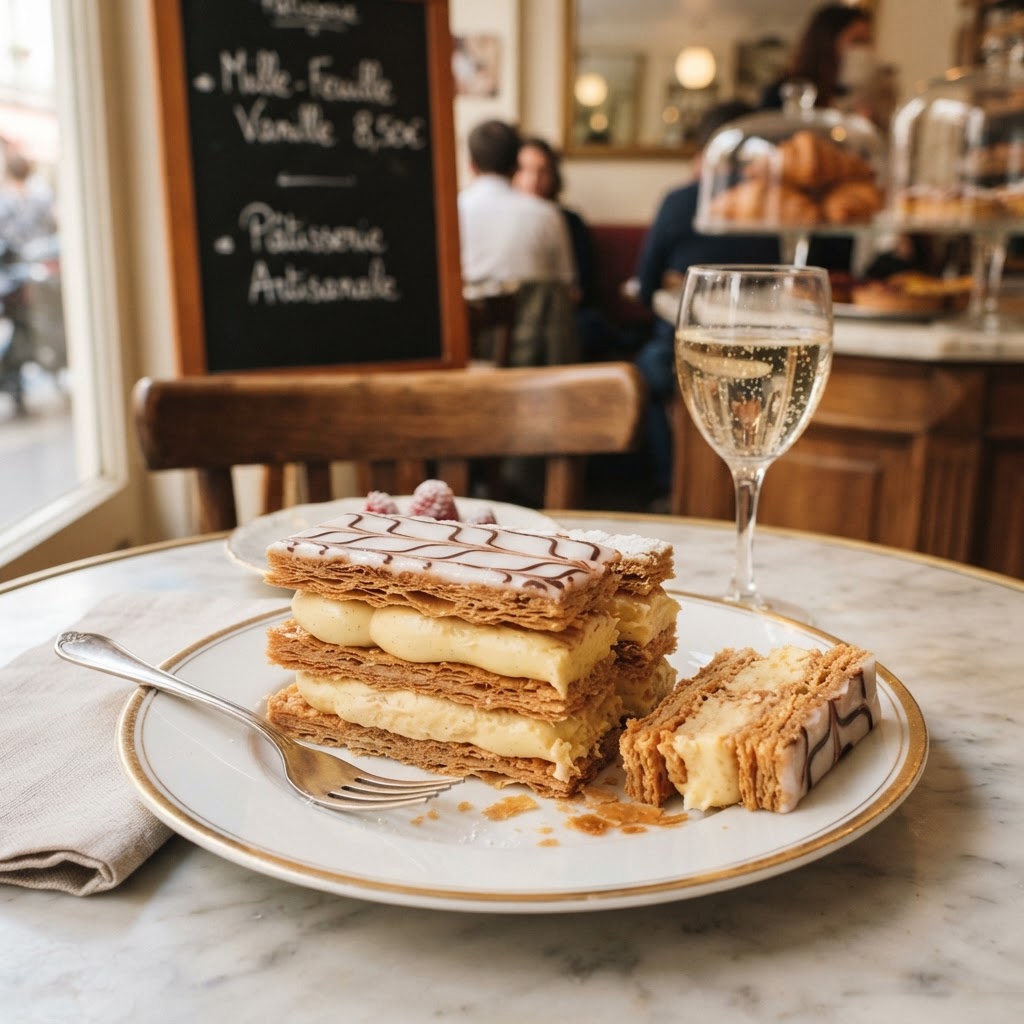
The first published recipe for a mille-feuille appeared in 1651, in *Le Cuisinier François* by François Pierre de la Varenne, one of the foundational cookbooks of French cooking, which also gave the early recipes for the roux and béchamel. La Varenne's version was a pastry of layered puff paste with various fillings, and the name itself, "thousand leaves," first appears in 1733, in an English-language cookbook by the French chef Vincent La Chapelle. The mille-feuille as we know it, three distinct layers of puff pastry with pastry cream, was refined by Marie-Antoine Carême (1784–1833), who perfected the techniques of French pâtisserie and the preparation of *pâte feuilletée*. In 1867 the Lyon pastry chef Adolphe Seugnot proposed the mille-feuille as his personal specialty and is credited with the classic white icing feathered with chocolate lines that tops the modern version.
In English-speaking countries the mille-feuille is often called a "Napoleon," a name with nothing to do with the emperor; it comes from *napolitain*, "from Naples," after the layered pastries of the Roman-Neapolitan tradition, and was shortened and misunderstood over time.
The technique is everything. The puff pastry must be baked until deeply golden and thoroughly crisp, the pastry cream thick and vanilla-flecked, and the assembly done just before serving so the pastry stays shattering. The contrast between the flaky pastry and the smooth, cool cream is the entire point. Our Mimosavated version infuses the pastry cream with Prosecco di Valdobbiadene, the bright, slightly acidic wine adding a floral note that lifts the vanilla cream without overpowering it.
Ingredients (serves 8):
The Puff Pastry: - 1 lb 2 oz all-butter puff pastry (store-bought is fine — just make sure it's all-butter, not margarine-based) - Powdered sugar, for dusting
The Prosecco Pastry Cream: - 2 ⅛ cups whole milk - 6 large egg yolks - 3 ½ oz granulated sugar - 1 ⅓ oz cornstarch - 3 ⅓ tbsp Prosecco di Valdobbiadene - 1 teaspoon vanilla extract - Seeds of ½ vanilla pod (or 1 teaspoon vanilla bean paste) - 1 oz unsalted butter, room temperature - A pinch of salt
The Icing: - 7 oz powdered sugar - 2–3 tablespoons warm water or lemon juice - 1 ¾ oz dark chocolate, melted
Baking the Puff Pastry: Preheat the oven to 392°F (400°F). Line a baking sheet with parchment paper.
Roll the puff pastry to a rectangle about 30x7 ⅞ in (12x8 inches) and 3mm thick. Place on the prepared baking sheet. Prick the entire surface with a fork — this prevents the pastry from rising too much. Place another baking sheet on top of the pastry (to weigh it down and keep it flat), and bake for 15 minutes. Remove the top baking sheet, dust with powdered sugar, and bake for another 10–15 minutes until deep golden brown and thoroughly crisp.
Let cool completely. Using a serrated knife, trim the edges and cut the pastry into three equal rectangles (each about 10x7 ⅞ in). These will be your three layers.
Making the Prosecco Pastry Cream: In a saucepan, heat the milk with the vanilla pod seeds (and the empty pod) until just below boiling. Remove from heat and let steep for 10 minutes, then remove the pod.
In a bowl, whisk together the egg yolks, sugar, cornstarch, and salt until thick and pale. Gradually whisk in the warm milk, then the Prosecco. Return to the saucepan and cook over medium-low heat, whisking constantly, until the cream thickens and comes to a boil — cook for 2 more minutes after boiling, to cook out the cornstarch.
Remove from heat and whisk in the butter and vanilla extract. Transfer to a bowl, cover with plastic wrap directly on the surface (to prevent a skin from forming), and chill completely. Before using, whisk the chilled cream until smooth.
Assembling: Place one pastry rectangle on a serving plate. Spread or pipe half of the pastry cream evenly over the pastry. Place the second pastry rectangle on top, and spread with the remaining cream. Place the third pastry rectangle on top.
Making the Icing: Mix the powdered sugar with enough warm water or lemon juice to make a smooth, spreadable icing — it should be thick but pourable. Spread over the top pastry layer. While the icing is still wet, pipe thin lines of melted chocolate across the surface at regular intervals. Drag a toothpick or skewer through the lines, alternating direction, to create the classic feathered pattern.
Serving: Let the icing set for 15–20 minutes, then slice with a serrated knife — use a gentle sawing motion to avoid crushing the layers. Serve immediately. The mille-feuille is best assembled and served the same day — the pastry cream will soften the puff pastry if left to sit.
The Mimosa Pairing Logic: Since the pastry cream contains Prosecco, pair with a classic Prosecco mimosa — orange juice and Prosecco. The bright citrus complements the vanilla cream and the buttery pastry. A strawberry mimosa is also excellent — the strawberry and vanilla is a classic pairing. Avoid heavy or dry mimosas — mille-feuille is light and elegant, and you need something equally light and bright.
Reference Links: - Mille-feuille on Wikipedia (1651, La Varenne, Carême): Wikipedia - Mille-Feuille: A Little History (1651 La Varenne): Gourmandise - The history of Mille-feuille (17th century, Seugnot): La Patisserie du Monde - The Long and Layered Story of Mille-feuille and the Napoleon: Cadbury Desserts Corner - Prosecco di Valdobbiadene: Wikipedia
Make-Ahead: The puff pastry can be baked up to 2 days ahead and stored in an airtight container at room temperature — keep it dry, as humidity will soften it. The pastry cream can be made up to 3 days ahead and refrigerated. The mille-feuille should be assembled no more than 4 hours before serving — the pastry cream will soften the puff pastry over time. Do not refrigerate the assembled mille-feuille — refrigeration softens the pastry. Do not freeze.
Pro Tips: Use all-butter puff pastry — margarine-based pastry doesn't have the same flavor or flakiness. Prick the pastry and weigh it down during baking — this keeps it flat and even, which is essential for a neat mille-feuille. Bake until deep golden brown — underbaked puff pastry is soggy and doughy, not crisp and flaky. Trim the edges after baking — the edges are often paler and less crisp; trimming gives you clean, even layers. The pastry cream must be thick — if it's too loose, it will squish out when you add the top layer. Cover the cream with plastic wrap directly on the surface while chilling — this prevents a skin from forming. Assemble close to serving time — the pastry cream will soften the puff pastry, and the contrast between shattering pastry and smooth cream is the entire point. Cut with a serrated knife using a gentle sawing motion — pressing down will crush the layers. The feathered icing is traditional and beautiful — take your time with the toothpick dragging; it's easier than it looks.
Rate this recipe
Be the first to rate this recipe
to submit your rating.
Recent Posts

Couscous Royale: North Africa's Grand Platter of Lamb, Chicken, and Merguez
October 14, 2026

Seattle Cream Cheese Dog Bites: Hadley Long's 1989 Pioneer Square Invention
October 14, 2026

Khao Soi: Chiang Mai's Northern Thai Coconut Curry Noodles
October 13, 2026

Korean Bibimbap: Jeonju's Joseon Dynasty Mixed Rice
October 11, 2026

Spaghetti alla Carbonara: Rome's World War II Pasta of Eggs, Guanciale, and Pecorino
October 9, 2026