Lobster Benedict with Tarragon Hollandaise
April 18, 2026
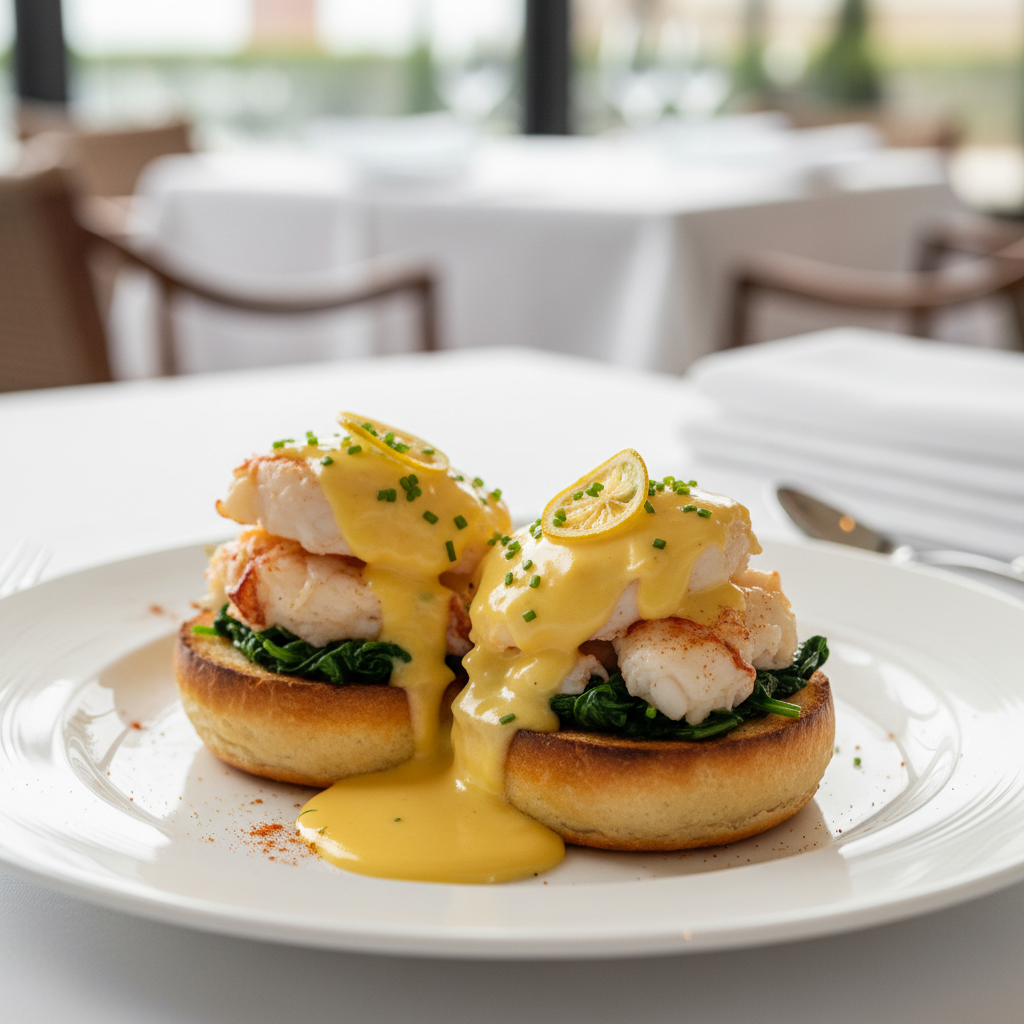
Lobster Benedict is the most luxurious version of what is already the most luxurious brunch dish. Poached lobster tail, briefly warmed in drawn butter, placed on a split and toasted brioche bun, topped with a perfectly poached egg and a hollandaise elevated with fresh tarragon and a whisper of cognac. It is the brunch dish for a truly special occasion — a birthday, a celebration, a long-awaited reunion — and it is, eaten properly, one of the finest things you can make at home.
The key difference between this and a standard Eggs Benedict is the lobster's sweetness. Where Canadian bacon provides a savory-salty contrast to the hollandaise, lobster provides a sweet, oceanic richness that requires a different balance in the sauce. Tarragon hollandaise — *béarnaise* minus the reduction, essentially — has an anise-herbal quality that is the natural partner for shellfish in French classical cooking.
About Lobster
Maine lobster (*Homarus americanus*) is the standard for this dish — its dense, sweet, slightly briny tail meat is ideal. Live lobsters are best purchased from a fish market on the day of cooking; frozen lobster tails (particularly from Maine Lobster Now (mainelobsternow.com) are excellent for this preparation. For a special brunch for 4–6 people, 2 live lobsters (1¼–1½ lbs each) provides adequate tail meat, with the claw meat as a bonus garnish.
Tarragon and French Cooking
French tarragon (*Artemisia dracunculus* var. *sativa*) is one of the four *fines herbes* of classical French cuisine (with chervil, chive, and parsley). Its distinctive anise-like flavor is considered the natural companion to shellfish, chicken, and eggs in French tradition — appearing in béarnaise sauce, *sauce verte*, and countless bistro preparations. Buy French tarragon specifically (not Russian tarragon, which is virtually flavorless).
Ingredients (serves 4): - 2 live whole Maine lobsters (1¼–1½ lbs each), or 4 frozen lobster tails (thawed) - 4 large, very fresh eggs (for poaching) - 4 brioche buns or English muffins, split and toasted - 2 tablespoons white wine vinegar (for poaching water) - 3 tablespoons unsalted butter, drawn (clarified) - Fresh tarragon sprigs and chives for garnish - Flaky sea salt and smoked paprika for finishing
Tarragon Hollandaise: - 4 large egg yolks - 1 tablespoon cold water - 1 cup (2 sticks) unsalted butter, clarified and kept warm - 2 tablespoons fresh lemon juice - 1 tablespoon fresh tarragon leaves, very finely minced - 1 tablespoon fresh chives, minced - 1 tablespoon cognac or dry vermouth (optional — adds exceptional depth) - Pinch of cayenne - Fine sea salt and white pepper
Cooking the Lobster: If using live lobster: bring a large pot of well-salted water to a boil. Plunge lobsters headfirst and cook 8–9 minutes. Remove, cool slightly, and extract tail and claw meat. The tail meat should be just cooked — opaque but not rubbery.
If using frozen tails: thaw overnight in the refrigerator. Butterfly the tails (cut through the top shell lengthwise) and broil 6–7 minutes at high heat, or poach in seasoned court-bouillon for 5–6 minutes until just opaque.
Cut the lobster tail meat into generous chunks (not minced). Warm gently in drawn butter in a small pan over very low heat — just enough to heat through, not to cook further.
Tarragon Hollandaise: Set a heatproof bowl over a saucepan of barely simmering water (the bowl must not touch the water). Whisk egg yolks with cold water vigorously until thick, pale, and doubled in volume — about 4 minutes. The mixture should leave a ribbon when the whisk is lifted. Remove from heat.
Slowly drizzle warm clarified butter into the egg mixture, beginning with a few drops while whisking constantly. Once the emulsion establishes, add butter in a thin, steady stream. Whisk in lemon juice, cognac (if using), cayenne, salt, and white pepper. Fold in minced tarragon and chives. Keep warm over the hot water with the heat off and the bowl covered loosely.
Poaching: Bring a wide, deep pan of water to a very gentle simmer. Add white wine vinegar. Working with one egg at a time: crack each egg into a small ramekin. Create a gentle swirl in the water with a spoon, and slide the egg in. Poach 3 minutes for a runny yolk, 3½ minutes for just-set. Remove to a paper-towel-lined plate with a slotted spoon.
Assembly: Toast brioche buns until deeply golden and genuinely crisp — they need structural integrity to hold the lobster and the sauce. Place each half on a warm plate. Pile warm lobster generously onto each bun half. Set the poached egg on top of the lobster. Spoon tarragon hollandaise generously over the egg — let it cascade down over the lobster. Finish with a pinch of flaky salt, a dusting of smoked paprika, and fresh tarragon and chive fronds.
The Pairing: Lobster Benedict alongside a classic Champagne Brut or a classic Mimosa is the definitive luxury brunch pairing. The wine's acidity and effervescence cut through the richness of the hollandaise and complement the sweetness of the lobster with remarkable precision.
Variations: - Crab Benedict: Substitute lump crab meat for lobster for a more accessible version that loses none of the elegance - Lobster Florentine: Add a layer of wilted baby spinach between the brioche and the lobster - Chive & Lemon Hollandaise: Replace the tarragon with a larger quantity of chives and increase the lemon for a brighter, simpler sauce
Reference Links: - Classic hollandaise technique: Serious Eats - Eggs Benedict history: Saveur Magazine
Pro Tips: The hollandaise can be made up to 1 hour ahead and kept warm over the barely hot water, covered. Poached eggs can be done up to 2 hours ahead: poach, immediately plunge into ice water, and refrigerate. Reheat by submerging in just-simmering water for 30–45 seconds. The lobster must be warmed at the last moment — overheated lobster becomes rubbery within minutes.
Rate this recipe
Be the first to rate this recipe
to submit your rating.
Recent Posts

Couscous Royale: North Africa's Grand Platter of Lamb, Chicken, and Merguez
October 14, 2026

Seattle Cream Cheese Dog Bites: Hadley Long's 1989 Pioneer Square Invention
October 14, 2026

Khao Soi: Chiang Mai's Northern Thai Coconut Curry Noodles
October 13, 2026

Korean Bibimbap: Jeonju's Joseon Dynasty Mixed Rice
October 11, 2026

Spaghetti alla Carbonara: Rome's World War II Pasta of Eggs, Guanciale, and Pecorino
October 9, 2026