Lebanese Ma'amoul: The Ancient Semolina Date Cookies of the Eastern Mediterranean
July 31, 2026
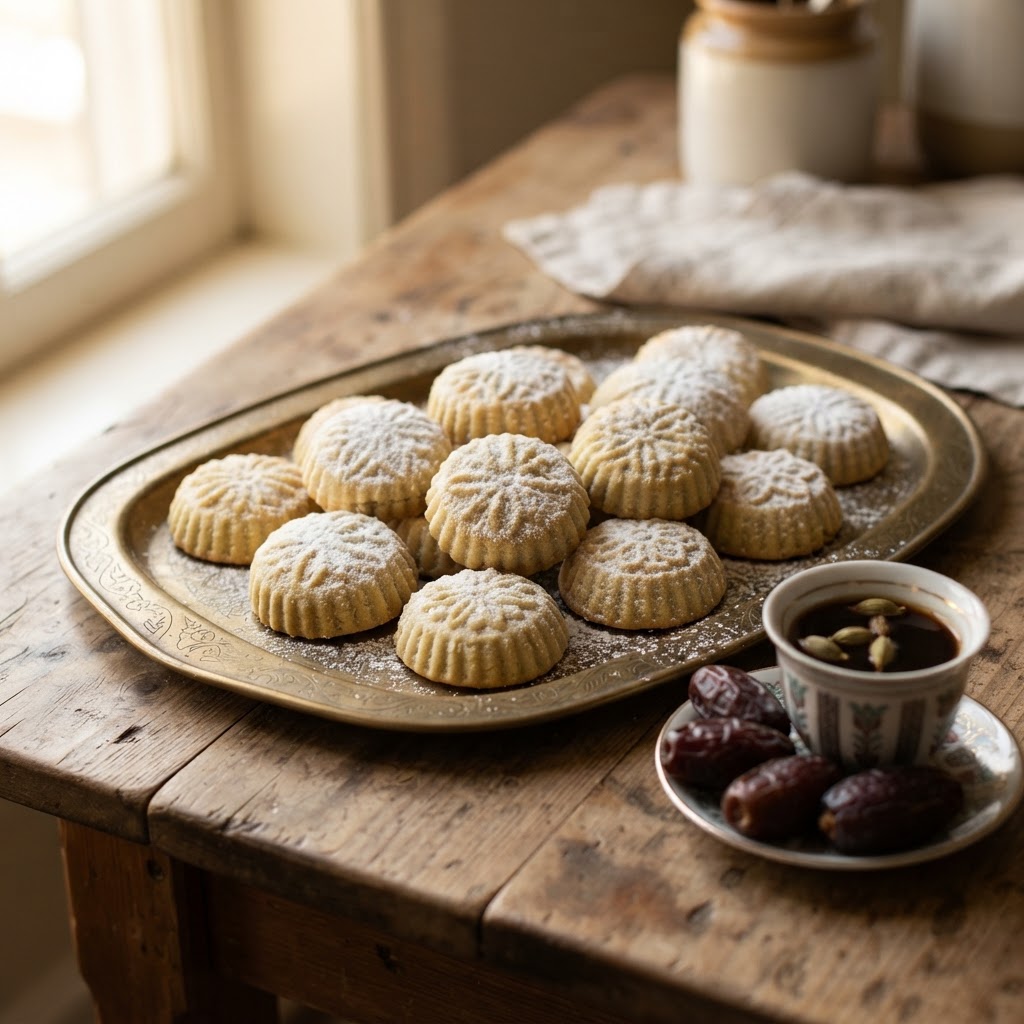
Ma'amoul is a filled shortbread cookie of the Levant, made of a buttery semolina dough pressed around a paste of dates, walnuts, or pistachios, shaped in a carved wooden mold, and dusted with powdered sugar. The cookie is ancient. Food historians trace it to the Egyptian *kahk*, a filled semolina cookie eaten at festivals since the time of the pharaohs, and through it to the *qullupu* of the Sumerians of ancient Mesopotamia, a dry date-stuffed biscuit baked for the spring festival of the goddess Ishtar. From those roots, ma'amoul became the festive cookie of the entire eastern Mediterranean, baked by Muslims for Eid, by Christians for Easter, and by Jews for Purim, and it is at every holiday table in Lebanon, Syria, Palestine, and Jordan (Wikipedia — Ma'amoul; Smithsonian Magazine — The History of Ma'amoul).
The cookie is defined by its dough, a mixture of coarse semolina, fine farina, butter, and a little milk or orange-blossom water, that is rested for hours so the semolina fully absorbs the moisture and becomes soft and pliable. The dough is formed into balls, pressed flat, filled with a paste of chopped dates or ground nuts, sealed, and pressed into a *taabeh*, a carved wooden mold that stamps the cookie with a distinctive pattern, circular for dates, ridged for walnuts, pointed for pistachios, so that each filling is identifiable at a glance. The cookies are baked pale, never browned, and dusted heavily with powdered sugar just before serving, and they are the rare pastry that is shared, in the same form, across the three great religious traditions of the region.
Ingredients (makes about 24 cookies): - 2 cups coarse semolina - 1 cup all-purpose flour - 1 cup (2 sticks) unsalted butter, melted - ¼ cup granulated sugar - 2 tablespoons milk - 1 teaspoon orange-blossom water (optional) - A pinch of salt - For the date filling: 1 lb Medjool or Deglet Noor dates, pitted - 2 tablespoons unsalted butter - 1 teaspoon orange-blossom water or cinnamon - Powdered sugar, for dusting
Instructions: For the dough: in a bowl, combine the semolina, flour, sugar, and salt. Pour in the melted butter and mix until the mixture resembles wet sand. Stir in the milk and orange-blossom water. Cover and let rest at least 2 hours (or overnight) so the semolina softens. For the filling: in a saucepan over low heat, combine the dates and butter; cook, mashing, until the dates soften into a smooth paste. Stir in the orange-blossom water or cinnamon; cool. Preheat the oven to 350°F. Take a walnut-sized piece of dough, flatten it in your palm, place a teaspoon of date paste in the center, and wrap the dough around the filling, sealing the edges. Press the ball into a ma'amoul mold (or flatten with a fork). Tap the mold to release the cookie onto a parchment-lined sheet. Bake 12 to 15 minutes, until barely golden at the edges; do not brown. Cool completely and dust generously with powdered sugar.
For a Crowd (makes 48): - Double the recipe; ma'amoul keep for two weeks in an airtight container and are traditionally baked in large batches for holidays. The dough and the filling can each be made days ahead and held in the refrigerator.
Variations: - Date Ma'amoul (Lebanese Classic): The traditional date-filled version, pressed in a circular mold. - Walnut Ma'amoul: Fill with a mixture of ground walnuts, sugar, and a little cinnamon. - Pistachio Ma'amoul: Fill with ground pistachios and a spoonful of orange-blossom-water syrup, dyed green for a festive presentation.
Pairing: Ma'amoul pair with a small cup of strong Arabic coffee, a glass of mint tea, or a glass of milk. For a brunch gathering, a sparkling mimosa or a sweet Muscat complements the dates and the orange-blossom water. Serve at room temperature, dusted with powdered sugar.
Reference Links: - Ma'amoul (semolina, Arab world, dates, religious festivals): Wikipedia - The History of Ma'amoul, a Middle Eastern Cookie (kahk, Sumerian qullupu, Ishtar, three faiths): Smithsonian Magazine
Pro Tips: Rest the dough for the full two hours, or overnight; semolina needs time to absorb the butter and the moisture, and an unrested dough will be crumbly and crack when shaped. Keep the filling cool and firm so it does not leak during baking; if the date paste is too soft, chill it before shaping. Press the cookies firmly into the mold and tap sharply to release them; a well-molded ma'amoul releases cleanly and keeps its pattern. Bake the cookies pale; they should be barely golden at the edges, never brown, because a browned ma'amoul is dry. Dust with powdered sugar just before serving, so it does not melt into the cookie, and serve the cookies with strong coffee, as they have been served in the Levant for a thousand years.
Rate this recipe
Be the first to rate this recipe
to submit your rating.
Recent Posts

Couscous Royale: North Africa's Grand Platter of Lamb, Chicken, and Merguez
October 14, 2026

Seattle Cream Cheese Dog Bites: Hadley Long's 1989 Pioneer Square Invention
October 14, 2026

Khao Soi: Chiang Mai's Northern Thai Coconut Curry Noodles
October 13, 2026

Korean Bibimbap: Jeonju's Joseon Dynasty Mixed Rice
October 11, 2026

Spaghetti alla Carbonara: Rome's World War II Pasta of Eggs, Guanciale, and Pecorino
October 9, 2026