Korean Mandu Dumplings with Soy Sesame Dipping Sauce: The Silk Road Dumpling That Became Korea's Comfort Food
June 1, 2026
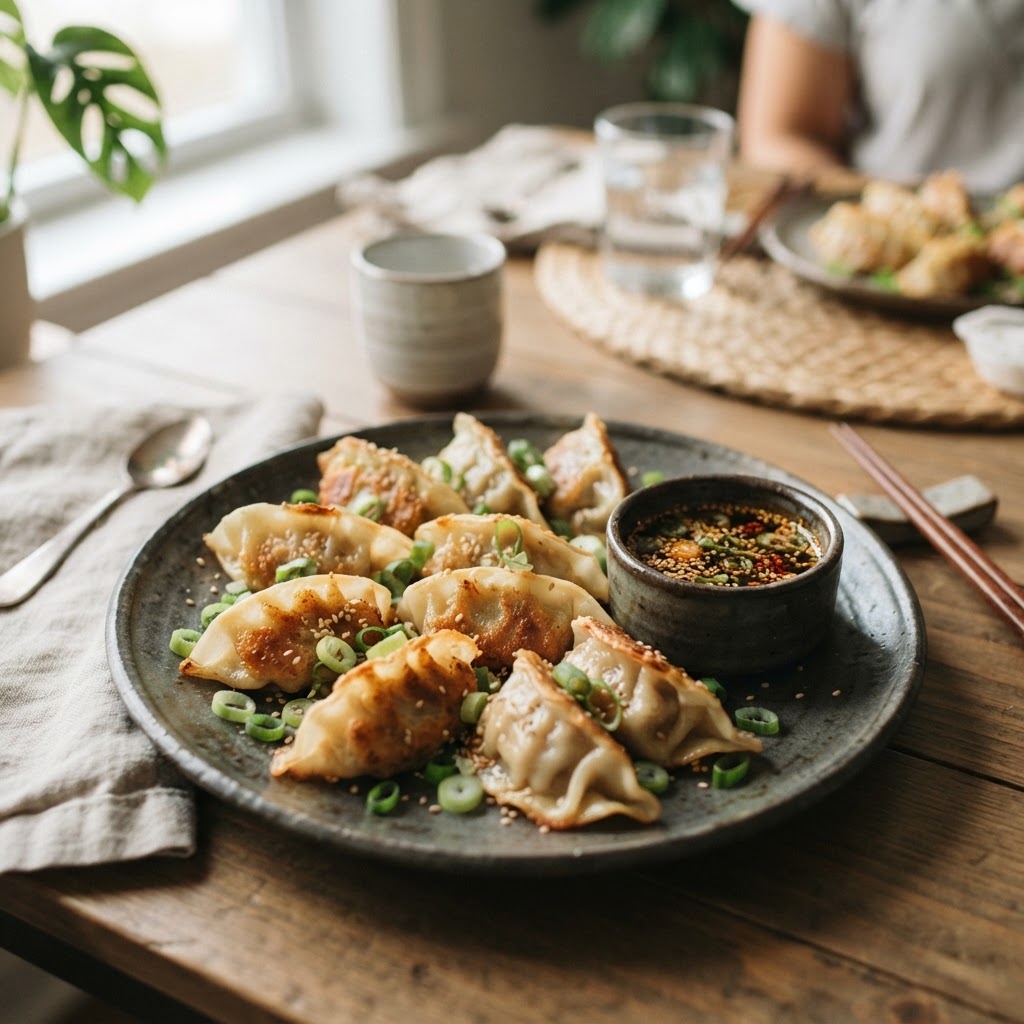
Korean mandu dumplings are the Silk Road's gift to Korea — pleated crescents of dough filled with pork, vegetables, and glass noodles, pan-fried until golden on the bottom and steamed on top, served with a soy sesame dipping sauce. They are the kind of appetizer that disappears from the plate, the kind that makes people forget there are other dishes on the table.
The History of Mandu
According to Wikipedia), mandu are dumplings in Korean cuisine. The name *mandu* is cognate with the names of similar meat-filled dumplings along the Silk Road in Central Asia — Uyghur *manta*, Tajik *mantu*, Turkish *mantı*, Kazakh *mänti*, Uzbek *manti*, Afghan *mantu*, and Armenian *mantʿi*. This Silk Road cognate family tells the story: dumplings spread from Mesopotamia east along the trade routes, leaving versions throughout Central and East Asia.
Mandu are believed to have been first brought to Korea from the Yuan dynasty in the 14th century, during the reign of the Goryeo dynasty. The state religion of Goryeo was Buddhism, which discouraged the consumption of meat. The Mongolian incursion into Goryeo relaxed the religious prohibition against consuming meat, and mandu was among the newly imported dishes that included meat. Another possibility is that mandu came to Korea at a much earlier period from the Middle East through the Silk Road. A Goryeo-era folk song, "Ssanghwajeom," tells a story of a mandu shop (*ssanghwa* meaning "dumplings," *jeom* meaning "shop") run by a foreigner, probably of Central Asian origin.
Mandu were long part of Korean royal court cuisine, but are now found in supermarkets, restaurants, and snack places throughout South Korea. The fillings vary — pork, beef, kimchi, vegetables — but the technique is the same: a thin wrapper, a generous filling, a pleated crescent shape, and a pan-fry-and-steam method that gives them their signature crispy bottom and tender top.
About the Ingredients
Dumpling wrappers — store-bought or homemade; round, thin, white wrappers made of wheat flour and water. If making from scratch, the dough is just flour and water, kneaded and rested.
Pork — ground, with some fat; the pork should be flavorful and juicy, not lean.
Glass noodles (dangmyeon) — sweet potato starch noodles, cooked and chopped; the noodles add texture and absorb the flavors of the filling.
Vegetables — napa cabbage, carrots, and scallions; the vegetables are salted and squeezed to remove excess water, so the filling isn't soggy.
Seasonings — soy sauce, sesame oil, garlic, ginger; the Korean flavor base.
Ingredients (makes 24 dumplings): - 24 round dumpling wrappers - 1/2 lb ground pork - 2 cups napa cabbage, finely chopped - 1/2 cup dried glass noodles (dangmyeon), soaked and chopped - 2 scallions, finely chopped - 2 cloves garlic, minced - 1 tsp grated fresh ginger - 1 tbsp soy sauce - 1 tbsp sesame oil - 1 tsp sugar - 1/2 tsp salt, 1/4 tsp black pepper - Neutral oil for pan-frying - Dipping sauce: 3 tbsp soy sauce, 1 tbsp rice vinegar, 1 tsp sesame oil, 1 tsp sesame seeds, 1/2 tsp gochugaru (Korean chili flakes, optional)
Instructions: Salt the chopped napa cabbage and let sit 15 minutes, then squeeze out all the excess water — this is critical for a non-soggy filling. In a bowl, combine the pork, squeezed cabbage, glass noodles, scallions, garlic, ginger, soy sauce, sesame oil, sugar, salt, and pepper. Mix well. To fill: place a wrapper in your hand, put a tablespoon of filling in the center, wet the edge with water, and pleat the wrapper into a crescent, pressing to seal. Heat 2 tablespoons of oil in a non-stick skillet over medium-high heat. Arrange the dumplings in the pan and fry 2–3 minutes, until the bottoms are golden. Add 1/4 cup of water, cover immediately, and steam 5 minutes, until the water is absorbed and the tops are translucent. Make the dipping sauce: whisk the soy sauce, rice vinegar, sesame oil, sesame seeds, and gochugaru. Serve the dumplings hot, with the dipping sauce.
The Mimosa Pairing Logic: Savory, pan-fried dumplings and bright sparkling wine is a Korean brunch match. A yuzu honey mimosa is the pan-Asian pick — the yuzu's citrus-fragrance plays against the ginger and the garlic in the filling, and the honey balances the soy. A kiwi mint mimosa is the garden alternative — the kiwi's tartness cuts the richness of the pork and the mint nods to the scallion. Either way, eat the dumpling while the bottom is crisp and the top is steamed, and raise the glass to Seoul.
Reference Links: - Mandu (food) (Silk Road cognates, 14th-century Yuan dynasty, Goryeo): Wikipedia)
Make-Ahead: The filling can be made a day ahead and kept refrigerated. The dumplings can be filled and pleated up to a day ahead, kept on a floured tray, covered, in the refrigerator. The dipping sauce can be made days ahead. But pan-fry and steam to order — a mandu that sits after cooking loses its crisp bottom. Fry in batches, steam, and pass hot.
Pro Tips: Squeeze the cabbage dry — this is the single most important step, as wet cabbage makes soggy dumplings. Don't overfill — a tablespoon of filling per wrapper is perfect, and more will burst. Pleat tightly — a leaky dumpling is a boiled dumpling, not a pan-fried one. Pan-fry before steaming — the crispy bottom is the point. And don't lift the lid during steaming — the steam is what cooks the top.
Rate this recipe
Be the first to rate this recipe
to submit your rating.
Recent Posts

Couscous Royale: North Africa's Grand Platter of Lamb, Chicken, and Merguez
October 14, 2026

Seattle Cream Cheese Dog Bites: Hadley Long's 1989 Pioneer Square Invention
October 14, 2026

Khao Soi: Chiang Mai's Northern Thai Coconut Curry Noodles
October 13, 2026

Korean Bibimbap: Jeonju's Joseon Dynasty Mixed Rice
October 11, 2026

Spaghetti alla Carbonara: Rome's World War II Pasta of Eggs, Guanciale, and Pecorino
October 9, 2026