Khachapuri (Adjaruli): Georgia's Iconic Boat-Shaped Cheese Bread
April 24, 2026
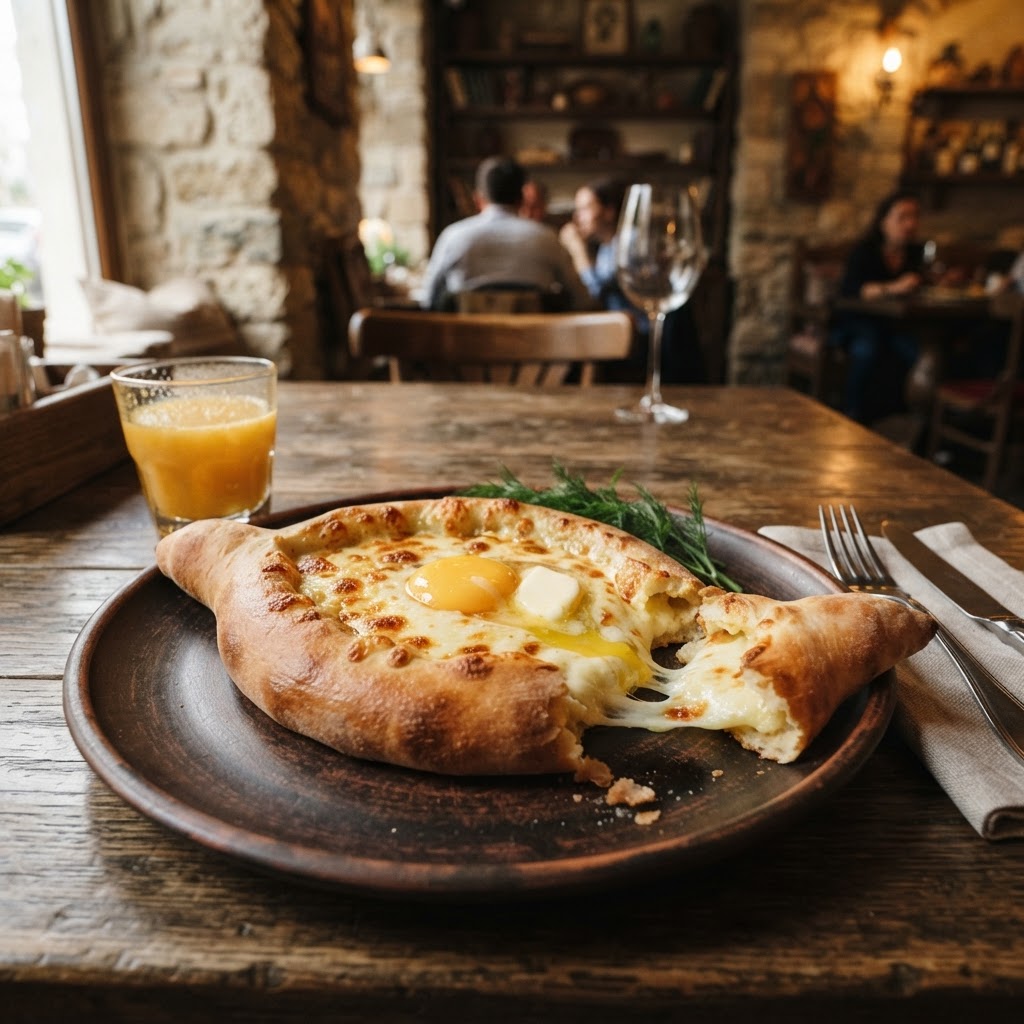
Khachapuri — Georgia's well-known cheese bread — is the national dish of a country that takes its food seriously. And while there are many regional variations across Georgia, the most famous and photogenic is the Adjaruli khachapuri: a boat-shaped bread filled with molten cheese, topped with a runny egg yolk and a pat of butter, served with the instruction to "tear off the pointed ends and stir them into the cheese." It's one of the most theatrical and satisfying brunch dishes in the world.
Khachapuri literally means "cheese bread" in Georgian (khacho = cheese curd, puri = bread), and it's been a staple of Georgian cuisine for centuries. Georgia — the country in the Caucasus, not the American state — is one of the oldest wine-producing regions in the world and has a culinary tradition that dates back thousands of years. Khachapuri is a cornerstone of that tradition, and virtually every region of Georgia has its own version.
The most common version is Imeruli khachapuri — a simple, round, flat bread completely enclosed around a filling of cheese, originating from the Imereti region in western Georgia. It's the version you'll find in virtually every Georgian home and bakery. But the Adjaruli version — from the Adjara region on the Black Sea coast — is the one that has captured the world's imagination. The dough is shaped into a boat, filled with cheese, and baked. Just before serving, an egg yolk and a pat of butter are placed in the center, and the pointed ends of the boat are meant to be torn off and used to stir the butter and egg into the molten cheese.
The cheese traditionally used is sulguni — a semi-soft, slightly tangy, brined cheese from the Samegrelo region of Georgia. It's similar to mozzarella but with a saltier, more complex flavor. Outside of Georgia, a mix of mozzarella and feta is often used as a substitute, which approximates the texture and saltiness of sulguni.
Khachapuri was designated a Georgian national dish and, in 2010, was added to Georgia's list of intangible cultural heritage. In 2017, the Georgian government even trademarked the dish to protect its authenticity. Today, khachapuri is gaining international recognition as one of the world's great comfort foods, and Adjaruli khachapuri in particular has become a social media sensation for its dramatic, interactive presentation.
Our Mimosavated version uses a mix of mozzarella and feta (to approximate sulguni) and serves the khachapuri with a bright, citrusy mimosa pairing.
Ingredients (serves 4):
The Dough: - 1 lb 2 oz all-purpose flour - ¼ oz active dry yeast (1 packet) - 1 teaspoon salt - 1 teaspoon sugar - 1 ¼ cups warm water - 2 tablespoons vegetable oil - 2 tablespoons plain yogurt (optional — makes the dough softer)
The Filling: - 8 ⅞ oz mozzarella cheese, grated - 5 ¼ oz feta cheese, crumbled - 1 ¾ oz unsalted butter, cut into pieces - 4 large egg yolks (one per khachapuri) - 1 egg, beaten (for egg wash)
Making the Dough: In a small bowl, combine the warm water, yeast, and sugar. Let sit for 5 minutes, until foamy. In a large bowl, combine the flour, salt, and yogurt. Add the yeast mixture and vegetable oil. Mix until a dough forms, then knead for 8–10 minutes until smooth and elastic.
Place the dough in a greased bowl, cover with a damp cloth, and let rise in a warm spot for 1–1.5 hours, until doubled in size.
Preparing the Filling: In a bowl, combine the grated mozzarella and crumbled feta. Mix well — this combination approximates the texture and saltiness of Georgian sulguni cheese.
Assembling the Khachapuri: Preheat the oven to 446°F (450°F). Line a baking sheet with parchment paper.
Divide the dough into 4 equal pieces. Roll each piece into an oval about 25x5 ⅞ in (10x6 inches). Spread a quarter of the cheese mixture down the center of each oval, leaving a ¾ in border around the edges.
Fold the long sides of the dough up and over the cheese, pinching the ends together to form a boat shape. Twist the two pointed ends together at the top to seal. Brush the dough with the beaten egg wash.
Baking: Bake for 12–15 minutes, until the dough is golden brown and the cheese is melted and bubbling. Remove from the oven.
Adding the Egg: Using a spoon, create a small well in the center of the melted cheese. Carefully slide a raw egg yolk into each well. Add a piece of butter beside the yolk. Return to the oven for 2–3 minutes, until the egg whites are just barely set but the yolks are still runny — watch carefully, as the egg cooks quickly.
Serving: Serve immediately, piping hot. To eat, tear off one of the pointed ends of the boat and use it to stir the runny egg yolk and butter into the molten cheese. Then use the torn pieces of bread to scoop up the cheese mixture. The combination of warm, chewy bread, salty, stretchy cheese, rich egg yolk, and melting butter is one of the great eating experiences.
The Mimosa Pairing Logic: Adjaruli khachapuri is rich, salty, and intensely cheesy. The ideal mimosa pairing is a classic Prosecco mimosa — orange juice and Prosecco. The bright, acidic citrus cuts through the richness of the melted cheese and the butter, while the Prosecco's effervescence cleanses the palate. A grapefruit mimosa is also excellent — the slight bitterness of grapefruit provides a refreshing contrast to the salty, rich cheese. Avoid heavy or sweet mimosas — the dish is already rich and salty, and you need something bright and acidic to balance it.
Reference Links: - Khachapuri on Wikipedia (Georgian cheese bread, regional variations): Wikipedia - Adjaruli Khachapuri (Georgian cheese bread, Adjara region): Caroline's Cooking - A Field Guide to Khachapuri (regional variations, Imeruli): Saveur - Everything You Need to Know About Khachapuri (sulguni cheese, Adjaria): Culture Cheese Magazine - Adjaruli Khachapuri (boat-shaped, Black Sea region): Polina Chesnakova
Make-Ahead: The dough can be made the night before and refrigerated after the first rise — let it come to room temperature before shaping. The assembled, unbaked khachapuri can be refrigerated for up to 4 hours before baking. The cheese mixture can be prepared a day ahead. The khachapuri should be baked and served immediately — the egg yolk needs to be runny and the bread at its crispest. Do not freeze assembled — the texture of both the dough and the cheese suffers. Leftovers can be reheated in a 347°F/350°F oven for 5 minutes, but the egg will cook further and the bread will lose its crispness.
Pro Tips: Use a mix of mozzarella and feta — mozzarella provides the stretchy, melty texture, while feta adds the salty, tangy flavor that approximates Georgian sulguni cheese. All mozzarella is too bland; all feta is too salty and doesn't stretch. Shape the dough into a proper boat — the high sides contain the molten cheese and the pointed ends are the "handles" you tear off to stir in the egg and butter. Don't overbake before adding the egg — the dough should be golden but the cheese still bubbling; you need the cheese hot enough to slightly cook the egg yolk when you add it. Watch the egg carefully after adding — it goes from perfectly runny to fully cooked in about 2 minutes. The yolk should be runny, the whites barely set. Serve immediately — the dish loses its magic quickly as the cheese cools and solidifies. The interactive element is essential — tear off the pointed end, stir it into the egg and butter and cheese, and eat. That's the whole point of Adjaruli khachapuri, and it's what makes it so memorable.
Rate this recipe
Be the first to rate this recipe
to submit your rating.
Recent Posts

Couscous Royale: North Africa's Grand Platter of Lamb, Chicken, and Merguez
October 14, 2026

Seattle Cream Cheese Dog Bites: Hadley Long's 1989 Pioneer Square Invention
October 14, 2026

Khao Soi: Chiang Mai's Northern Thai Coconut Curry Noodles
October 13, 2026

Korean Bibimbap: Jeonju's Joseon Dynasty Mixed Rice
October 11, 2026

Spaghetti alla Carbonara: Rome's World War II Pasta of Eggs, Guanciale, and Pecorino
October 9, 2026