Indian Gulab Jamun al Moscato
May 31, 2026
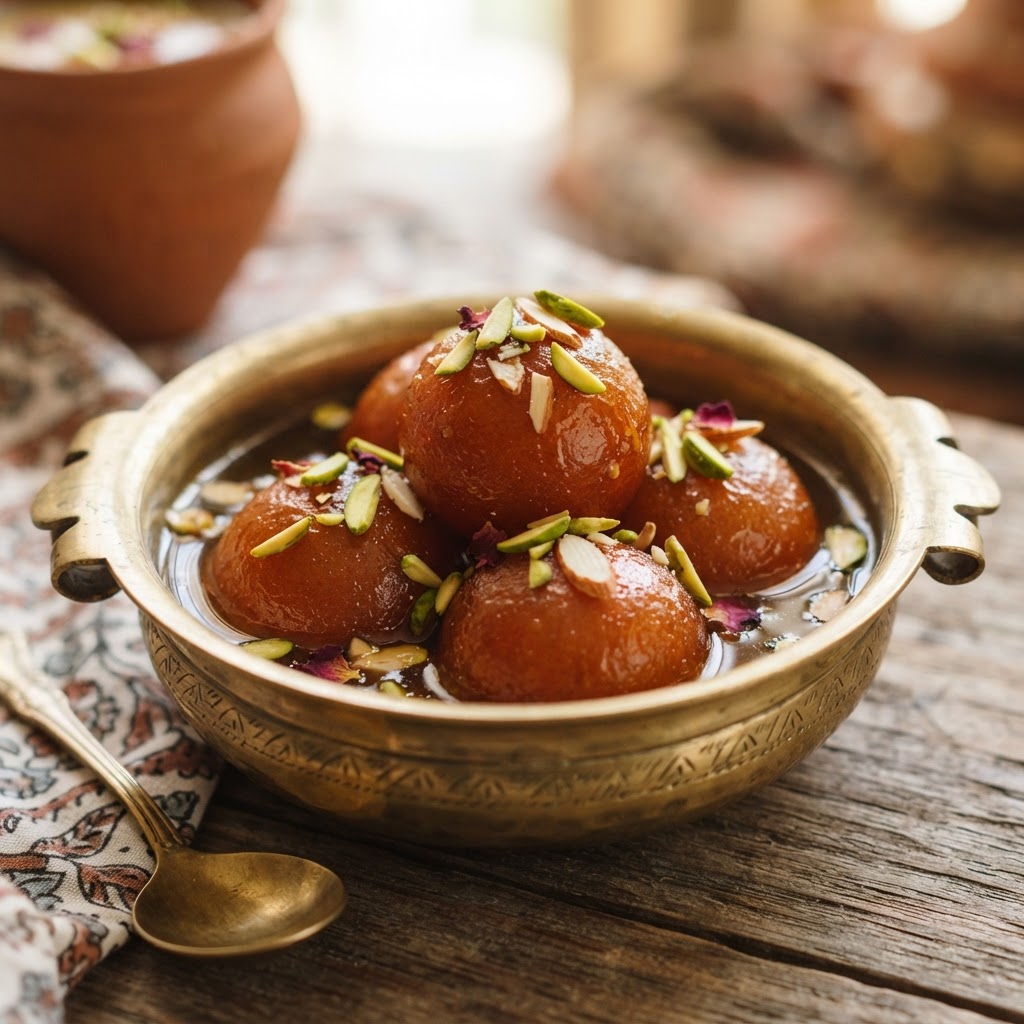
Gulab jamun — deep golden-brown fried milk dumplings soaked in rose- and cardamom-scented sugar syrup — is one of the most popular sweets of the Indian subcontinent, the dessert that ends weddings, festivals, and family celebrations across India, Pakistan, Bangladesh, and Nepal. Its name tells its story: *gulab* comes from the Persian words *gul* (flower/rose) and *āb* (water), referring to the rose-water syrup, and *jamun* refers to the Indian Java plum, a dark fruit the dumplings resemble in size and shape.
According to Wikipedia, gulab jamun is a sweet dessert originating in the Indian subcontinent, popular across India, Bangladesh, Nepal, Pakistan, the Maldives, and Burmese cuisines. The 13th-century Arab dessert *luqmat al-qadi* (the judge's morsel) is similar in appearance to gulab jamun, soaked in rosewater-scented syrup — the only Persian connection may be the common use of rosewater syrup. Gulab jamun emerged in medieval India during the Mughal Empire, blending Persianate influence with local traditions. As Kinara recounts, food historians trace the dessert to a similar Arabic sweet called *luqmat al qadi*, made from fried dough balls dipped in honey. Over time, as Mughal chefs brought Persian influences into Indian kitchens, the recipe was adapted using *khoya* (reduced milk solids), rose water, and cardamom, giving birth to the gulab jamun we know today. By the 16th century, during the reign of the first Mughal emperor Babur, North Indian kitchens were transformed by chefs arriving from Afghanistan, Persia, and beyond, and gulab jamun became a fixture of royal feasts before crossing class and regional boundaries.
The genius of gulab jamun is the contrast between the warm, spongy dumpling and the fragrant syrup. The dumplings are made from *khoya* — milk solids obtained by slowly reducing milk until only the solids remain — kneaded with a little flour and a pinch of baking powder, shaped into smooth balls, and deep-fried slowly over low heat until deep golden brown. They are then dropped into warm, rose- and cardamom-scented sugar syrup, where they soak for at least an hour, absorbing the syrup and becoming soft, juicy, and fragrant throughout. The slow frying is essential — too hot, and the dumplings brown on the outside while staying raw inside; too cool, and they absorb oil and become heavy. The dumplings should be crack-free, or they break apart in the oil. The syrup is perfumed with rose water, green cardamom, and sometimes saffron, and the dumplings must be soaked while warm to absorb it fully. Gulab jamun is served warm or at room temperature, often with a scoop of vanilla ice cream or *kulfi*, and garnished with slivered pistachios or almonds.
Our Mimosavated version adds a splash of Moscato d'Asti to the sugar syrup — the fragrant, lightly sparkling sweet wine with peach, orange blossom, and honeysuckle aromas echoes the rose water and the cardamom, adding a delicate floral depth.
Ingredients (makes about 20 gulab jamun):
The Dumplings: - 8 ⅞ oz milk powder (or khoya, if available) - 1 ¾ oz all-purpose flour - ½ teaspoon baking soda (or baking powder) - 2 ⅔ tbsp milk (plus extra if needed), at room temperature - 1 tablespoon ghee, melted - Ghee or oil, for deep frying
The Moscato Rose Syrup: - 14 ⅛ oz granulated sugar - 1 ⅔ cups water - 3 ⅓ tbsp Moscato d'Asti - 4–5 green cardamom pods, lightly crushed - 1 teaspoon rose water - A few strands of saffron (optional)
Garnish: - Slivered pistachios or almonds
Making the Syrup: In a saucepan, combine the sugar, water, and crushed cardamom pods. Bring to a gentle boil, stirring until the sugar dissolves. Simmer for 8–10 minutes, until the syrup is slightly thickened but still pourable — it should be a light syrup, not a thick caramel. Remove from heat and stir in the Moscato, rose water, and saffron. Keep the syrup warm (not hot) while you make and fry the dumplings.
Making the Dumplings: In a bowl, combine the milk powder, flour, and baking soda. Add the melted ghee and rub it in with your fingertips until the mixture resembles breadcrumbs. Add the milk, a little at a time, kneading gently until you have a smooth, soft dough — be careful not to overwork it, as over-kneading makes the dumplings tough. Add only enough milk to bind the dough; it should be soft but not sticky.
Divide the dough into about 20 equal portions and roll each into a smooth, crack-free ball about the size of a small walnut. Take your time — cracks in the dough cause the dumplings to break apart while frying. Cover the balls with a damp cloth while you heat the oil.
Frying: Heat the ghee or oil in a deep pan over low to medium heat — the oil should be around 302°F (300°F), warm but not hot. The low temperature is crucial: too hot, and the dumplings brown too quickly on the outside while staying raw inside. Fry the dumplings in small batches, turning them gently and continuously with a slotted spoon or chopsticks, until they are evenly deep golden brown all over — about 8–10 minutes per batch. The constant turning ensures even color and prevents them from sinking and sticking.
Soaking: Remove the fried dumplings and drain briefly on paper towels. While still warm, transfer them straight into the warm syrup. Let them soak for at least 1 hour, though longer is better — the dumplings should absorb the syrup fully and become soft, spongy, and fragrant throughout.
Serving: Serve warm or at room temperature, with a slivered pistachio or almond garnish. A scoop of vanilla ice cream or kulfi beside the warm gulab jamun is a wonderful contrast of warm and cold.
The Mimosa Pairing Logic: Since the syrup contains Moscato d'Asti, pair with a peach bellini mimosa — peach purée and Prosecco. The peach echoes the Moscato and complements the rose and cardamom. A lychee rose mimosa is even more thematic — the lychee and rose echo the rose water in the syrup, a classic Mughal-Persian pairing. Avoid heavy or dry mimosas — gulab jamun is sweet, syrup-soaked, and fragrant with rose, and you need something light and floral to complement it.
Reference Links: - Gulab jamun (Indian subcontinent, Mughal Empire, luqmat al-qadi, gulab/jamun): Wikipedia - Gulab Jamun: The Story, the Recipe, and the Sweet (Persian/Arabic, luqmat al qadi, Mughal kitchens, 16th century Babur): Kinara - Moscato d'Asti wine guide: Wine Folly
Make-Ahead: The syrup can be made up to 1 week ahead and stored at room temperature — gently re-warm before soaking. The dumplings can be fried up to 1 day ahead and stored, unsoaked, in an airtight container at room temperature; soak in the warm syrup for at least 1 hour before serving. Once soaked, gulab jamun keeps for 4–5 days in the refrigerator — gently re-warm in the syrup before serving (do not boil, or they'll become hard). The dumplings can be fried and frozen, unsoaked, for up to 1 month; thaw, then soak in warm syrup. The soaked gulab jamun actually improves after a day as the syrup fully penetrates the dumplings.
Pro Tips: Make the syrup first and keep it warm while you fry — the dumplings must go into warm syrup while they are still warm from the oil; this temperature matching is what allows full absorption. The dough must be soft, smooth, and crack-free — knead gently, add only enough milk to bind, and roll the balls carefully; cracks cause the dumplings to break apart in the oil. The oil temperature is the single most important factor — too hot, and the dumplings brown instantly on the outside while staying raw and doughy inside; keep the oil low and steady (around 302°F / 300°F) and fry slowly for 8–10 minutes, turning constantly. Don't crowd the pan — fry in small batches so the oil temperature stays steady and the dumplings have room to turn. Soak the dumplings for at least an hour — the longer they soak, the softer and juicier they become; a quick soak gives a hard, dry center. The rose water and cardamom are essential — they are the soul of the syrup; don't substitute vanilla. Serve warm — cold gulab jamun is firm and less fragrant; gentle warming in the syrup restores the soft, spongy texture.
Rate this recipe
Be the first to rate this recipe
to submit your rating.
Perfect Mimosa Pairings
Mimosas that pair perfectly with this dish
Recent Posts

Couscous Royale: North Africa's Grand Platter of Lamb, Chicken, and Merguez
October 14, 2026

Seattle Cream Cheese Dog Bites: Hadley Long's 1989 Pioneer Square Invention
October 14, 2026

Khao Soi: Chiang Mai's Northern Thai Coconut Curry Noodles
October 13, 2026

Korean Bibimbap: Jeonju's Joseon Dynasty Mixed Rice
October 11, 2026

Spaghetti alla Carbonara: Rome's World War II Pasta of Eggs, Guanciale, and Pecorino
October 9, 2026