German Sauerbraten: The Marinated Pot Roast of the Rhineland
June 2, 2026
In the Rhineland of western Germany, for centuries before refrigeration, cooks preserved tough cuts of beef by soaking them in a brine of wine vinegar, water, and spices for several days before roasting. The marinade both preserved the meat and tenderized it, and the sweet-and-sour gravy that resulted became the signature of the dish: sauerbraten, literally "sour roast," regarded as one of the national dishes of Germany. The technique is old enough that some food historians trace it to the Roman practice of preserving meat in vinegar and spices, and by the Middle Ages the dish was well established across the German-speaking lands. The Rhineland version, distinctively, is finished with raisins and crushed gingerbread (Lebkuchen) for sweetness, a counterpoint to the sharp vinegar of the marinade (Wikipedia — Sauerbraten; Be Special Tours — Sauerbraten Recipe & History).
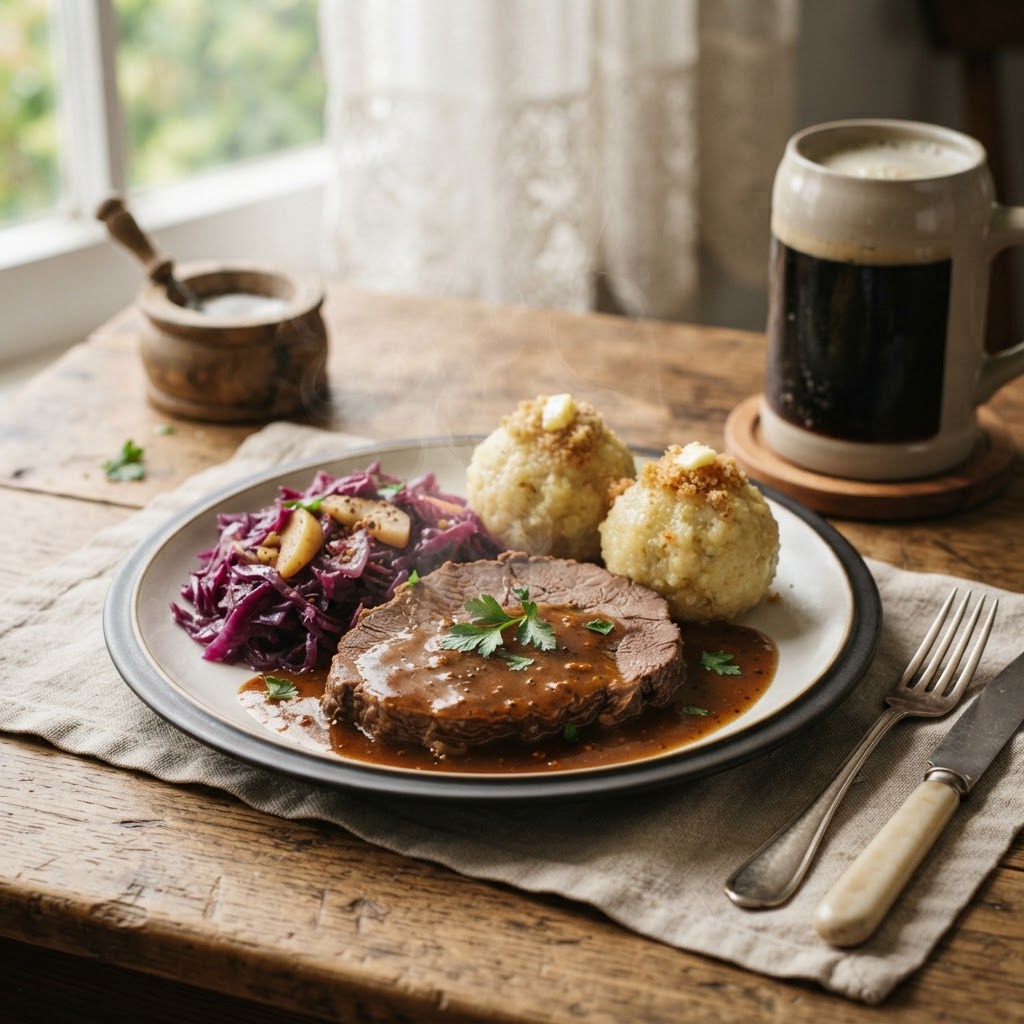
The dish is built on patience. A proper sauerbraten marinates for three to five days, turning once or twice a day, so the vinegar penetrates the meat and the spices — juniper berries, cloves, bay leaves, peppercorns — infuse it. The beef is then browned and braised slowly in the strained marinade, and the gravy is thickened with crumbled gingerbread or gingersnaps, which give it a deep, dark sweetness. The result is a roast of fork-tender meat in a glossy, sweet-sour sauce, traditionally served with red cabbage (Rotkohl) and potato dumplings (Kartoffelklöße) at Sunday dinners and German festivals.
Ingredients (serves 6): - 1 beef bottom round or rump roast (about 3 lb) - 2 cups dry red wine - 2 cups red wine vinegar - 2 cups water - 1 large onion, sliced - 2 carrots, sliced - 2 bay leaves - 1 tablespoon juniper berries - 1 tablespoon whole black peppercorns - 4 whole cloves - 2 tablespoons vegetable oil - 2 tablespoons butter - 3 tablespoons all-purpose flour - ⅓ cup raisins - 3 gingersnaps or 1 piece Lebkuchen, crushed - 1 tablespoon sugar - ½ cup heavy cream (optional) - Salt, to taste
Instructions: In a large pot, combine the wine, vinegar, water, onion, carrot, bay leaves, juniper berries, peppercorns, and cloves. Bring to a boil, then cool completely. Place the beef in a non-reactive container and pour the cooled marinade over it; refrigerate, covered, for 3 to 5 days, turning twice daily. Remove the beef and pat dry; strain the marinade and reserve both the liquid and the vegetables separately. Season the beef with salt. In a large Dutch oven, heat the oil and butter over medium-high heat and brown the beef on all sides, about 10 minutes. Add the strained vegetables and cook 5 minutes. Pour in 3 cups of the reserved marinade; bring to a simmer, cover, and cook over low heat for 2½ hours, until the beef is fork-tender, turning occasionally. Remove the beef to a platter and rest 15 minutes. Strain the cooking liquid and return it to the pot. Whisk in the crushed gingersnaps, raisins, and sugar; simmer 10 minutes until thickened. Stir in the cream if using. Slice the beef against the grain and serve with the gravy.
For a Crowd (serves 12): - Use a 6-lb roast and double the marinade; the braise time extends to about 3½ hours. Sauerbraten reheats beautifully and is traditionally made a day ahead.
Variations: - Rheinischer Sauerbraten (Rhineland): The classic version, finished with raisins and Lebkuchen for sweetness. - Bavarian Sauerbraten: Finished without the sweetening, sharper and more savory. - Sauerbraten with Potato Dumplings: The traditional accompaniment — serve with Kartoffelklöße and Rotkohl (red cabbage).
Pairing: Sauerbraten pairs with a German beer such as a dark Bock or a Märzen, or with a fruity red such as a Spätburgunder (German Pinot Noir). For a brunch gathering, a sparkling wine or a radler (beer and lemonade) is a lighter option. Serve with red cabbage, potato dumplings, and a dollop of applesauce.
Reference Links: - Sauerbraten (Rhineland, vinegar marinade, national dish of Germany): Wikipedia - Sauerbraten: Recipe & History (Roman origins, Rhineland, raisins): Be Special Tours
Pro Tips: Marinate for the full three to five days; anything less and the meat will be tough and the flavor shallow. Use a non-reactive container — glass, ceramic, or stainless steel — never aluminum, which will react with the vinegar. Save the marinade; it is the base of both the braise and the gravy. The gingersnaps or Lebkuchen are the traditional thickener, and they give the gravy its dark sweetness — flour alone will not reproduce the flavor. Slice the roast against the grain, and pour the gravy generously; sauerbraten is, above all, a sauce dish. Made a day ahead, the flavors deepen and the meat is easier to slice cold before reheating in the warm gravy.
Rate this recipe
Be the first to rate this recipe
to submit your rating.
Recent Posts

Couscous Royale: North Africa's Grand Platter of Lamb, Chicken, and Merguez
October 14, 2026

Seattle Cream Cheese Dog Bites: Hadley Long's 1989 Pioneer Square Invention
October 14, 2026

Khao Soi: Chiang Mai's Northern Thai Coconut Curry Noodles
October 13, 2026

Korean Bibimbap: Jeonju's Joseon Dynasty Mixed Rice
October 11, 2026

Spaghetti alla Carbonara: Rome's World War II Pasta of Eggs, Guanciale, and Pecorino
October 9, 2026