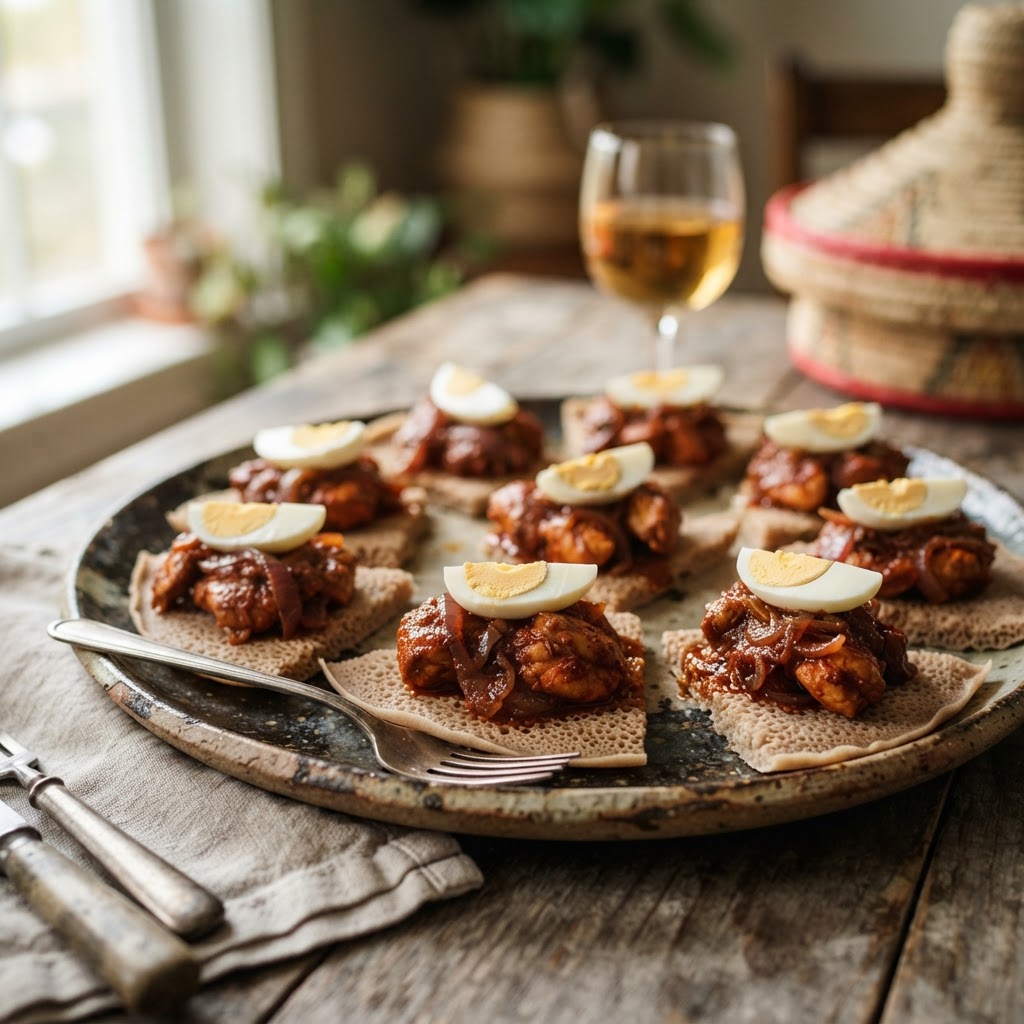
Ethiopian Doro Wat on Injera Bites
June 8, 2026
Doro wat is Ethiopia's most widely known dish — a deeply spiced chicken stew slow-cooked with onions, *berbere* spice, and *niter kibbeh* (spiced clarified butter), finished with hard-boiled eggs and served atop *injera*, the spongy sour flatbread made from teff. As The Daring Gourmet notes, doro wat is traditionally served with injera, a spongy pancake made with teff flour, and is the signature dish of Ethiopian cuisine, often reserved for special occasions. Diversivore describes it as a richly spiced, fragrant chicken-and-egg stew from Ethiopia and Eritrea, built on slow-cooked onions, berbere, and ginger. Wikipedia's injera entry describes the flatbread itself — a sour, fermented, spongy pancake that is the staple of the Horn of Africa and the plate, utensil, and centerpiece of the Ethiopian table.
For a party, doro wat on injera bites are the ideal hand-held form: small torn pieces of injera topped with a spoonful of the red, berbere-rich stew and a slice of the boiled egg, in a bite that captures all the deep, layered spice of the original.
About the Ingredients
Chicken — bone-in thighs and drumsticks are traditional; the skin is pierced so the spices penetrate. For a party, boneless thighs cut into bite-sized pieces are easier.
Berbere is the foundational Ethiopian spice blend — a deep red mix of chili, fenugreek, ginger, cardamom, coriander, and more. It gives doro wat its characteristic color and heat.
Niter kibbeh is Ethiopian spiced clarified butter, infused with herbs and aromatics; it is the fat that carries the flavor. The Daring Gourmet provides a recipe for both.
Onions are slow-cooked without added water until they melt into a jam — the base of the stew. Do not rush this step.
Injera is the spongy teff flatbread; buy it fresh or frozen from an Ethiopian market.
Ingredients (serves 8–10 as a party appetizer): - 2 large onions, finely chopped - 3 tbsp niter kibbeh (or ghee) - 3 tbsp berbere spice - 1 lb boneless skinless chicken thighs, cut into 1-inch pieces - 4 hard-boiled eggs, peeled and sliced - 1 tsp ground ginger - 3 cloves garlic, minced - Salt to taste - Injera, torn into bite-sized pieces
Instructions: In a heavy pot, cook the onions over medium-low heat with a pinch of salt, uncovered, until completely soft and jammy, about 25–30 minutes (do not brown). Add the niter kibbeh and berbere and cook 5 minutes more. Add the garlic and ginger, then the chicken pieces; stir to coat. Add a splash of water, cover, and simmer 30–40 minutes until the chicken is very tender and the sauce is thick and deep red. Taste and adjust salt.
To serve: lay torn pieces of injera on a platter. Spoon a generous teaspoon of the stew onto each piece. Top with a slice of boiled egg. Serve warm; guests eat with their hands, the injera as the utensil.
The Mimosa Pairing Logic: The deep, complex berbere spice and the rich, slow-cooked stew want a bright, fruit-driven drink that can lift the heat and cool the palate. A pomegranate mimosa is a beautiful choice — the tart pomegranate echoes the berbere's sweet-heat and cools the stew's intensity. For those who like heat, a spicy jalapeño mimosa amplifies the berbere in a way that feels right at the Ethiopian table. The wine's effervescence refreshes the palate between bites of the rich stew. This pairing is, in its way, the brunch equivalent of doro wat and a glass of Ethiopian honey wine (tej) — a sparkling toast to one of the world's great cuisines.
Reference Links: - Doro Wat (Spicy Ethiopian Chicken Stew): The Daring Gourmet - Doro Wat recipe and technique: Diversivore - Injera (teff flatbread) overview: Wikipedia
Make-Ahead: The doro wat improves with rest and can be made up to 2 days ahead and refrigerated; reheat gently. The hard-boiled eggs can be cooked ahead. Assemble on the injera just before serving; the injera softens under the stew if it sits too long.
Pro Tips: Cook the onions down without water until they are truly jammy — this is the foundation of the dish, and rushing it makes a thin sauce. Bloom the berbere in the fat for the full 5 minutes; uncooked berbere tastes raw and bitter. Pierce or score the chicken so the spice penetrates. Keep the sauce thick; a watery doro wat is wrong. Serve with the hands and the injera — that is the authentic, communal way to eat it.
Rate this recipe
Be the first to rate this recipe
to submit your rating.
Perfect Mimosa Pairings
Mimosas that pair perfectly with this dish
Recent Posts

Couscous Royale: North Africa's Grand Platter of Lamb, Chicken, and Merguez
October 14, 2026

Seattle Cream Cheese Dog Bites: Hadley Long's 1989 Pioneer Square Invention
October 14, 2026

Khao Soi: Chiang Mai's Northern Thai Coconut Curry Noodles
October 13, 2026

Korean Bibimbap: Jeonju's Joseon Dynasty Mixed Rice
October 11, 2026

Spaghetti alla Carbonara: Rome's World War II Pasta of Eggs, Guanciale, and Pecorino
October 9, 2026