Crown Roast of Pork with Apple and Sausage Stuffing
July 3, 2026
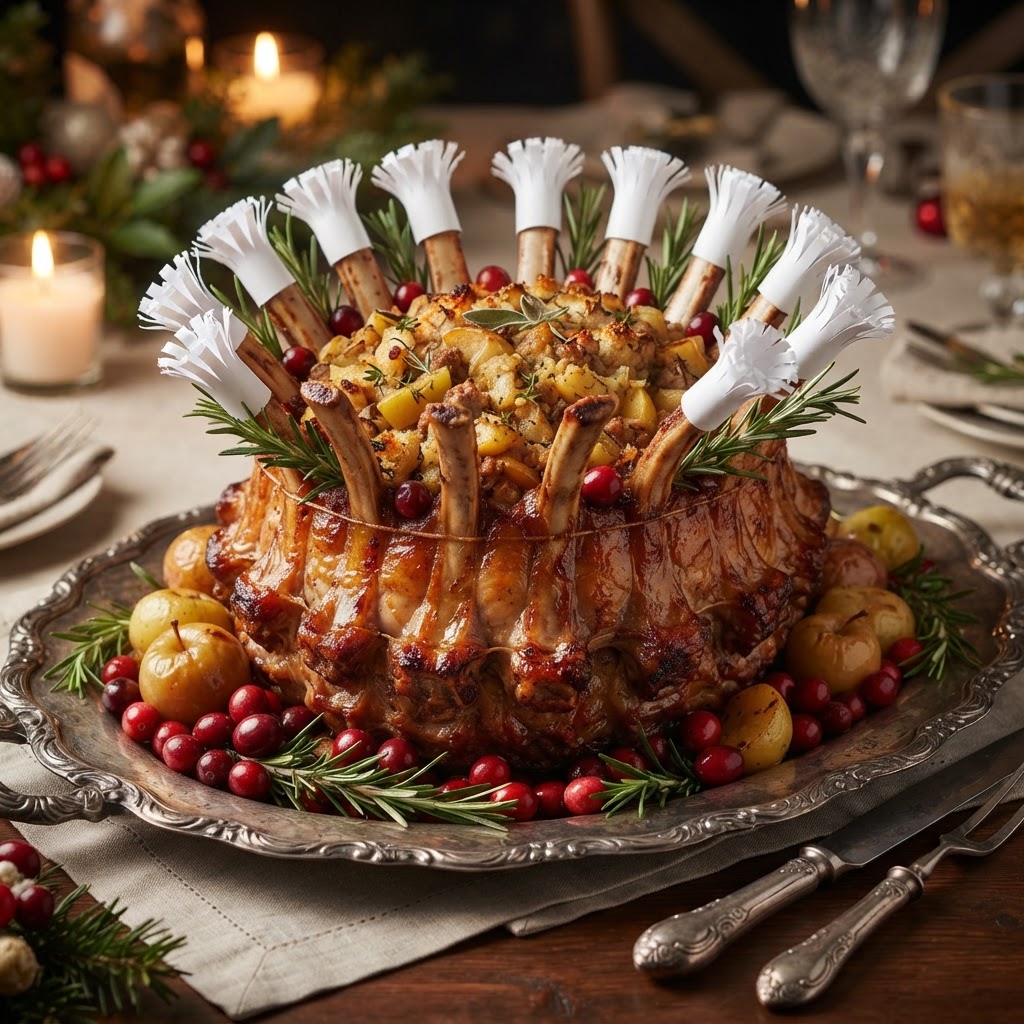
The Crown Roast of Pork is one of the most dramatic and visually stunning centerpieces in all of Western cuisine — a rack of pork ribs tied into a circular crown with the rib bones pointing upward like the turrets of a castle, the center filled with a savory apple and sausage stuffing, and the bone tips capped with decorative paper frills. When brought to the table, it is a moment of pure theater — a golden, architectural monument to the art of the roast. The crown roast has been a fixture of grand holiday dinners, formal banquets, and celebratory feasts since the Victorian era, when elaborate meat presentations were the hallmark of fine entertaining.
The crown roast is made from two racks of pork (also called pork rib roasts or racks of ribs), frenched (the meat scraped clean from the tips of the rib bones for a decorative presentation), and curved into a circle with the bones facing outward and upward. The two racks are tied together at the ends to form a continuous ring, creating a "crown." The center cavity is filled with stuffing — traditionally a bread, apple, and sausage stuffing that echoes the classic pairing of pork and apple. The frills on the bone tips (called "papillotes" in French) are a centuries-old tradition that protects the bone tips from burning while adding a festive, decorative element.
The key to a great crown roast is the quality of the pork (heritage breeds like Berkshire or Duroc are worth seeking out), a properly balanced stuffing (not too wet, not too dry), and careful temperature control (pork should be cooked to 145°F for juicy, slightly pink meat — the old 165°F standard produces dry, overcooked pork). The stuffing must be cooked separately if the crown is not large enough to hold all of it, or it can be partially cooked ahead and finished in the crown.
Ingredients (serves 8–10 as a main course):
The Crown Roast: - 2 racks of pork (8 ribs each, 3–4 lbs each rack), frenched (ask the butcher to french the bones — scrape the meat clean from the last 2 inches of each rib bone) - 2 tablespoons olive oil - 2 tablespoons Dijon mustard - 4 garlic cloves, minced - 1 tablespoon fresh thyme leaves - 1 tablespoon fresh rosemary, minced - 1 teaspoon fennel seeds, crushed (pork and fennel is a classic Italian pairing) - Salt and pepper - Kitchen twine (for tying the racks into a crown) - Paper frills (optional, for the bone tips)
Apple and Sausage Stuffing: - 7 oz good-quality pork sausage (Italian sweet or sage sausage — remove from casings) - 1 large onion, diced - 2 celery stalks, diced - 2 large apples (Honeycrisp or Granny Smith), cored and diced (do not peel — the skin adds color and texture) - 4 cups fresh breadcrumbs (from day-old bread — crusts removed) - 3 ½ oz dried cranberries or raisins (optional) - 1 ¾ oz pecans or walnuts, toasted and chopped (optional) - 2 tablespoons fresh sage, finely chopped - 1 tablespoon fresh thyme leaves - 1 tablespoon fresh rosemary, minced - ⅞ cup chicken stock (or apple cider for a sweeter stuffing) - 2 tablespoons unsalted butter - 2 tablespoons olive oil - Salt and pepper
Pan Gravy: - 3 tablespoons all-purpose flour - 1 ⅔ cups chicken stock - 1 tablespoon Dijon mustard - 1 tablespoon fresh thyme leaves - 1 tablespoon apple cider vinegar - Salt and pepper
Preparing the Crown Roast: Have the butcher french the rib bones (scrape the meat clean from the last 2 inches of each bone). To form the crown: stand one rack of pork upright with the bones curving upward. Curve it into a semicircle. Take the second rack and curve it to complete the circle, interlocking the ends. Tie the two racks together at the seam using kitchen twine, wrapping tightly at 2–3 points. The result should be a continuous crown with the bones pointing upward. If the crown does not hold its shape, tie it around the outside with a long piece of twine.
Alternatively, ask the butcher to tie the crown for you — most butchers will do this free of charge when you purchase the racks.
Seasoning the Crown: In a small bowl, combine olive oil, Dijon mustard, minced garlic, thyme, rosemary, crushed fennel seeds, salt, and pepper. Rub this paste all over the exterior of the crown roast, coating the meat thoroughly. Let the roast sit at room temperature for 45 minutes before cooking.
Making the Stuffing: Heat 1 tablespoon butter and 1 tablespoon olive oil in a large skillet. Add the sausage (casing removed) and cook, breaking it up with a wooden spoon, until browned and cooked through. Remove to a large bowl. Add the remaining 1 tablespoon butter and 1 tablespoon olive oil to the skillet. Add the diced onion and celery; cook 5 minutes until softened. Add the diced apples and cook 2 minutes. Add the thyme, sage, and rosemary; cook 1 minute.
Transfer the apple mixture to the bowl with the sausage. Add the fresh breadcrumbs, dried cranberries (if using), and toasted nuts (if using). Pour in the chicken stock and toss gently — the stuffing should be moist but not wet. Season generously with salt and pepper. (Stuffing can be made 1 day ahead; refrigerate.)
Roasting: Preheat oven to 375°F (374°F). Place the crown roast in a roasting pan (the bones should form a circle, and the center should be open for the stuffing). Fill the center of the crown with the stuffing, mounding it slightly above the rim. If there is extra stuffing, bake it in a separate dish alongside. Wrap each bone tip with a small piece of aluminum foil to prevent burning (or place paper frills after cooking).
Roast at 375°F for 20 minutes per pound (approximately 75–90 minutes for a 4–5 lb crown). After 45 minutes, cover the stuffing loosely with foil to prevent it from drying out or burning. The roast is done when a meat thermometer inserted into the thickest part of the meat (not touching the bone) reads 145°F (145°F) — this produces juicy, slightly pink pork. Remove from the oven.
Resting: Tent the roast loosely with foil and let it rest for 15 minutes — the internal temperature will rise to about 150°F during resting, and the juices will redistribute. Do not skip the resting step — slicing into the roast immediately causes the juices to run onto the cutting board.
Pan Gravy: While the roast rests, pour off the pan drippings into a saucepan. Add 3 tablespoons flour and whisk over medium heat 2 minutes to form a roux. Gradually whisk in the chicken stock. Bring to a simmer and cook 5 minutes, whisking constantly, until thickened. Whisk in the Dijon mustard, thyme, and apple cider vinegar. Season with salt and pepper. Strain if desired for a smoother gravy.
Service: Place the crown roast on a warmed platter. Remove the foil from the bone tips and replace with paper frills if desired. Carve by slicing between each rib bone — each serving is one chop with a portion of stuffing. Spoon the pan gravy over the meat and stuffing. Serve with roasted vegetables, mashed potatoes, and cranberry sauce.
The Mimosa Pairing Logic: The savory, herby, slightly sweet character of the crown roast and its apple-sausage stuffing calls for a mimosa with bright fruit that complements the pork and apple pairing. A classic orange mimosa is the most natural pairing — the citrus refreshes the palate and the champagne's toasty notes complement the roasted pork. A peach bellini mimosa is inspired — the peach's sweetness creates a beautiful resonance with the apple in the stuffing, and the prosecco's fruitiness complements the pork. For a more structured pairing, a cardamom orange blossom mimosa provides a warm, aromatic bridge with the fennel and sage in the seasoning. Avoid very dry, bitter mimosas — the dish's savory-sweet character needs a mimosa with complementary fruit.
Reference Links: - Crown roast of pork technique: Cutco - Crown roast of pork with apple stuffing: That Skinny Chick Can Bake - Crown roast of pork with fruit stuffing: Something New for Dinner - Safe pork cooking temperature: USDA
Make-Ahead: The stuffing can be made 1 day ahead and refrigerated. The crown can be seasoned and assembled (tied into the crown shape) up to 4 hours ahead and refrigerated. Bring to room temperature before roasting. The roast must be cooked just before service, but the resting period (15 minutes) gives you time to finish the gravy and other dishes.
Pro Tips: Having the butcher french the bones and tie the crown is the single most important step — attempting to do this yourself without experience produces a lopsided, uneven crown. The butcher will do it free of charge. Wrapping the bone tips with foil during roasting is essential — exposed bone tips burn and become bitter, and the foil (or paper frills) protects them. The pork should be cooked to 145°F (not the old 165°F standard) — this produces juicy, slightly pink pork that is safe to eat and far superior to the dry, gray pork produced by overcooking. The stuffing should be moist but not wet — too much stock makes it soggy and heavy, too little makes it dry and crumbly. Fresh breadcrumbs are essential — dried stuffing mix produces a dense, gummy texture that lacks the light, airy, crisp-topped quality of fresh-bread stuffing.
Rate this recipe
Be the first to rate this recipe
to submit your rating.
Recent Posts

Couscous Royale: North Africa's Grand Platter of Lamb, Chicken, and Merguez
October 14, 2026

Seattle Cream Cheese Dog Bites: Hadley Long's 1989 Pioneer Square Invention
October 14, 2026

Khao Soi: Chiang Mai's Northern Thai Coconut Curry Noodles
October 13, 2026

Korean Bibimbap: Jeonju's Joseon Dynasty Mixed Rice
October 11, 2026

Spaghetti alla Carbonara: Rome's World War II Pasta of Eggs, Guanciale, and Pecorino
October 9, 2026