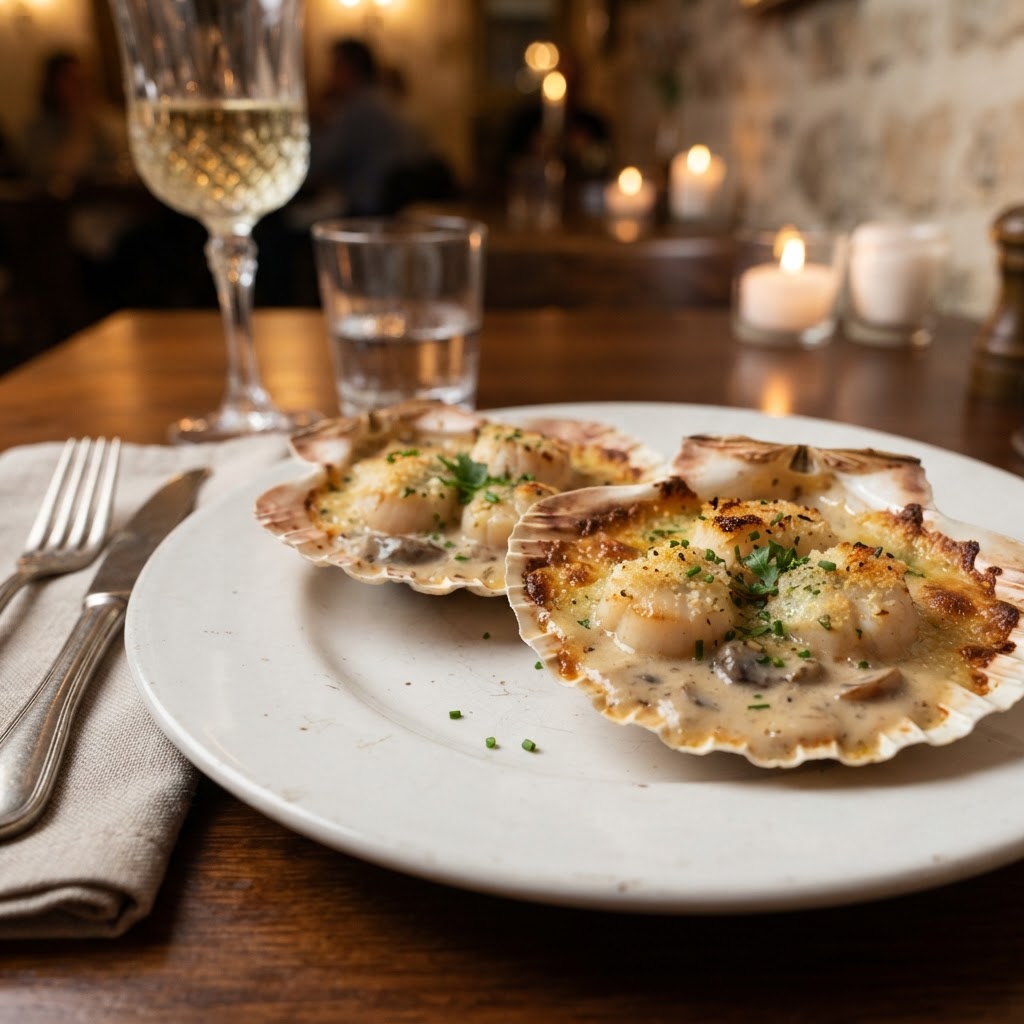
Coquilles Saint-Jacques Gratinée (French Scallop Gratin)
January 19, 2026
Coquilles Saint-Jacques is one of the most popular first courses in all of French cuisine — plump sea scallops bathed in a rich mushroom and white wine sauce, topped with buttery breadcrumbs and gratinéed until bubbling and golden. The dish takes its name from Saint Jacques — Saint James the Greater, one of the twelve apostles and the patron saint of pilgrims. The scallop shell (coquille Saint-Jacques) has been the symbol of the Camino de Santiago pilgrimage to the shrine of Saint James at Santiago de Compostela in Galicia, northwestern Spain, since the Middle Ages. Medieval pilgrims carried scallop shells as both a drinking vessel and a badge of their completed journey, and the shell became so identified with the saint that the French word for scallop itself is "Saint-Jacques."
The classic preparation — scallops in a creamy mushroom sauce, returned to their shells (or decorative scallop-shell dishes), topped with breadcrumbs and cheese, and broiled until golden — is a masterpiece of French bistro and fine-dining cuisine. The dish appears in Auguste Escoffier's "Le Guide Culinaire" (1903), the foundational text of modern French cooking, and it has been a fixture of French dinner parties, bistros, and Michelin-starred restaurants for over a century. The key to a great Coquilles Saint-Jacques is perfectly cooked scallops (which are easy to overcook and turn rubbery), a deeply flavored mushroom duxelles, and a sauce that is rich enough to feel luxurious but not so heavy that it masks the delicate sweetness of the scallop.
Ingredients (serves 6 as a first course or 4 as a light main): - 18–24 large sea scallops (U/10 or 10/20 count), preferably diver-caught - 6 clean scallop shells or decorative ramekins (coquilles Saint-Jacques dishes are available online) - 2 tablespoons butter - 1 tablespoon olive oil
Mushroom Duxelles: - 8 ⅞ oz mushrooms (cremini, button, or a mix of wild mushrooms), finely diced - 1 medium shallot, very finely minced - 2 garlic cloves, minced - 2 tablespoons unsalted butter - 1 tablespoon olive oil - 2 tablespoons dry white wine (Sauvignon Blanc or Chardonnay) - 1 tablespoon fresh parsley, finely chopped - ½ teaspoon fresh thyme leaves - Salt and white pepper
The Sauce (Sauce Nantaise or Velouté): - 1 ⅓ oz unsalted butter - 1 ⅓ oz all-purpose flour - 1 ¼ cups fish stock or shellfish stock (made from the scallop trimmings if possible) - ½ cup dry white wine - ½ cup heavy cream (crème fraîche can be substituted for a tangier sauce) - 1 tablespoon fresh lemon juice - 1 teaspoon Dijon mustard (optional, for depth) - Salt, white pepper, and a pinch of cayenne
Topping: - 3 ½ oz fresh breadcrumbs (made from day-old bread — never dried breadcrumbs, which are too fine and dense) - 1 ¾ oz unsalted butter, melted - 1 ¾ oz Gruyère cheese, finely grated - 2 tablespoons fresh parsley, finely chopped - 1 garlic clove, grated
Preparing the Scallops: If the scallops still have the tough side muscle (the foot), remove it by pulling it away — it peels off easily. Pat the scallops completely dry with paper towels — dry scallops sear properly; wet scallops steam. Cut any very large scallops in half horizontally so all pieces are roughly the same size and will cook evenly.
Mushroom Duxelles: In a skillet, heat 1 tablespoon butter and 1 tablespoon olive oil over medium-high heat. Add the finely diced mushrooms in a single layer and cook undisturbed for 3 minutes — they should brown, not steam. Add the shallot and garlic; cook 2 minutes. Add the white wine and cook until evaporated. Stir in parsley and thyme. Season with salt and white pepper. The duxelles should be dry and concentrated — if there is any liquid, cook it off. Set aside.
The Sauce: In a saucepan, melt 1 ⅓ oz butter over medium heat. Whisk in 1 ⅓ oz flour and cook 2 minutes, stirring constantly — this is the roux. Gradually whisk in the fish stock, then the white wine, whisking constantly to prevent lumps. Bring to a simmer and cook 5 minutes until thickened. Remove from heat and whisk in the cream, lemon juice, and mustard (if using). Season with salt, white pepper, and a pinch of cayenne. Fold the mushroom duxelles into the sauce. Taste and adjust.
Searing the Scallops: Heat 2 tablespoons butter and 1 tablespoon olive oil in a large skillet over high heat. When the butter foams, add the scallops in a single layer (work in batches — do not crowd). Sear 1–2 minutes per side until golden with a caramelized crust. The scallops should still be slightly undercooked in the center — they will finish cooking under the broiler. Remove immediately.
Assembly: Preheat broiler to high. Place a spoonful of the mushroom sauce in each scallop shell. Arrange 3–4 scallop pieces on top. Spoon more sauce over the scallops. Combine breadcrumbs, melted butter, grated Gruyère, parsley, and grated garlic. Sprinkle generously over each shell.
Gratinée: Place under the broiler for 3–5 minutes until the topping is deeply golden and the sauce is bubbling. Watch carefully — the broiler can go from perfect to burnt in seconds. Serve immediately in the shells.
The Mimosa Pairing Logic: The delicate, sweet character of scallops and the rich, creamy mushroom sauce call for a mimosa with bright acidity that cuts through the richness without overpowering the scallop's subtle flavor. A classic orange mimosa is the most natural pairing — the citrus echoes the lemon in the sauce and the champagne's toasty notes complement the Gruyère gratin. A lavender elderflower mimosa is exceptional — the floral notes create a beautiful resonance with the thyme in the duxelles, and the gentle sweetness balances the briny sweetness of the scallops. For a more structured pairing, a grapefruit rosemary mimosa provides a bright, slightly bitter counterpoint that refreshes the palate between bites. Avoid very sweet tropical mimosas — they overwhelm the delicate scallop flavor.
Reference Links: - Coquilles Saint-Jacques recipe: Serious Eats - Coquilles Saint-Jacques history: Recipetineats - Scallop gratin technique: Entertaining with Beth - Saint James and the scallop shell symbol: Wikipedia - Escoffier's Le Guide Culinaire: Internet Archive
Make-Ahead: Mushroom duxelles (2 days, refrigerated). The sauce can be made up to 1 day ahead and refrigerated. The assembled gratins (un-broiled) can be refrigerated for up to 4 hours. Broil just before service — the scallops should be warm and the topping crisp. Do not overcook — the scallops become rubbery if left under the broiler too long.
Pro Tips: Dry scallops are essential — "wet" scallops (treated with sodium tripolyphosphate, a preservative that makes them absorb water) will never sear properly and taste soapy. Ask your fishmonger for "dry" or "chemical-free" scallops, or look for diver-caught scallops. The mushrooms must be cooked until completely dry — wet duxelles dilutes the sauce and makes the gratin soggy. The scallops should be seared quickly at high heat — 1–2 minutes per side is sufficient — they will finish cooking under the broiler. Overcooked scallops are rubbery and grainy. Fresh breadcrumbs (made by pulsing day-old bread in a food processor) are vastly superior to dried breadcrumbs — they toast into a light, crisp, golden crust rather than a dense, hard topping.
Rate this recipe
Be the first to rate this recipe
to submit your rating.
Recent Posts

Couscous Royale: North Africa's Grand Platter of Lamb, Chicken, and Merguez
October 14, 2026

Seattle Cream Cheese Dog Bites: Hadley Long's 1989 Pioneer Square Invention
October 14, 2026

Khao Soi: Chiang Mai's Northern Thai Coconut Curry Noodles
October 13, 2026

Korean Bibimbap: Jeonju's Joseon Dynasty Mixed Rice
October 11, 2026

Spaghetti alla Carbonara: Rome's World War II Pasta of Eggs, Guanciale, and Pecorino
October 9, 2026