Colombian Arepa de Huevo: Cartagena's Fried Egg-Stuffed Corn Arepa
June 20, 2026
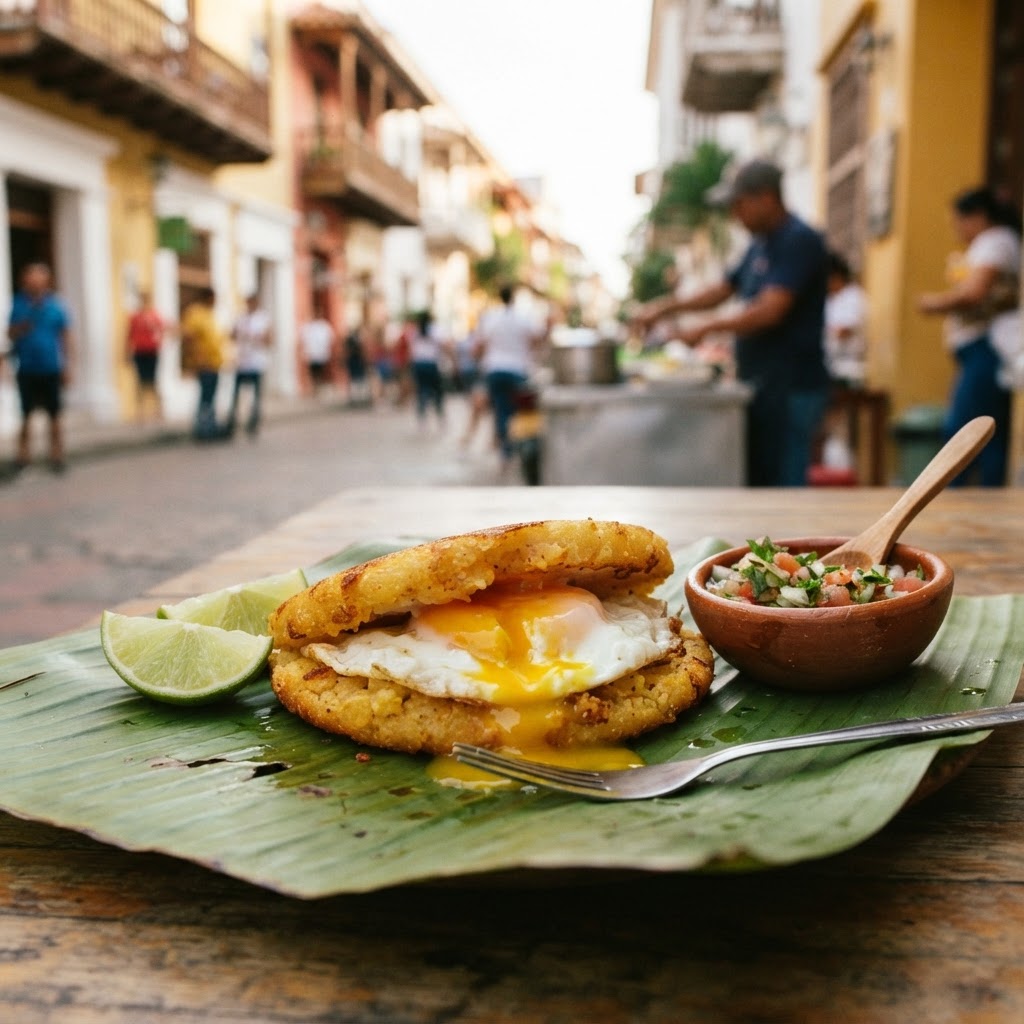
The arepa de huevo is the great breakfast of Colombia's Caribbean coast — a yellow cornmeal arepa, fried until puffed and golden, then slit open and stuffed with a whole raw egg, sealed, and returned to the hot oil to fry again until the egg is cooked and the arepa is crisp and golden, a technique so distinctive to the coastal cities of Cartagena and Barranquilla that the dish is virtually unknown in the interior of the country. According to Mashed, the arepa de huevo "either came from Cartagena or Barranquilla, two cities on Colombia's Caribbean coast that are less than 100 miles apart," and the dish is a popular street food sold from carts along the beaches and in the markets of the coast. Sweet y Salado describes the arepa de huevo as "extremely popular in the Colombian Caribbean coast," an arepa "stuffed with egg" that is fried, opened, filled, and fried again — a multi-step technique that produces a crisp, puffy corn shell around a soft, whole cooked egg.
The genius of the arepa de huevo is the double-fry: the cornmeal arepa is first fried until it puffs up like a pillow, creating a hollow pocket; it is then removed, slit open, filled with a whole egg, sealed with a paste of wet cornmeal, and returned to the oil, where it fries again until the shell is deep golden and crisp and the egg inside is cooked to a soft, sunny-side-up consistency. Cut open, the arepa reveals a bright yellow yolk inside a crisp, golden corn shell — a breakfast that is as much a feat of engineering as of cooking.
About the Ingredients
Yellow cornmeal — pre-cooked yellow cornmeal (the kind used for arepas, such as P.A.N. brand); the cornmeal is mixed with water and salt to form a smooth, pliable dough.
Eggs — whole eggs, one per arepa, cracked into the fried arepa pocket; the egg should be at room temperature so it does not cool the hot oil when added.
Oil — neutral oil with a high smoke point (canola or vegetable), for deep-frying; the oil must be hot enough (about 350°F) to puff the arepa on the first fry and to cook the egg on the second.
Salt — a pinch of salt in the dough and in the frying oil.
Salsa — a Colombian-style salsa (salsa de ajo or salsa rosada) for serving; lime wedges and shredded cabbage are common accompaniments.
Ingredients (makes 6 arepas): - 1 cup pre-cooked yellow cornmeal (P.A.N. or similar) - 1 cup warm water - 1/4 tsp salt - 6 large eggs, at room temperature - Neutral oil (canola or vegetable), for deep-frying - Salsa, lime wedges, and shredded cabbage, to serve
Instructions: In a bowl, mix the cornmeal, warm water, and salt. Knead briefly until the dough is smooth and pliable — if it cracks, add a little more water; if it is too wet, add a little more cornmeal. Divide into 6 equal pieces and shape each into a ball, then flatten into a disc about 1/4 inch thick and 4 inches across.
Heat 2 inches of oil in a deep, heavy pot to 350°F. Carefully lower one arepa at a time into the hot oil. Fry 2–3 minutes, pressing it down gently with a spatula, until it puffs up and turns golden. Remove with a slotted spoon and drain briefly on paper towels. Repeat with the remaining arepas.
Working quickly while the arepas are still hot and puffed: use a sharp knife to slit the side of each puffed arepa, creating a pocket. Crack one egg into the pocket. Seal the opening with a small dab of wet cornmeal dough, pressing firmly to close.
Return the stuffed arepa to the 350°F oil and fry 2–3 minutes more, turning once, until deep golden and the egg inside is cooked. Drain on paper towels. Serve at once with salsa, lime wedges, and shredded cabbage.
The Mimosa Pairing Logic: The crisp, fried corn shell and the soft egg inside want a bright, tropical drink that echoes the Caribbean coast and cuts the richness. A passionfruit mimosa is a beautiful choice — the passionfruit nods to the Colombian coast and its tropical acidity balances the fried corn. A tropical mango mimosa is equally lovely, its golden fruit a beautiful mirror for the yellow corn arepa. This pairing is, in its way, the brunch equivalent of an arepa de huevo and a cup of Colombian coffee — a sparkling toast to Cartagena and the double-fried corn arepa of the coast.
Reference Links: - The Debated Origins Of Arepa De Huevo (Cartagena or Barranquilla, Caribbean coast): Mashed - Colombian Arepa de Huevo (Egg Arepa) (Caribbean coast, popular street food): Sweet y Salado
Make-Ahead: The cornmeal dough can be made ahead and held, covered, at room temperature for several hours. The arepas can be shaped ahead and held between sheets of plastic wrap. The first fry can be done ahead and the arepas held at room temperature for an hour or two; slit, fill, and do the second fry to order. The second fry must be done just before serving; the crisp shell and the soft, freshly-cooked egg are the point.
Pro Tips: The oil must be hot enough (350°F) on the first fry or the arepa will not puff; a flat arepa cannot be stuffed. Work quickly while the arepa is still hot and puffed; once it cools, it deflates and is harder to slit and fill. Seal the opening thoroughly with wet dough; a poorly sealed arepa leaks egg into the oil and makes a mess. Use room-temperature eggs; a cold egg dropped into a hot arepa lowers the temperature and the egg may not cook through on the second fry. Fry the second time until genuinely deep golden; a pale arepa is soft and greasy, and a well-fried one is crisp and light.
Rate this recipe
Be the first to rate this recipe
to submit your rating.
Recent Posts

Couscous Royale: North Africa's Grand Platter of Lamb, Chicken, and Merguez
October 14, 2026

Seattle Cream Cheese Dog Bites: Hadley Long's 1989 Pioneer Square Invention
October 14, 2026

Khao Soi: Chiang Mai's Northern Thai Coconut Curry Noodles
October 13, 2026

Korean Bibimbap: Jeonju's Joseon Dynasty Mixed Rice
October 11, 2026

Spaghetti alla Carbonara: Rome's World War II Pasta of Eggs, Guanciale, and Pecorino
October 9, 2026