Cochinillo Asado: Spain's Legendary Roast Suckling Pig of Segovia
August 23, 2026
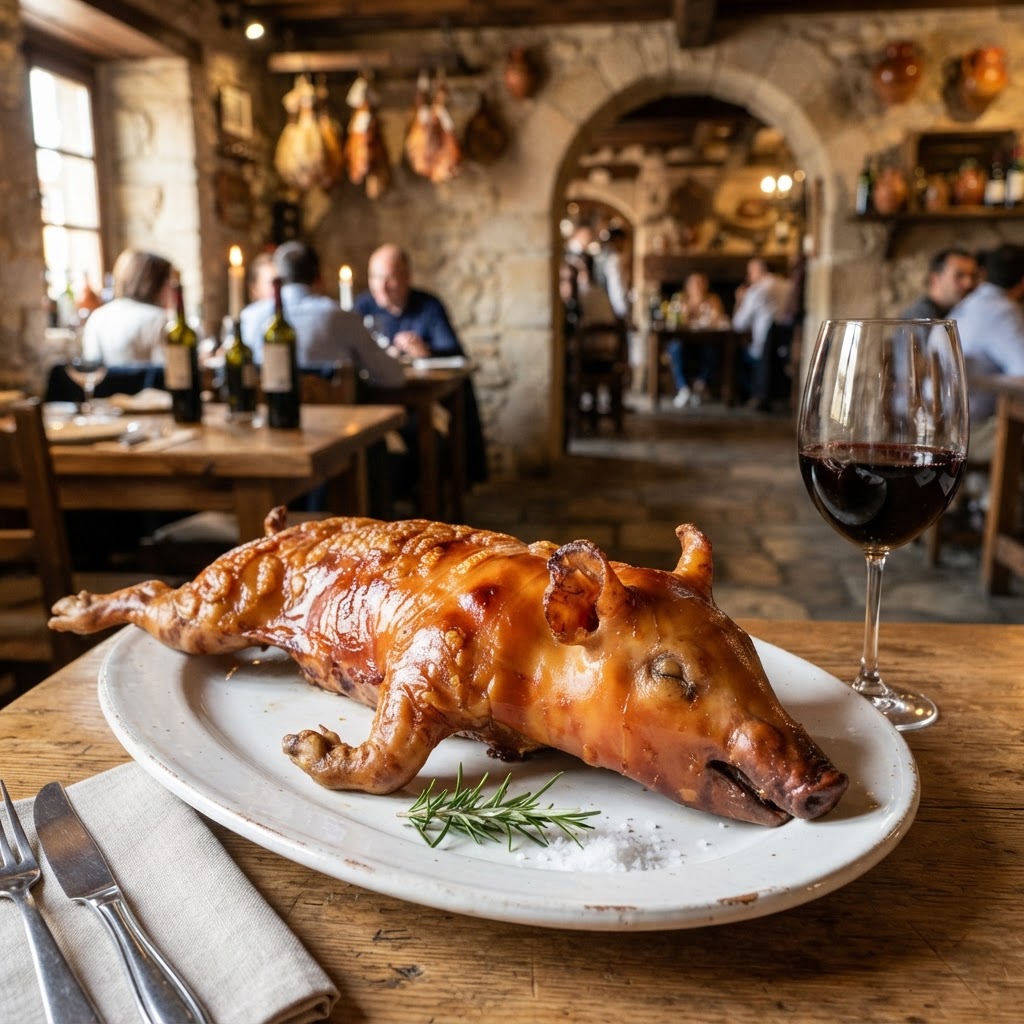
Cochinillo asado is the great celebration roast of Castile — a whole suckling pig, no more than three weeks old and having fed only on its mother's milk, roasted slowly in a clay dish with little more than lard, garlic, and salt until the skin shatters into glass and the meat is so tender it can be cut with the edge of a plate. According to Wikipedia, *cochinillo asado* (or *tostón asado*) is a dish consisting of roast suckling pig, commonly used in the Spanish cuisine of Castile, with the variants of the provinces of Segovia, Ávila, and Valladolid. The Suckling pig article notes that *cochinillo asado* is a pork dish most specifically associated with Segovia, featuring a whole roasted suckling pig cooked over charcoal, and that the dish dates back centuries in the Castilian tradition. Socarrat NYC describes the famed Segovian tradition of cochinillo slow-roasted until the skin crackles and the meat is succulent and tender, a dish prepared for centuries.
The Segovian ritual is the stuff of legend: the piglet, just two or three weeks old, is roasted in an earthenware dish in a wood-fired oven, basted in its own fat and a little white wine, for hours, until the skin is a dark, crackling bronze and the meat falls from the bone. In the famous Segovian restaurants, the roast is presented whole, then the waiter cuts the piglet into portions with the edge of a white plate — thrown to the floor to prove the crispness of the skin. (The real secret of the dish is the youth of the piglet and the patience of the cook.)
About the Ingredients
The piglet — a suckling pig no more than three weeks old, having fed only on milk; the flesh is pale, tender, and mild. This is the one ingredient that cannot be substituted; order from a specialty butcher.
Lard and garlic — the piglet is rubbed with lard and a little garlic; the flavoring is intentionally minimal, so the delicate milk-fed meat shines.
White wine and water — a splash of white wine and water in the clay dish keeps the piglet moist in the long, slow roast and forms the *caldo* (gravy) of the dish.
Clay dish — traditionally roasted in an earthenware *cazuela de barro*, which regulates the heat and builds the gravy; a heavy roasting pan works.
Ingredients (serves 6): - 1 whole suckling piglet (about 9–11 lb), cleaned - 1/2 cup lard, melted - 1 head of garlic, halved horizontally - 1 cup dry white wine - 1/2 cup water - Coarse sea salt - 2 tbsp olive oil
Instructions: Preheat the oven to 350°F (347°F). Rub the piglet inside and out with the lard and olive oil; season generously with salt. Place the garlic halves in the cavity. Set the piglet, back-up, in a clay dish or heavy roasting pan. Add the white wine and water to the dish (not over the pig).
Roast 2 to 2 1/2 hours, basting every 20 minutes with the pan juices, until the skin is deep golden and crackling and the meat is tender to the bone. (If the skin is browning too fast, cover loosely with foil and reduce the heat.) In the last 30 minutes, turn the piglet skin-up to crisp the back. The skin should shatter like glass when tapped. Rest 15 minutes.
To serve in the Segovian style, present the whole piglet, then cut into portions with the edge of a white plate (and, in the show tradition, drop the plate to the floor to shatter, proving the skin's crispness). Pour the pan juices, reduced, over the meat.
The Mimosa Pairing Logic: The crisp, rich cochinillo and the glass-shattering skin want a bright, refreshing drink that can cut the richness and echo the Spanish table. A classic Champagne mimosa is the safe and perfect choice — the citrus cuts the rich pork and the crackling skin, and the wine's effervescence refreshes the palate. A pomegranate mimosa is equally lovely, the tart fruit a beautiful bright Spanish partner. This pairing is, in its way, the brunch equivalent of cochinillo and a glass of Ribera del Duero — a sparkling toast to Castile.
Reference Links: - Cochinillo Asado (Castile, Segovia, Ávila, Valladolid): Wikipedia - Suckling Pig (Spanish cochinillo, Segovia tradition): Wikipedia - Cochinillo: Spain's Roast Suckling Pig: Socarrat NYC
Make-Ahead: Cochinillo is made to serve, hot from the oven; the crackling skin is the prize and softens as it sits. The piglet can be trimmed and seasoned an hour ahead. The long, slow roast (2 1/2 hours) is the point — a rushed cochinillo is a tough cochinillo. Carve at the table; the theatre of the plate-cut is the Segovian tradition. Reheat leftovers gently, uncovered, to re-crisp the skin.
Pro Tips: The piglet must be a true suckling, no more than three weeks old and milk-fed; an older piglet does not shatter and is not cochinillo. Season sparingly — salt, garlic, lard — so the delicate milk-fed meat shines; heavy seasoning overwhelms it. Baste every 20 minutes with the pan juices; the baste builds the gravy and crisps the skin. Roast skin-up at the end for the shattering crackle. Test the skin by tapping; a properly crackled cochinillo sounds like glass. Present whole and carve at the table; the theatre is part of the dish.
Rate this recipe
Be the first to rate this recipe
to submit your rating.
Recent Posts

Couscous Royale: North Africa's Grand Platter of Lamb, Chicken, and Merguez
October 14, 2026

Seattle Cream Cheese Dog Bites: Hadley Long's 1989 Pioneer Square Invention
October 14, 2026

Khao Soi: Chiang Mai's Northern Thai Coconut Curry Noodles
October 13, 2026

Korean Bibimbap: Jeonju's Joseon Dynasty Mixed Rice
October 11, 2026

Spaghetti alla Carbonara: Rome's World War II Pasta of Eggs, Guanciale, and Pecorino
October 9, 2026