The Chilean Maqui Berry Champagne Mimosa
September 10, 2026
The maqui berry (Aristotelia chilensis) is a small, deep-purple berry that grows wild in the Valdivian temperate rainforests of southern Chile, where it has been gathered and consumed by the Mapuche people for centuries. The Mapuche, among the few Indigenous peoples of the Americas to resist both Inca and Spanish conquest, call the maqui one of their three sacred trees, and they have long valued the berry both as a food and as a traditional medicine. The fruit's extraordinary, near-black color comes from one of the highest concentrations of anthocyanin antioxidants of any berry in the world — a pigment so intense that a single teaspoon of maqui purée stains a glass of water a deep, luminous violet.
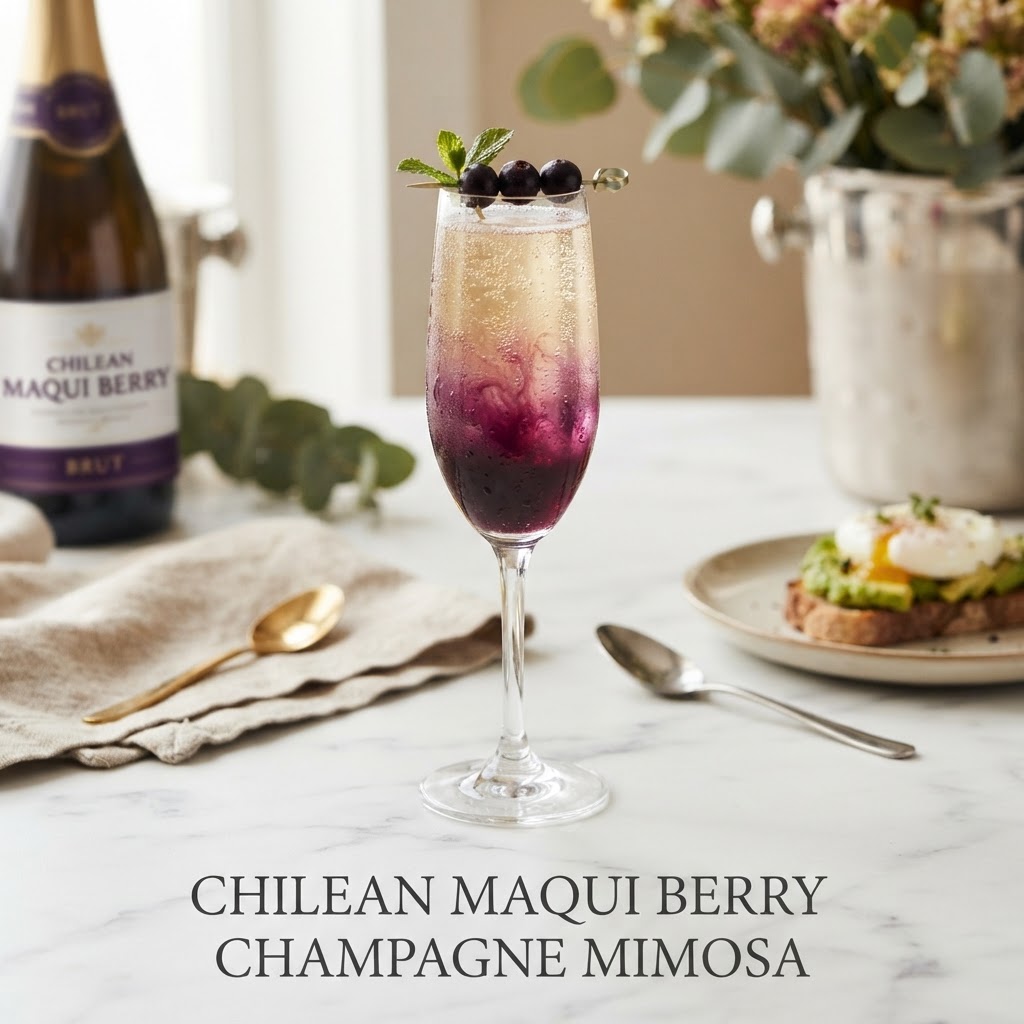
It is this intensity that makes a maqui berry mimosa so visually and flavorfully striking. The berry's flavor is tart and earthy, somewhere between a blackberry and an elderberry, with a dry, slightly tannic finish that gives the drink a grown-up, complex character no ordinary fruit mimosa can match. Over Champagne, the maqui's deep violet pigment blooms through the pale wine in dramatic, inky gradients of extraordinary beauty.
About Maqui Berries
Maqui (Aristotelia chilensis), also called the Chilean wineberry, is an evergreen tree in the Elaeocarpaceae family, native to the Valdivian temperate rainforests of southern Chile and adjacent parts of Argentina. The berries are small, about the size of a blackcurrant, and deep violet-black when ripe. The Mapuche have traditionally consumed maqui fresh, dried, and as a fermented drink, and the tree holds a central place in Mapuche ritual life. Modern interest in the berry's exceptional antioxidant content has brought maqui to international markets, most commonly as a freeze-dried powder. Reference: Aristotelia chilensis — Wikipedia
For a mimosa, freeze-dried maqui powder (widely available from superfood suppliers) is the most accessible form — it dissolves into a syrup with extraordinary color. Fresh maqui berries, if you can find them, are extraordinary but rare outside Chile.
Maqui Berry Syrup: - 1 cup water - ½ cup granulated sugar - 2 tablespoons freeze-dried maqui berry powder - 1 tablespoon fresh lemon juice
Combine water and sugar in a small saucepan and heat gently, stirring until the sugar dissolves. Remove from heat and whisk in the maqui powder until fully dissolved — the syrup will turn a vivid, near-black violet. Stir in lemon juice. Chill thoroughly. The syrup will be a deep, luminous indigo-violet with a tart, earthy aroma. Refrigerate for up to 2 weeks.
Ingredients (serves 6): - 3 oz maqui berry syrup (above — ½ oz per serving) - 3 oz fresh lemon juice (½ oz per serving — the bright acid bridges the maqui's tart, earthy depth) - 1 bottle (25 oz chilled Champagne Brut NV or Crémant de Limoux (Crémant de Limoux — the world's oldest sparkling wine region, in southern France — provides a bright, appley character that complements the maqui's forest-berry depth; Champagne Brut provides more structure) - A few fresh maqui berries or a dusting of maqui powder on the foam for garnish - Optional: ½ oz of crème de mûre (blackberry liqueur) per serving for amplified dark-berry depth
Instructions: Combine the maqui berry syrup and lemon juice. Chill thoroughly. Chill Champagne flutes for 5 minutes. Pour 1 oz of the maqui-lemon blend into each flute. Add crème de mûre if using. Top slowly with chilled Champagne or Crémant, pouring down the side. The deep violet syrup will bloom through the pale wine in dramatic, inky gradients. Garnish with a dusting of maqui powder on the foam surface or a few fresh maqui berries. Do not stir.
For a Mimosa Bar (serves 12): - 6 oz maqui berry syrup - 6 oz fresh lemon juice - 3 oz crème de mûre (optional) - 2 bottles Champagne Brut or Crémant de Limoux, chilled
Variations: - Replace Champagne with sparkling rosé for a deeper magenta-violet hue. - Add ½ oz of pisco (Chilean pisco, such as Capel) per serving for a Chilean Pisco Maqui Mimosa that honors the berry's origin. - Steep a sprig of fresh rosemary in the warm syrup for an aromatic, resinous counterpoint.
Mimosa Pairing Logic: The maqui's tart, earthy, tannic depth calls for a bright, appley sparkling wine whose fruit character resonates with the berry while its acidity lifts the dark pigment. The wine's dryness balances the syrup's sweetness. For a related pour, the Blackberry Sage Mimosa is the herbal cousin, and the Elderberry Lemon Champagne Mimosa shares the dark-forest-berry-over-Champagne logic.
Reference Links: - Aristotelia chilensis (maqui, Chilean wineberry, Mapuche): Wikipedia - Maqui as a Chilean functional food (antioxidant bioactivity): PMC / NIH
Make-Ahead: Maqui berry syrup (2 weeks, refrigerated). The maqui-lemon blend (3 days, refrigerated). Assemble per glass just before serving.
Pro Tips: Freeze-dried maqui powder is the most reliable way to capture the berry's extraordinary color outside Chile; a little goes a long way, so start with 2 tablespoons and adjust. The powder stains intensely, so use a glass or ceramic bowl and avoid plastic, which holds the stain. The lemon juice is essential: without it, the maqui's tart, earthy depth reads as flat and medicinal. Crémant de Limoux is a wonderful, affordable Champagne alternative here; the Limoux region's claim to be the birthplace of sparkling wine (documented at the Abbey of Saint-Hilaire in 1531) gives the pairing a pleasing historical resonance with the maqui's own ancient, Mapuche-gathered provenance.
Rate this recipe
Be the first to rate this recipe
to submit your rating.
Perfect Mimosa Pairings
Mimosas that pair perfectly with this dish
Recent Posts

Couscous Royale: North Africa's Grand Platter of Lamb, Chicken, and Merguez
October 14, 2026

Seattle Cream Cheese Dog Bites: Hadley Long's 1989 Pioneer Square Invention
October 14, 2026

Khao Soi: Chiang Mai's Northern Thai Coconut Curry Noodles
October 13, 2026

Korean Bibimbap: Jeonju's Joseon Dynasty Mixed Rice
October 11, 2026

Spaghetti alla Carbonara: Rome's World War II Pasta of Eggs, Guanciale, and Pecorino
October 9, 2026