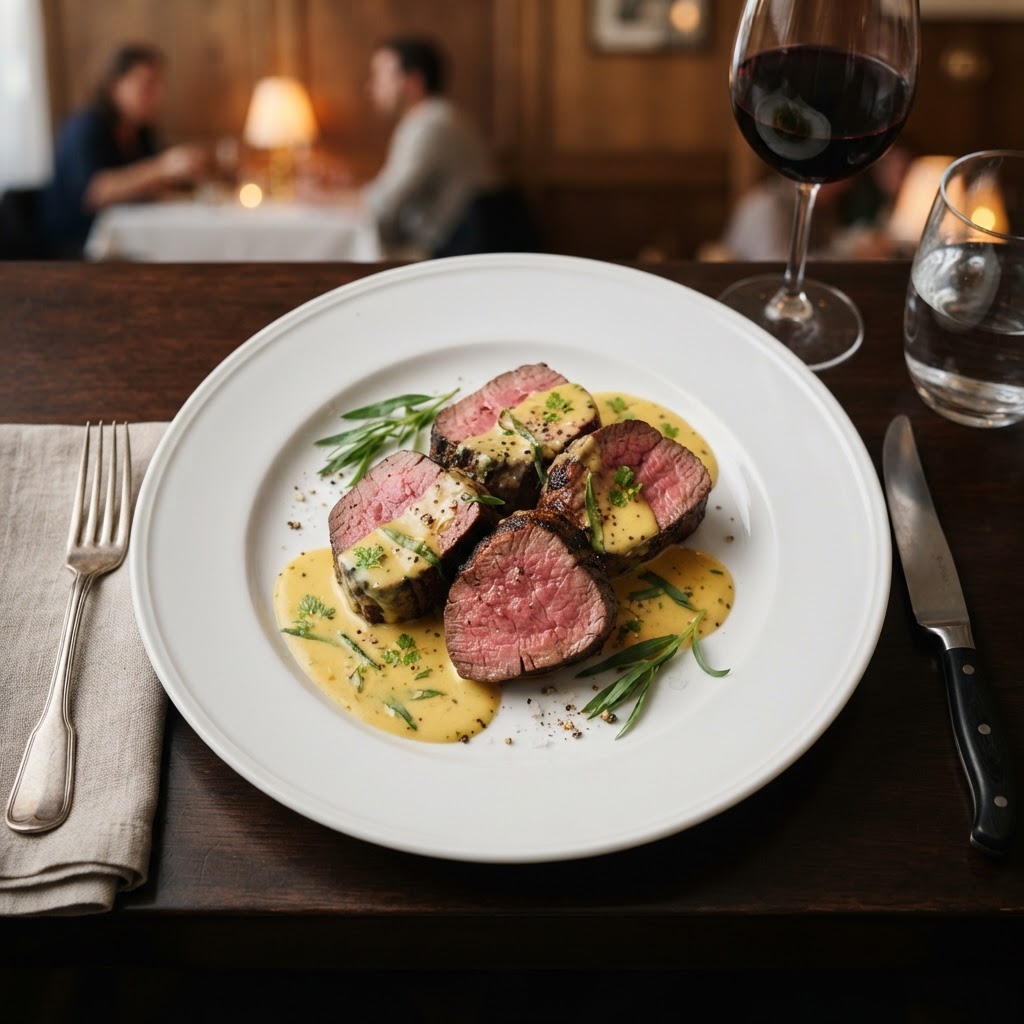
Châteaubriand with Béarnaise Sauce
January 12, 2026
The Châteaubriand is one of the most legendary cuts in all of French cuisine — a thick, center-cut steak from the tenderloin, large enough for two, grilled and served with a classic sauce. The dish was created in the early 1820s by Montmireil, the personal chef of François-René de Châteaubriand (1768–1848), the celebrated French writer, diplomat, and aristocrat. Montmireil's original method was famously extravagant: he wrapped the prized center cut between two lesser pieces of tenderloin to protect it from the direct flame, grilled the whole assembly, then discarded the outer pieces and served only the perfect center cut to his employer. The modern version dispenses with the sacrificial outer cuts but retains the essential character — a generous, thick slab of the finest beef tenderloin, seared to a perfect crust and served with one of two classic sauces: béarnaise or sauce Châteaubriand (a white wine, shallot, and demi-glace reduction).
Béarnaise sauce — the indispensable accompaniment — was created in 1836 by Jean-Louis Françoise-Collenet, chef at the Pavillon Henri IV restaurant in Saint-Germain-en-Laye, just west of Paris. The sauce was named in honor of the Béarn region, birthplace of King Henri IV, for whom the restaurant's pavilion was named. Béarnaise is a hollandaise variant enriched with a reduction of white wine vinegar, shallots, tarragon, and peppercorns, which gives it a complex, tangy, herbal character that is the perfect counterpoint to the rich, lean beef. The marriage of Châteaubriand and béarnaise is one of the most widely known pairings in the French culinary canon — the toasty, buttery, herbaceous sauce elevates the clean flavor of the tenderloin to the level of ceremony.
Ingredients (serves 6–8 as a plated main course):
The Châteaubriand: - 1 whole center-cut beef tenderloin, 2.5–3 lbs (1.2–3 ⅛ lb), trimmed of silver skin and chain (also called the châteaubriand roast — it is the thickest, most uniform center section) - 2 tablespoons neutral oil (grapeseed or canola — olive oil has too low a smoke point for proper searing) - 2 tablespoons unsalted butter - 4 garlic cloves, smashed - 4 sprigs fresh thyme - 2 sprigs fresh rosemary - Flaky sea salt (Maldon or fleur de sel) - Coarsely cracked black pepper
Béarnaise Sauce: - 3 large egg yolks (or 4 medium) - 1 tablespoon water - 8 ⅞ oz unsalted butter, cut into cubes, at room temperature (the butter must be cool-room-temperature, not warm, or the sauce will break) - 2 tablespoons white wine vinegar - 2 tablespoons dry white wine (or additional vinegar) - 1 medium shallot, very finely minced - 1 tablespoon fresh tarragon leaves, finely chopped (plus additional for finishing) - ½ teaspoon coarsely cracked black peppercorns - 1 teaspoon fresh lemon juice - Salt to taste
Garnish: - Château potatoes (small potatoes turned into olive shapes, roasted in butter until golden) - Watercress or mâche salad - Fresh tarragon sprigs - Flaky sea salt
Preparing the Tenderloin: Remove the tenderloin from the refrigerator 45 minutes before cooking to allow it to come to room temperature — this ensures even cooking from edge to center. Pat completely dry with paper towels. Season generously with salt and cracked pepper on all sides. The seasoning should be visible — an under-seasoned tenderloin is a common flaw.
Cooking the Châteaubriand (Two-Stage Method): The professional method is a two-stage cook: first sear at very high heat to develop the Maillard crust, then finish at low heat (in the oven) to bring the internal temperature to the desired doneness without overcooking the outer layers. This produces a perfectly even medium-rare from edge to center.
Stage 1 — The Sear: Preheat oven to 400°F (392°F). Heat a heavy cast-iron skillet over high heat until it is smoking hot. Add the neutral oil. Carefully place the tenderloin in the pan and sear 2 minutes per side, using tongs to sear all surfaces including the ends — the entire exterior should be deeply browned with a hard crust. Add butter, garlic, thyme, and rosemary to the pan. As the butter foams, tilt the pan and use a spoon to continuously baste the beef with the aromatic butter for 1 minute. Transfer the tenderloin to a roasting pan (reserve the butter and aromatics for basting).
Stage 2 — The Roast: Roast at 400°F for 12–15 minutes for medium-rare (internal temperature of 125°F on a meat thermometer — the temperature will rise to 130°F during resting, which is perfect medium-rare). Baste once with the reserved butter after 7 minutes. The total cooking time for a 2.5–3 lb tenderloin should be approximately 15 minutes — do not overcook. Remove from the oven when the thermometer reads 125°F for medium-rare or 130°F for medium.
Resting: Transfer to a cutting board and rest for at least 10 minutes (15 minutes is better). Resting is non-negotiable — the juices redistribute and the internal temperature equalizes. Slice into 1-inch medallions just before serving. The interior should be a perfect, even pink from edge to edge.
Béarnaise Sauce: Begin the béarnaise while the tenderloin is coming to room temperature. In a small saucepan, combine white wine vinegar, white wine, minced shallot, cracked peppercorns, and half the fresh tarragon. Bring to a simmer over medium heat and reduce until only about 1 tablespoon of liquid remains — the shallots should be glossy and the vinegar smell should have mellowed. Strain through a fine sieve, pressing on the shallots to extract all the liquid. Discard the solids (or keep the shallots for a more rustic texture). Let the reduction cool slightly.
In a heatproof bowl set over a pan of barely simmering water (the water must not touch the bottom of the bowl — this is a bain-marie), whisk the egg yolks with 1 tablespoon water until they are thickened and pale yellow. Add the cooled vinegar reduction and whisk to combine. Begin adding the butter cubes one at a time, whisking constantly. Each cube should be fully incorporated before adding the next — the sauce will thicken progressively into a glossy, velvety emulsion. Once all the butter is incorporated, the sauce should coat the back of a spoon in a thick, glossy layer. Remove from heat immediately. Stir in the remaining fresh tarragon, lemon juice, and salt to taste.
Service: Arrange the sliced medallions on a warmed platter or individual plates. Spoon béarnaise generously over the beef. Serve with château potatoes and a small handful of watercress. Garnish with fresh tarragon and flaky sea salt. The béarnaise should be served warm, not hot — if it is heated too aggressively it will break. If the sauce begins to look thin or greasy, whisk in 1 teaspoon of warm water to re-emulsify.
The Mimosa Pairing Logic: Châteaubriand with béarnaise is one of the most luxurious dishes in the French canon, and the mimosa pairing must rise to the occasion. A classic champagne mimosa is the most natural pairing — the champagne's toasty, yeasty depth mirrors the Maillard crust on the beef, while the citrus brightens the rich béarnaise. A lavender elderflower mimosa is inspired — the floral notes create a beautiful resonance with the tarragon in the béarnaise, and the gentle sweetness balances the savory beef. For a more structured pairing, a saffron honey champagne mimosa creates an aromatic bridge with the toasted, buttery character of the sauce. Avoid very sweet tropical mimosas — they overwhelm the delicate, herbaceous character of the béarnaise and the clean flavor of the tenderloin.
Reference Links: - Châteaubriand steak history: Wikipedia) - Béarnaise sauce history and recipe: Serious Eats - Beef tenderloin guide: Serious Eats - Béarnaise sauce technique: The Spruce Eats - French sauce history at Pavillon Henri IV: Epicurious
Make-Ahead: The béarnaise reduction (vinegar, wine, shallots, peppercorns, tarragon) can be made up to 2 days ahead and refrigerated. The finished béarnaise can be held warm for up to 1 hour in a thermos or over a pan of warm (not hot) water — if it begins to separate, whisk in 1 teaspoon of warm water to re-emulsify. The tenderloin can be trimmed and tied up to 24 hours ahead. Everything else must be done à la minute.
Pro Tips: The two-stage cooking method (sear then roast) is the single most important technique for a perfect Châteaubriand — searing at high heat develops the crust, while finishing at 400°F in the oven produces even cooking from edge to center. A meat thermometer is essential — visual estimation is unreliable for a cut this expensive, and a few degrees of overcooking transforms a perfect tenderloin into a merely good one. The resting period is non-negotiable — slicing into the tenderloin before 10 minutes of rest causes the juices to run onto the board, leaving the meat dry. The béarnaise must be made over gentle heat (bain-marie) — if the bowl gets too hot, the egg yolks scramble and the sauce is ruined. Adding the butter gradually, one cube at a time, is what builds a stable emulsion — dumping it all in at once causes the sauce to break.
Rate this recipe
Be the first to rate this recipe
to submit your rating.
Recent Posts

Couscous Royale: North Africa's Grand Platter of Lamb, Chicken, and Merguez
October 14, 2026

Seattle Cream Cheese Dog Bites: Hadley Long's 1989 Pioneer Square Invention
October 14, 2026

Khao Soi: Chiang Mai's Northern Thai Coconut Curry Noodles
October 13, 2026

Korean Bibimbap: Jeonju's Joseon Dynasty Mixed Rice
October 11, 2026

Spaghetti alla Carbonara: Rome's World War II Pasta of Eggs, Guanciale, and Pecorino
October 9, 2026