Cassoulet Toulousain (French Meat and White Bean Casserole)
February 2, 2026
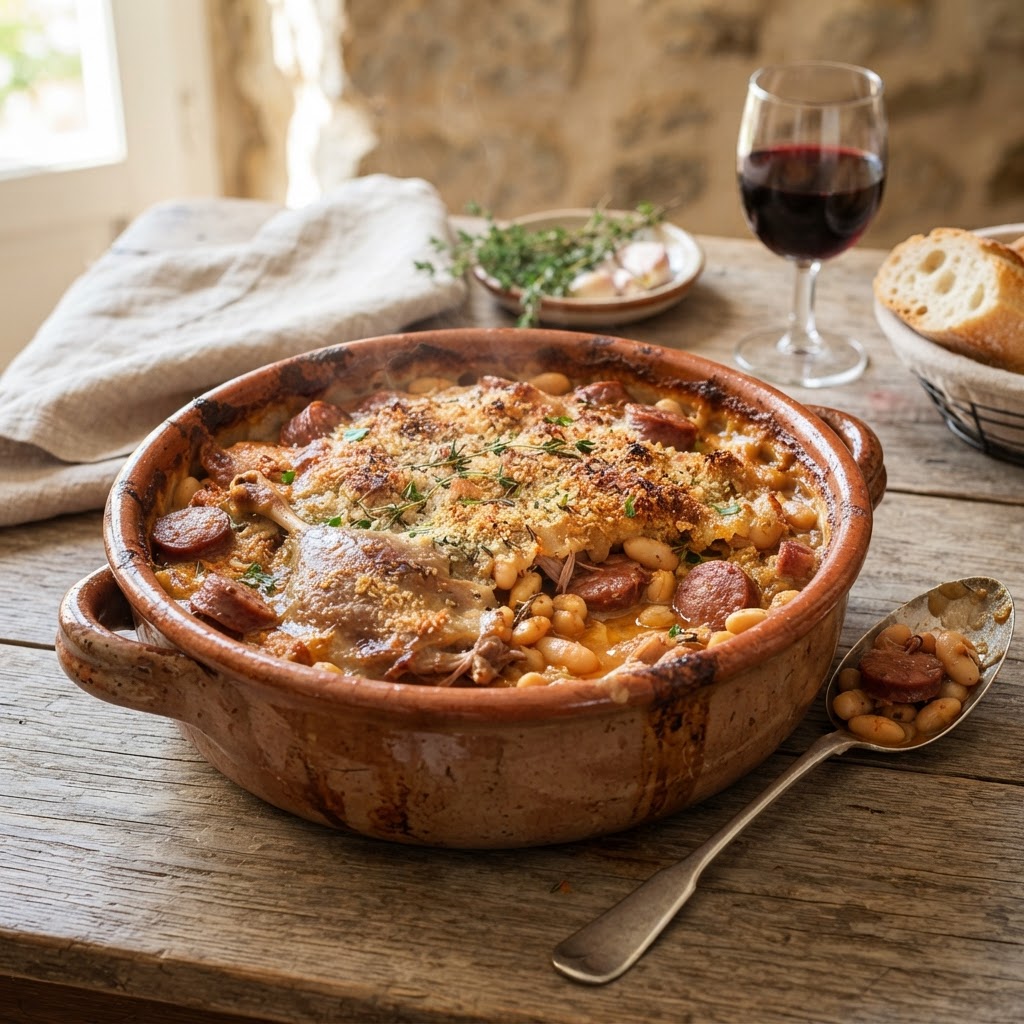
Cassoulet takes its name from the cassole, the deep, wide, conical earthenware pot from the Languedoc region of southwestern France in which it is traditionally baked, and the cassole's shape is essential to the dish: its wide top allows maximum surface area for the crust, while its deep, conical base ensures even, slow heat distribution. It is a slow-cooked casserole of white beans, pork, duck confit, and sausage, baked until the top develops a deeply golden, crunchy crust that is broken and stirred back into the beans three times during cooking.
According to tradition, cassoulet was invented in 1355 in the town of Castelnaudary, under siege by the English during the Hundred Years' War (Wikipedia). The legend holds that the starving inhabitants gathered whatever food they had, beans, pork, duck, sausages, and cooked it all together in a single pot; thus fortified, they rallied and repelled the English attackers. Whether the legend is true or not, cassoulet became the defining dish of the Languedoc, and three towns, Castelnaudary, Carcassonne, and Toulouse, have contested for centuries over whose version is the authentic original. The chef Prosper Montagné, in his 1929 book *Le Festin Occitan*, declared that "God the Father is the cassoulet of Castelnaudary, God the Son that of Carcassonne, and the Holy Spirit that of Toulouse," a doctrine still preached by the Académie Universelle du Cassoulet.
The Toulouse version includes duck confit, Toulouse sausage, pork shoulder, and pork skin, simmered with white Tarbais beans (a heritage variety grown at the foot of the Pyrenees), aromatics, and tomato, then baked with multiple layers of crust formation. The dish is a study in patience: it takes two days to make properly, and the slow cooking is what transforms the humble ingredients into something transcendent.
Ingredients (serves 10–12 as a main course):
The Beans: - 1 lb 2 oz dried white beans (Tarbais, Cannellini, or Great Northern — Tarbais is the authentic choice, available from specialty importers) - 1 large onion, halved and studded with 2 cloves - 1 head of garlic, halved horizontally - 1 large carrot, cut into large chunks - 2 celery stalks, cut into large chunks - 1 bouquet garni (thyme, parsley stems, bay leaves tied in cheesecloth) - Water to cover
The Meats: - 6 duck legs, confit (either homemade or purchased — duck confit is available at specialty shops and online) - 14 ⅛ oz Toulouse sausage (or good-quality fresh garlic sausage — Toulouse sausage is a coarse-ground pork sausage with garlic, salt, and pepper) - 14 ⅛ oz pork shoulder, cut into 2-inch cubes - 5 ¼ oz pork skin (fresh, with the fat — available from butchers; this is essential for the authentic texture) - 4 tablespoons duck fat (from the confit, or purchased)
The Base: - 2 large onions, finely diced - 4 garlic cloves, minced - 2 tablespoons tomato paste - 14 ⅛ oz canned crushed tomatoes (San Marzano) - ⅞ cup dry white wine - 1 tablespoon fresh thyme leaves - 2 bay leaves - Salt and pepper
The Crust: - 3 ½ oz fresh breadcrumbs (from day-old bread) - 2 tablespoons duck fat, melted
Day 1 — Soaking the Beans: Soak the dried beans in cold water overnight (at least 12 hours) — they will expand significantly. Drain.
Day 1 — Preparing the Meats: In a large Dutch oven, heat 2 tablespoons duck fat over medium-high heat. Brown the pork shoulder cubes in batches until deeply golden on all sides. Remove to a plate. Brown the Toulouse sausage links until golden. Remove. Add the pork skin and brown lightly. Remove. Drain excess fat, leaving 2 tablespoons in the pot.
Add the diced onions and cook 5 minutes until softened. Add garlic and cook 1 minute. Add tomato paste and cook 1 minute until darkened. Add the crushed tomatoes and white wine. Bring to a simmer and cook 5 minutes. Return all the meats to the pot. Add thyme and bay leaves. Add water to just cover. Bring to a simmer, cover, and cook at a bare simmer for 1 hour.
Meanwhile, cook the soaked beans in a large pot of fresh water with the studded onion, halved garlic head, carrot, celery, and bouquet garni. Simmer gently for 45–60 minutes until the beans are tender but not mushy. Drain, reserving the cooking liquid. Remove and discard the aromatics.
Day 1 — Assembly: Preheat oven to 300°F (302°F). In a large Dutch oven or traditional cassole, layer the ingredients: half the beans, then the pork shoulder, sausage (cut into 2-inch pieces), and pork skin (cut into strips), then the remaining beans. Nestle the duck confit legs on top. Pour the tomato-meat sauce over everything. Add enough bean cooking liquid to just barely cover the beans. The liquid should be visible but not submerging the beans — cassoulet is not a soup.
Day 1 — First Bake (Crust Formation 1): Bake uncovered at 300°F for 1 hour. A crust will form on top. Remove from oven and break the crust with a spoon, stirring it back into the beans. Return to oven.
Day 2 — Second and Third Bakes (Crust Formations 2 and 3): The next day, preheat oven to 300°F. Add more bean cooking liquid if the cassoulet looks dry — the beans should always be just barely covered. Bake 1 hour. Break the crust. Bake 1 more hour. Break the crust. This process of forming and breaking the crust three times is the hallmark of authentic cassoulet — each time, the crust flavors the beans and creates the layered, complex texture that characterizes the dish.
Day 2 — Final Bake: For the final bake, sprinkle fresh breadcrumbs mixed with melted duck fat over the top. Bake 30 minutes at 350°F until the crust is deeply golden and the cassoulet is bubbling vigorously at the edges.
Service: Bring the entire pot to the table. Serve in shallow bowls, making sure each portion gets beans, meat, and some of the crisp crust. The duck confit should be falling off the bone. The beans should be creamy and tender, suspended in a rich, reduced sauce.
The Mimosa Pairing Logic: Cassoulet is one of the richest, most substantial dishes in the French repertoire, and the mimosa pairing must provide bright, refreshing contrast to cut through the richness of the duck fat, pork, and beans. A classic orange mimosa is the most natural pairing — the citrus refreshes the palate and the champagne's acidity balances the richness. A blood orange mimosa is exceptional — the slight bitterness of the blood orange provides an elegant counterpoint to the deeply savory, fatty cassoulet. For a more aromatic pairing, a lavender elderflower mimosa creates a beautiful resonance with the thyme and bay in the cassoulet. Avoid very sweet tropical mimosas — they amplify the richness rather than providing contrast.
Reference Links: - Traditional French cassoulet: Serious Eats - Cassoulet history and technique: Paula Wolfert — The Food Dictator - Cassoulet — Wikipedia: Wikipedia - Duck confit technique: Serious Eats - Tarbais beans guide: Tarbais Beans
Make-Ahead: Cassoulet is specifically designed to be made over two days — the flavors deepen and the crust formation requires the overnight rest. In fact, cassoulet is always better on the second day. The assembled cassoulet can be refrigerated for up to 3 days before the final bake. The crust formation and final bake should be done just before service.
Pro Tips: The three crust formations (forming, breaking, and stirring back) are the defining technique of authentic cassoulet — this is what separates a real cassoulet from a simple bean and meat stew. Each crust adds a layer of roasted, caramelized flavor to the beans. The beans must be cooked gently — a hard boil ruptures the skins and turns them to mush. Duck confit is non-negotiable for authentic flavor — it provides the rich, savory, deeply duck-y character that characterizes the dish. If making duck confit from scratch (which is ideal), it should be done at least one day ahead. The pork skin is an essential but often overlooked ingredient — it melts into the beans during cooking, adding unctuousness and body that cannot be replicated. Tarbais beans are the authentic choice — their thin skins and creamy interiors are uniquely suited to cassoulet, but good-quality Cannellini or Great Northern beans work well as substitutes.
Rate this recipe
Be the first to rate this recipe
to submit your rating.
Recent Posts

Couscous Royale: North Africa's Grand Platter of Lamb, Chicken, and Merguez
October 14, 2026

Seattle Cream Cheese Dog Bites: Hadley Long's 1989 Pioneer Square Invention
October 14, 2026

Khao Soi: Chiang Mai's Northern Thai Coconut Curry Noodles
October 13, 2026

Korean Bibimbap: Jeonju's Joseon Dynasty Mixed Rice
October 11, 2026

Spaghetti alla Carbonara: Rome's World War II Pasta of Eggs, Guanciale, and Pecorino
October 9, 2026