Cassata Siciliana Brut
April 11, 2026
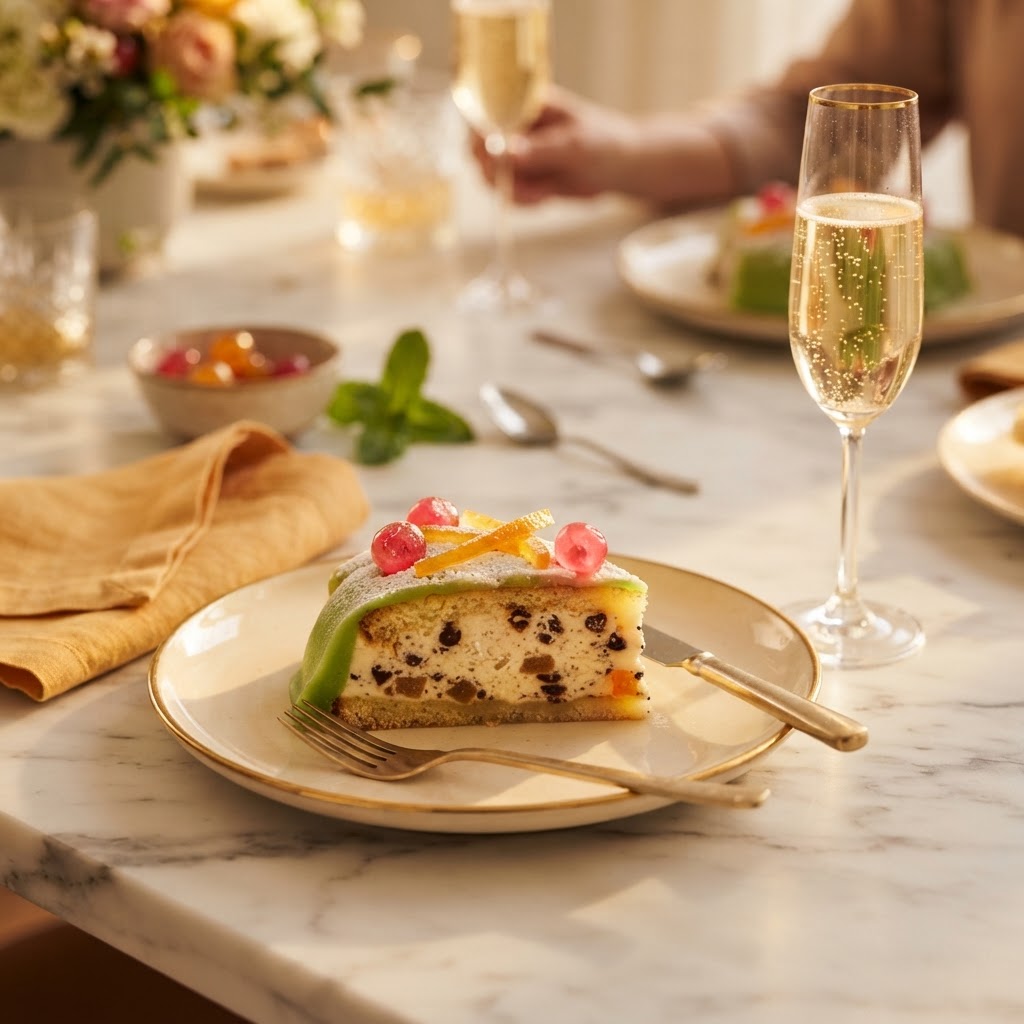
Cassata Siciliana is the most exuberant, most colorful, most defiantly over-the-top dessert in the Italian canon. It's a layered cake of sponge, sweetened ricotta, and marzipan, decorated with neon-bright candied fruits and icing that looks like it was designed by someone who had never encountered the concept of "restraint." And that's exactly the point — cassata was born as a celebration cake, meant to dazzle.
The origins of cassata stretch back to the Arab occupation of Sicily (9th–11th century), when the Arabs introduced sugar cane, citrus fruits, almonds, and advanced irrigation to the island. The name "cassata" is thought to derive from the Arabic "qas'ah," referring to the bowl-shaped mold used to make it. The original was likely a simpler affair — a ricotta-sweetened mixture baked with bread — but over the centuries, Sicilian pastry chefs layered in marzipan (pasta reale, itself of Arab origin), sponge cake (pan di Spagna), candied fruit, and sugar icing. By the 19th century, cassata had become what it is today: a towering, jewel-encrusted cake that is the centerpiece of every Sicilian Easter table.
Our Mimosavated version replaces the traditional soaking liquid (usually a sweet wine or liqueur like Marsala or rum) with Champagne Brut, which adds a dry, bright counterpoint to the sweet ricotta. The result is a cassata that feels slightly lighter, slightly more elegant, and slightly more brunch-appropriate than the traditional version.
Ingredients (serves 10-12):
The Sponge (Pan di Spagna): - 4 large eggs - 5 ¼ oz granulated sugar - 5 ¼ oz all-purpose flour, sifted - 1 teaspoon vanilla extract - A pinch of salt
The Ricotta Filling: - 2 ¼ lb whole-milk ricotta, drained overnight - 8 ⅞ oz granulated sugar - 3 ½ oz dark chocolate chips - 1 ¾ oz candied orange peel, chopped - 1 teaspoon vanilla extract - Zest of 1 orange
The Soaking Liquid: - ⅔ cup Champagne Brut (or Prosecco Brut) - 2 tablespoons granulated sugar - 1 tablespoon orange juice
The Marzipan Layer (Pasta Reale): - 10.6 oz almond flour (or finely ground almonds) - 8 ⅞ oz granulated sugar - ½ cup water - A few drops of green food coloring (traditional) - Cornstarch, for dusting
To Decorate: - 7 oz powdered sugar - 2-3 tablespoons lemon juice - Assorted candied fruits (cherries, orange slices, citron) - Candied angelica (if available)
Making the Sponge: Preheat the oven to 356°F (350°F). Line a round cake pan (9 inches with parchment paper. In a stand mixer, beat the eggs and sugar on high speed for 10-15 minutes until thick, pale, and tripled in volume. Gently fold in the sifted flour, vanilla, and salt using a large spatula — fold, don't stir, or you'll deflate the eggs. Pour into the prepared pan and bake for 25-30 minutes, until golden and springy to the touch. Let cool completely.
Making the Ricotta Filling: The night before, place the ricotta in a sieve over a bowl and let drain in the refrigerator. In a bowl, combine the drained ricotta and sugar. Beat until smooth and creamy — a food processor gives the silkiest result. Fold in the chocolate chips, candied orange peel, vanilla, and orange zest. Refrigerate until ready to assemble.
Making the Marzipan (Pasta Reale): In a saucepan, combine the sugar and water. Bring to a boil and cook to the soft-ball stage (239°F / 240°F). Remove from heat and stir in the almond flour. Mix until it forms a smooth paste. Turn out onto a cornstarch-dusted surface and knead until smooth. Add green food coloring and knead until evenly colored. Wrap in plastic and let rest for at least 1 hour.
Assembly: Line a round cake pan (9 in) with plastic wrap, leaving enough overhang to cover the top. Roll the marzipan out to 3mm thickness and line the bottom and sides of the pan, trimming the edges.
Slice the sponge into ⅓ in-thick layers. Cut one layer to fit the bottom of the marzipan-lined pan. Brush generously with the Champagne soaking liquid. Spread half the ricotta filling over the sponge. Add another layer of sponge, brush with soaking liquid, and spread the remaining ricotta. Top with a final layer of sponge, brushed with soaking liquid. Fold the overhanging marzipan over the top to seal. Cover with plastic wrap and refrigerate for at least 4 hours, ideally overnight.
Decorating: Invert the cassata onto a serving plate. Mix the powdered sugar with lemon juice to make a thick icing — it should be pourable but not runny. Pour over the top and let it drip down the sides. Before the icing sets, arrange the candied fruits on top in a decorative pattern — traditionally, the fruits represent the seasons or the months of the year. Let the icing set for at least 1 hour before serving.
The Mimosa Pairing Logic: The Champagne in the soaking liquid makes a classic Champagne mimosa the perfect companion. A blood orange mimosa is particularly inspired here — the blood orange echoes the candied citrus in the cassata and adds a gorgeous color contrast. For something more adventurous, a pomegranate mimosa adds tartness that cuts through the sweet ricotta and marzipan. Avoid very sweet or heavy mimosas — the cassata is already one of the sweetest desserts in the Italian canon, and it needs a bright, acidic counterpoint.
Reference Links: - Cassata Siciliana history and Arab origins: La Pa - Cassata origin in Palermo: Wikipedia - Arab influence on Sicilian cuisine: Great Italian Chefs - Marzipan (pasta reale) technique: King Arthur Baking - Ricotta draining technique: Serious Eats
Make-Ahead: The sponge can be baked a day ahead. The ricotta filling can be made 2 days ahead. The marzipan can be made up to a week ahead and refrigerated. The assembled cassata should rest in the refrigerator for at least 4 hours before decorating, and can be made up to 2 days ahead. Decorate on the day of serving for the best appearance.
Pro Tips: The ricotta must be thoroughly drained — excess moisture will make the cassata soggy and cause the marzipan to weep. Drain overnight in the refrigerator for the best results. The sponge should be completely cool before slicing — warm sponge tears and compresses. When making the marzipan, reaching the correct sugar temperature is critical; use a candy thermometer. If the marzipan is too sticky, dust with cornstarch; if it's too dry, knead in a few drops of water. The icing should be thick enough to coat but thin enough to pour — adjust with lemon juice. When decorating, work quickly — once the icing sets, the candied fruits won't adhere. Traditionally, cassata is served cold, straight from the refrigerator.
Rate this recipe
Be the first to rate this recipe
to submit your rating.
Recent Posts

Couscous Royale: North Africa's Grand Platter of Lamb, Chicken, and Merguez
October 14, 2026

Seattle Cream Cheese Dog Bites: Hadley Long's 1989 Pioneer Square Invention
October 14, 2026

Khao Soi: Chiang Mai's Northern Thai Coconut Curry Noodles
October 13, 2026

Korean Bibimbap: Jeonju's Joseon Dynasty Mixed Rice
October 11, 2026

Spaghetti alla Carbonara: Rome's World War II Pasta of Eggs, Guanciale, and Pecorino
October 9, 2026