Carrot Cake allo Spumante
February 24, 2026
The first printed recipe for a carrot cake appears in 1814, in the second volume of *L'art du cuisinier* by Antoine Beauvilliers, a former chef to Louis XVI, who called it *Gâteau de Carotte*, and it was copied into English within a decade. The roots of the cake are older and plainer: medieval European cooks, with sugar scarce and dear, used the natural sweetness of carrots to sweeten their puddings, and a carrot pudding appears in a tenth-century Swiss manuscript. The English adapted these dense, steamed or boiled carrot puddings through the centuries, and Hannah Glasse included a carrot pudding in *The Art of Cookery Made Plain and Easy* in 1747. The Swiss *Rüeblitorte*, a ground-almond carrot cake with a kirsch glacé icing, has been popular since the nineteenth century.
The modern layered carrot cake with cream cheese frosting is a mid-twentieth-century American invention. During the Second World War, with sugar rationed in Britain, the Ministry of Food promoted carrots as a sweetener and published a "Dr. Carrot" cake in its War Cookery Leaflets, and the cake crossed to the United States in the same years. The cream cheese frosting now inseparable from the cake was first paired with it in American bakeries in the 1960s, and by the 1970s the combination was a staple of American bakery counters.
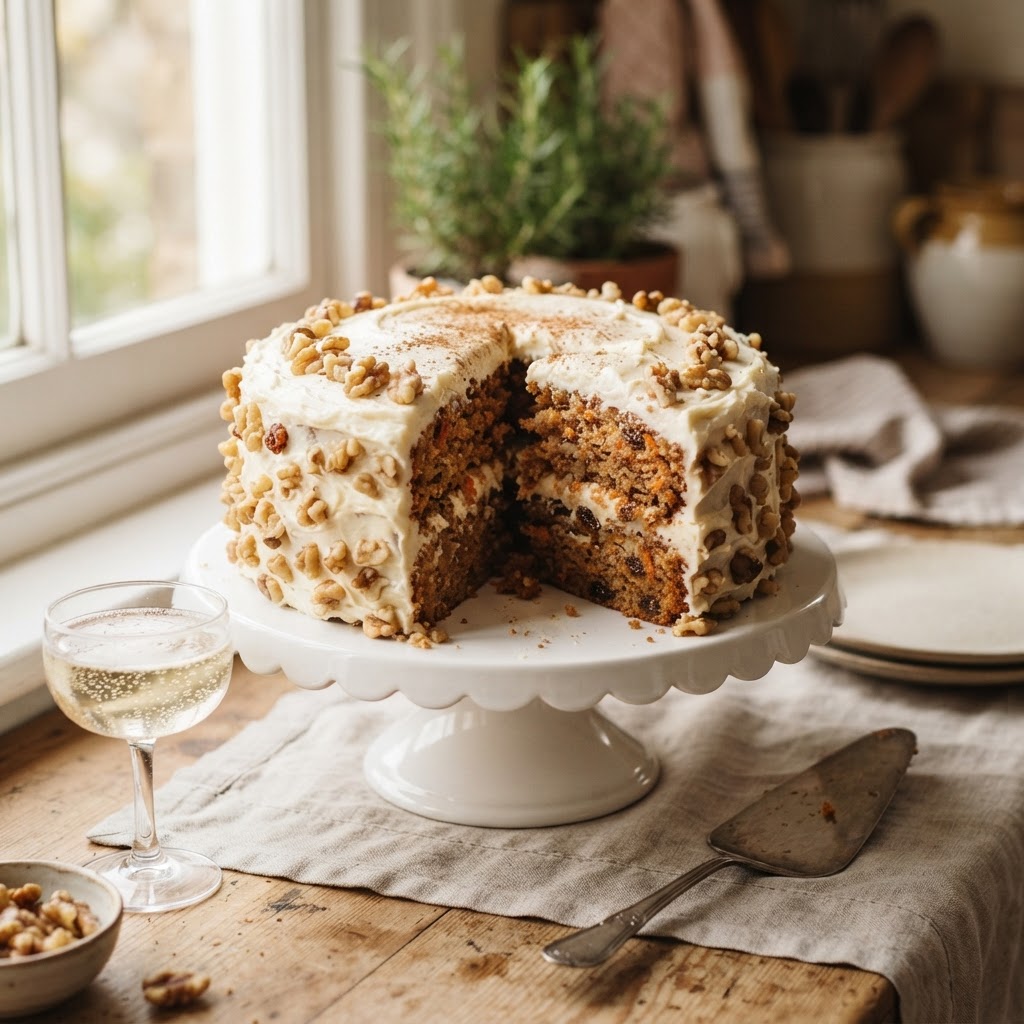
A great carrot cake is defined by its texture: moist, tender, and dense with grated carrots, nuts, and warm spices, cinnamon, nutmeg, and sometimes ginger and cloves. The cream cheese frosting is the tangy, creamy counterpoint to the sweet, spiced crumb. Our Mimosavated version adds a splash of Spumante to the frosting, the bright, slightly acidic wine cutting the richness of the cream cheese and making the frosting taste lighter.
Ingredients (serves 12):
The Carrot Cake: - 10.6 oz all-purpose flour - 2 teaspoons baking powder - 1 teaspoon baking soda - 1 teaspoon salt - 2 teaspoons ground cinnamon - 1 teaspoon ground nutmeg - ½ teaspoon ground ginger - 10.6 oz granulated sugar - 7 oz vegetable oil - 4 large eggs, room temperature - 12 ⅓ oz carrots, finely grated (about 4–5 medium carrots) - 3 ½ oz walnuts, chopped (plus extra for decoration) - 3 ½ oz crushed pineapple, drained (optional but recommended for moisture) - 1 teaspoon vanilla extract
The Spumante Cream Cheese Frosting: - 15 ⅞ oz full-fat cream cheese, room temperature - 3 ½ oz unsalted butter, room temperature - 14 ⅛ oz powdered sugar, sifted - 3 ⅓ tbsp Spumante (Italian sparkling wine, brut) - 1 teaspoon vanilla extract - A pinch of salt - Chopped walnuts, for decorating the sides
Making the Cake: Preheat the oven to 347°F (350°F). Butter and flour two 7 ⅞ in (8-inch) round cake pans, and line the bottoms with parchment paper.
In a medium bowl, whisk together the flour, baking powder, baking soda, salt, cinnamon, nutmeg, and ginger. In a large bowl, whisk together the sugar, oil, eggs, and vanilla until smooth. Gradually add the dry ingredients to the wet, mixing just until combined. Fold in the grated carrots, walnuts, and crushed pineapple.
Divide the batter evenly between the two prepared pans. Bake for 35–40 minutes, until a skewer inserted into the center comes out clean. Let cool in the pans for 10 minutes, then turn out onto wire racks to cool completely. The cakes must be completely cool before frosting.
Making the Spumante Cream Cheese Frosting: In a stand mixer, beat the cream cheese and butter together until smooth and creamy. Gradually add the powdered sugar, beating on low speed until combined, then increase speed and beat until light and fluffy. Add the Spumante, vanilla, and salt, and beat until just combined. Don't overbeat or the frosting will become too soft.
Assembling: If the cake layers have domed, use a serrated knife to level them. Place the first layer on a cake stand and spread with about a third of the frosting. Top with the second layer and frost the top and sides. Press chopped walnuts onto the sides of the cake for decoration. Pipe decorative rosettes of frosting around the top edge if desired.
Serving: Slice with a hot, clean knife — dip in hot water and wipe between cuts. Serve at room temperature.
The Mimosa Pairing Logic: Since the frosting contains Spumante, pair with a classic Prosecco mimosa — orange juice and Prosecco. The bright citrus complements the warm spices and the sweet carrots. A mango mimosa is also excellent — the tropical fruit echoes the spices and the pineapple in the cake. Avoid heavy or bitter mimosas — carrot cake is sweet and spiced, and you need something light and bright to balance it.
Reference Links: - Carrot cake on Wikipedia (medieval carrot pudding origins): Wikipedia - The Surprising History of Carrot Cake (Swiss Rüeblitorte): Baking Heritage - History of Carrot Cake (medieval puddings, 10th century Switzerland): Carrot Museum - This Food in History: Carrot Cake (10th century Switzerland): Uncultured Palate - Spumante Italian sparkling wine guide: Wine Folly
Make-Ahead: The cake layers can be baked up to 2 days ahead and stored, well-wrapped, at room temperature or frozen for up to 1 month. The frosting can be made a day ahead and refrigerated — bring to room temperature and re-whip before using. The assembled cake can be refrigerated for up to 3 days; bring to room temperature before serving for the best texture.
Pro Tips: Grate the carrots finely — coarse shreds will give the cake an unpleasant, chewy texture. Use the fine holes of a box grater or a food processor. Don't skip the crushed pineapple — it adds moisture and a subtle tropical sweetness that makes the cake better. The oil (rather than butter) is what gives carrot cake its characteristic moist, tender texture — don't substitute butter, as it will make the cake drier. Don't overmix the batter once the flour is added — overmixing develops gluten and makes the cake tough. The cream cheese and butter for the frosting must be at room temperature — cold ingredients will create lumps. Make sure the cake layers are completely cool before frosting — even slightly warm layers will melt the frosting. Don't overbeat the frosting once the sugar is added — overbeating can make it too soft or grainy. Level the cake layers before frosting for a professional, even look.
Rate this recipe
Be the first to rate this recipe
to submit your rating.
Recent Posts

Couscous Royale: North Africa's Grand Platter of Lamb, Chicken, and Merguez
October 14, 2026

Seattle Cream Cheese Dog Bites: Hadley Long's 1989 Pioneer Square Invention
October 14, 2026

Khao Soi: Chiang Mai's Northern Thai Coconut Curry Noodles
October 13, 2026

Korean Bibimbap: Jeonju's Joseon Dynasty Mixed Rice
October 11, 2026

Spaghetti alla Carbonara: Rome's World War II Pasta of Eggs, Guanciale, and Pecorino
October 9, 2026