The California Boysenberry Champagne Mimosa
September 6, 2026
In the early 1920s, a horticulturist named Rudolph Boysen, working on a farm in Anaheim, California, crossed a blackberry, a loganberry, and a red raspberry to create a large, maroon-colored berry of extraordinary, complex flavor. The berry nearly disappeared when Boysen sold his farm, but in 1932 the United States Department of Agriculture's George Darrow came looking for it, and he and a farmer named Walter Knott tracked down Boysen (by then the park superintendent in Anaheim), who led them to two or three scraggly surviving plants growing in the weeds by an irrigation ditch. Knott took the plants home to Buena Park, nursed them back to health, named them Boysenberries after their creator, and by 1934 was producing twenty-two hundred baskets from one hundred vines. The boysenberry became the foundation of Knott's Berry Farm, and Boysen himself, like Ephraim Bull before him, made no money from the fruit that carried his name.
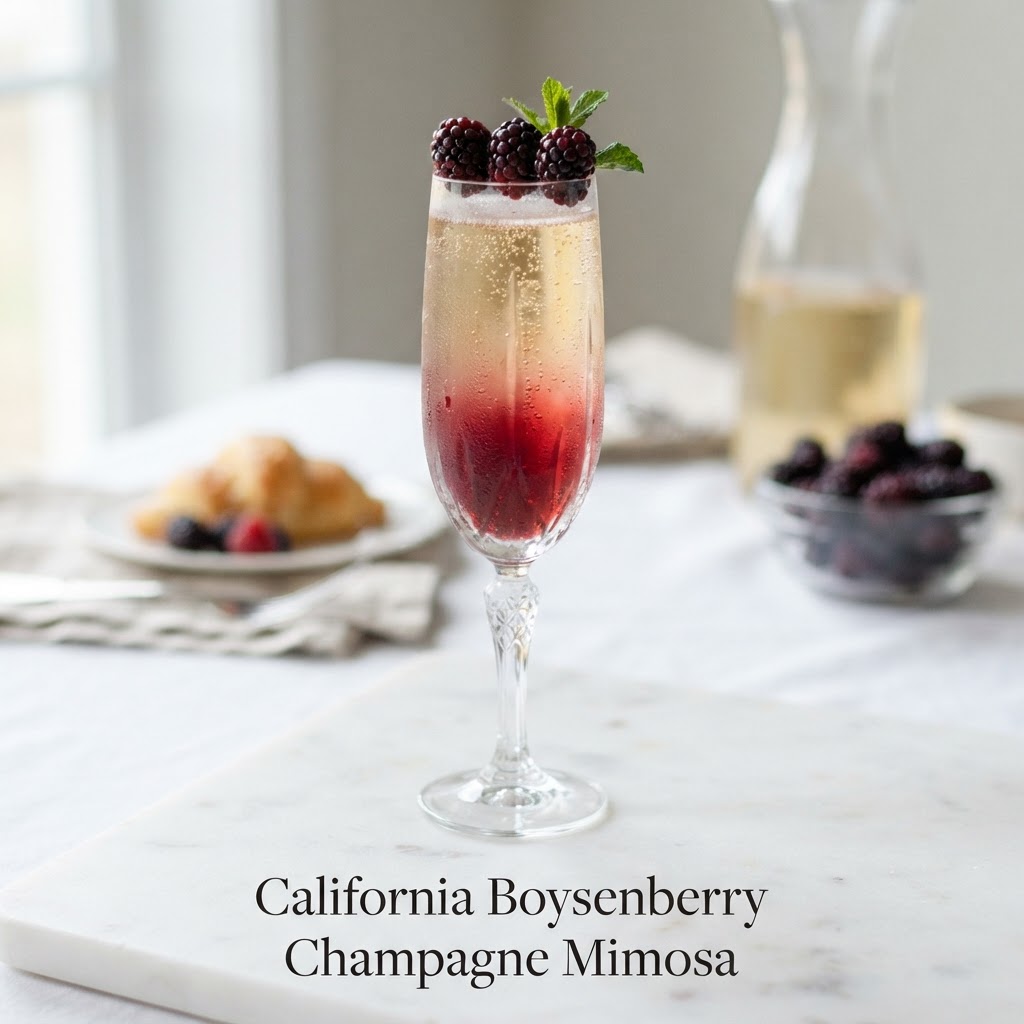
The boysenberry's flavor is its gift: a deep, winey complexity that combines the dark richness of a blackberry, the floral brightness of a raspberry, and a wild, almost loganberry-like tang. Over Champagne, its deep reddish-purple juice produces a mimosa of remarkable color and layered flavor — darker and more complex than any blackberry or raspberry mimosa.
About Boysenberries
The boysenberry (Rubus ursinus × Rubus idaeus) is a hybrid bramble fruit, larger and softer than a blackberry, with a deep maroon-purple color and a flavor that is at once sweet, tart, and winey. The fruit is notoriously delicate — it does not ship well and is rarely found fresh outside of farmers' markets in California and the Pacific Northwest during its brief June-to-August season. Frozen boysenberries and quality boysenberry preserves (Knott's own preserves are the direct descendant of Walter Knott's original) are excellent substitutes that capture the berry's distinctive character year-round. Reference: History of Knott's Berry Farm — Wikipedia
Boysenberry Purée: - 2 cups fresh or frozen boysenberries - 1 tablespoon fresh lemon juice - 1 tablespoon honey or granulated sugar (only if berries are tart)
If using frozen berries, thaw them first. Simmer the boysenberries in a saucepan over medium-low heat for 6–8 minutes until they release their juices. Blend briefly, then strain through a fine-mesh sieve, pressing firmly to extract maximum color and flavor while leaving the seeds behind. Stir in lemon juice and sweetener to taste. Chill thoroughly. The purée will be a deep, winey reddish-purple. Use within 3 days.
Ingredients (serves 6): - 1 cup boysenberry purée (above) - 1 bottle (25 oz chilled Champagne Brut NV or sparkling rosé (sparkling rosé — such as a Brut Rosé from Champagne or a dry Crémant de Bourgogne rosé — amplifies the berry's rosy depth; Champagne Brut NV provides more structure) - A few fresh boysenberries for garnish - Optional: ½ oz of Chambord (black raspberry liqueur) per serving for amplified berry richness
Instructions: Chill Champagne flutes for 5 minutes. Pour 1½ oz of the boysenberry purée into each flute. Add Chambord if using. Top slowly with chilled Champagne or sparkling rosé, pouring down the side. The deep reddish-purple purée will bloom through the pale or rosé wine in luminous, layered gradients. Garnish with a few fresh boysenberries on the rim. Do not stir.
For a Mimosa Bar (serves 12): - 2 cups boysenberry purée - 3 oz Chambord (optional) - 2 bottles Champagne Brut or sparkling rosé, chilled - Fresh boysenberries for garnish
Variations: - Replace Champagne with Prosecco for a lighter, more fruit-forward expression. - Add a sprig of fresh mint expressed over the glass for a bright, aromatic lift. - Combine with ½ oz of limoncello per serving for a Boysenberry Lemon Mimosa that brightens the berry's winey depth.
Mimosa Pairing Logic: The boysenberry's winey, layered complexity calls for a Champagne or sparkling rosé whose own berry notes resonate with the fruit. The wine's acidity and bubbles lift the berry's richness. For a related pour, the Blackberry Sage Mimosa is the herb-forward cousin, and the Strawberry Mimosa shares the berry-over-bubbles logic.
Reference Links: - History of Knott's Berry Farm (Rudolph Boysen, Walter Knott, 1932): Wikipedia - The Boysenberry at Knott's Berry Farm (Orange County History): Orange County Historical Society
Make-Ahead: Boysenberry purée (3 days, refrigerated). Assemble per glass just before serving.
Pro Tips: Boysenberries are delicate and perishable, so frozen berries are an excellent and reliable substitute: they are picked at peak ripeness and hold their flavor. Strain the purée thoroughly; boysenberry seeds are large and gritty. The winey, complex flavor of the boysenberry is the point of this drink, so do not over-sweeten and let the berry's natural tartness shine through, balanced by the Champagne's dryness. Sparkling rosé is the more harmonious pairing here; its own red-fruit character resonates with the boysenberry where a leaner Blanc de Blancs would read as stark. If using boysenberry preserves instead of fresh purée, thin them with a little lemon juice and water to a pourable consistency.
Rate this recipe
Be the first to rate this recipe
to submit your rating.
Perfect Mimosa Pairings
Mimosas that pair perfectly with this dish
Recent Posts

Couscous Royale: North Africa's Grand Platter of Lamb, Chicken, and Merguez
October 14, 2026

Seattle Cream Cheese Dog Bites: Hadley Long's 1989 Pioneer Square Invention
October 14, 2026

Khao Soi: Chiang Mai's Northern Thai Coconut Curry Noodles
October 13, 2026

Korean Bibimbap: Jeonju's Joseon Dynasty Mixed Rice
October 11, 2026

Spaghetti alla Carbonara: Rome's World War II Pasta of Eggs, Guanciale, and Pecorino
October 9, 2026