Buttermilk Scones with Clotted Cream and Jam: The Art of the British Cream Tea
April 6, 2026
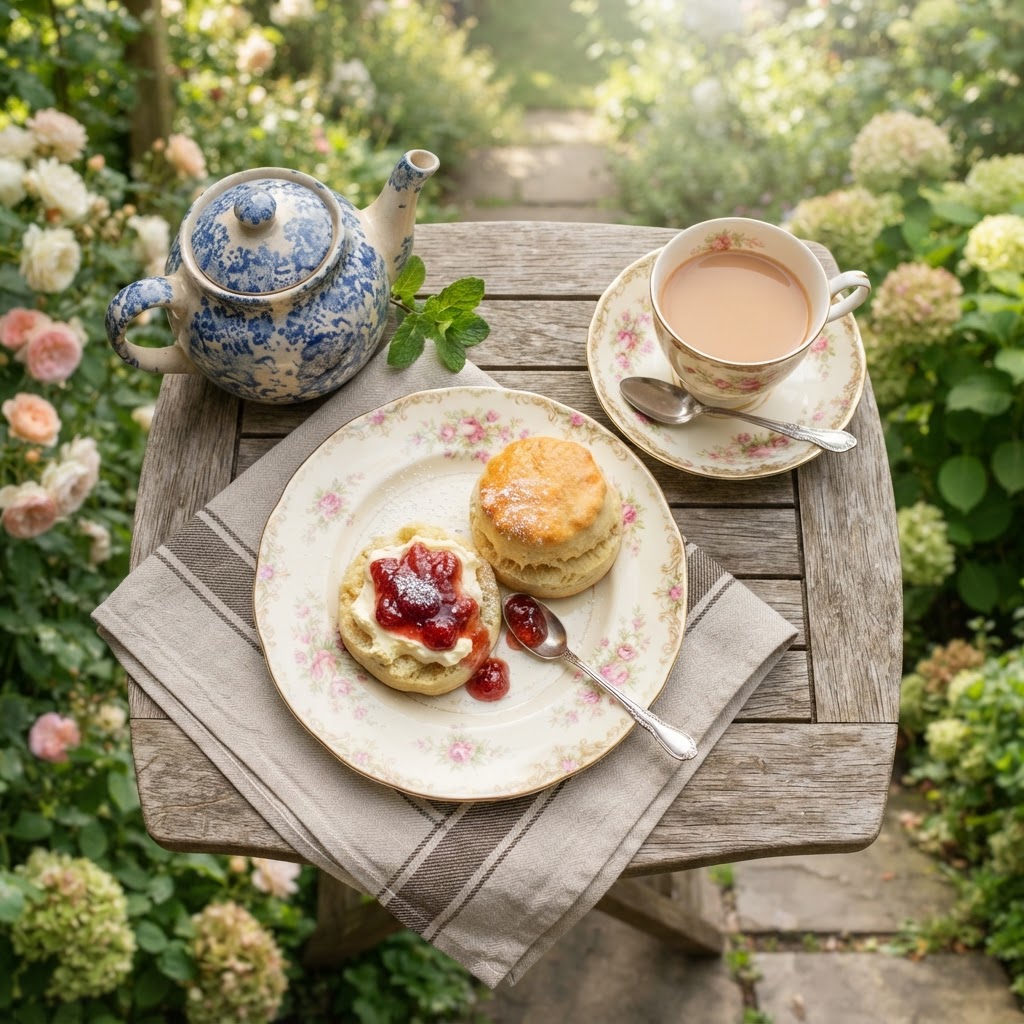
The cream tea — afternoon tea served with scones, clotted cream, and jam — is one of the most civilised traditions in British culinary culture, and the buttermilk scone is its centrepiece. A proper scone is a thing of beauty: golden-topped, split open while still warm, and served with a generous dollop of thick, buttery clotted cream and a spoonful of fruit jam. It is the quintessence of British baking — simple, elegant, and utterly dependent on quality ingredients and careful technique.
The cream tea tradition is most strongly associated with the West Country of England — specifically the counties of Devon and Cornwall — though its roots stretch back to the eleventh century. According to legend, the tradition began at Tavistock Abbey in Devon, where the monks served bread with cream and jam to workers who had helped restore the abbey after a Viking raid in 997 AD. The tradition spread through the West Country and was popularised nationally in the Victorian era, when afternoon tea became a fashionable social ritual.
The **great scone debate** — whether to put the cream or the jam on first — is one of the most famous culinary rivalries in Britain. The **Devon method** (also called the "Devonshire split") puts the clotted cream on the scone first, followed by the jam — like buttering bread. The **Cornwall method** (the "Cornish method") puts the jam first, then the cream — like a cake. In 2010, the Cream Tea Society was established to promote the tradition, and the debate shows no sign of resolution.
Clotted cream (*clouted cream* in its historic spelling) is the essential accompaniment. Made by heating full-fat cow's milk to 180°F (180°F) and holding it at that temperature for an hour, then cooling slowly, the cream rises to the top and forms a thick, yellow, crusty layer with a minimum fat content of 55%. Rodda's, established in Cornwall in 1890, is the most famous producer of clotted cream and holds a Protected Designation of Origin (PDO) for "Cornish Clotted Cream." Authentic clotted cream is difficult to find outside the UK, but it can be made at home with heavy cream and patience.
About the Ingredients
Flour should be a soft, low-protein flour for the tenderest scones. White Lily or a blend of all-purpose and cake flour works. In the UK, plain flour is standard.
Buttermilk provides both tenderness (its acidity inhibits gluten formation) and a subtle tang. Use full-fat cultured buttermilk. If unavailable, substitute with 1 cup milk + 1 tablespoon lemon juice, let sit 5 minutes.
Butter should be very cold European-style butter (Plugrá or Kerrygold) for the richest flavour and the flakiest texture.
Clotted cream is available from Rodda's or The English Tea Store in the US. If unavailable, a reasonable substitute can be made by whipping 1 cup of heavy cream with ¼ cup of mascarpone and 1 tablespoon of powdered sugar until thick.
Jam should be a good-quality fruit preserve — strawberry is the classic, but raspberry, blackberry, and damson plum are equally traditional. Bonne Maman and Tiptree (Wilkin & Sons) produce excellent preserves.
Ingredients (serves 6):
For the scones: - 2 cups all-purpose flour (plus extra for dusting) - 2 tablespoons granulated sugar - 1 tablespoon baking powder - ½ teaspoon salt - ½ cup (1 stick) cold unsalted butter, cut into small cubes - ¾ cup cold buttermilk - 1 large egg (for egg wash) - 1 tablespoon milk (for egg wash)
For serving: - 1 jar (12 oz) Bonne Maman Strawberry Preserves (or raspberry) - 1 jar (8 oz) Rodda's Clotted Cream (or homemade substitute) - A pot of Earl Grey or English Breakfast tea
For the Scones: Preheat oven to 425°F. Line a baking sheet with parchment paper. In a large bowl, whisk together the flour, sugar, baking powder, and salt. Cut in the cold butter using a pastry cutter or your fingers until the mixture resembles coarse crumbs with some pea-sized pieces remaining.
Make a well in the centre and pour in the buttermilk. Stir with a fork just until the dough comes together — it should be slightly shaggy. Do not overmix. Turn the dough onto a lightly floured surface and gently pat it into a disc about 1 inch thick. Do not roll it out too thin — thick scones are tall, proud scones.
Using a 2½-inch round cutter, cut out scones by pressing straight down (do not twist — twisting seals the edges and prevents rising). Re-roll scraps and cut again. Place scones on the baking sheet, about 1 inch apart. Whisk the egg with the milk and brush the tops generously.
Bake 12–15 minutes until golden brown and risen. Transfer to a wire rack. Serve warm (or at room temperature — never cold).
To Serve: Split each warm scone horizontally. Add a generous spoonful of clotted cream and a spoonful of jam. (The Devon method: cream first, then jam. The Cornwall method: jam first, then cream.) Serve with a pot of strong tea and milk.
Batch (serves 12): - Double the scone dough (bake on two sheets, rotating halfway) - Provide multiple jam varieties (strawberry, raspberry, blackberry) - Set out a buffet with scones in a bread basket, bowls of clotted cream and jam, and a tea station
Variations: - Add 1 cup of fresh blueberries or raisins to the dough for fruit scones. - Add 1 tablespoon of grated lemon zest and 1 teaspoon of poppy seeds for Lemon Poppy Seed Scones. - Replace ½ cup of flour with ½ cup of rolled oats for Oat Scones. - Add 1 cup of grated sharp cheddar and 2 tablespoons of chopped fresh chives for Savoury Cheese Scones.
Pairing: Buttermilk scones with clotted cream and jam are served with afternoon tea — Earl Grey, English Breakfast, or Darjeeling. For a brunch celebration, a Classic Champagne Mimosa or a Kir Royale is the perfect accompaniment — the elegance of the dish calls for bubbles. For a non-alcoholic option, a Rooibos Vanilla Spritz complements the scones beautifully.
Pro Tips: The butter must be very cold — if it softens during mixing, the scones will be flat and dense. Work quickly and handle the dough as little as possible. Do not twist the cutter — press straight down; twisting seals the layers and prevents the scones from rising. The dough should be slightly shaggy — a smooth, fully incorporated dough has been overworked. Serve scones warm or at room temperature — cold scones are dense and unappealing. If making ahead, reheat briefly in a 300°F oven for 3–4 minutes before serving.
Reference Links: - Wikipedia — Cream tea: en.wikipedia.org/wiki/Cream_tea - Wikipedia — Clotted cream: en.wikipedia.org/wiki/Clotted_cream - Rodda's Clotted Cream: roddas.co.uk - Cream Tea Society: creamteasociety.co.uk - BBC Good Food — Buttermilk Scones: bbcgoodfood.com/recipes/best-ever-buttermilk-scones - Tiptree Preserves: tiptree.com
Rate this recipe
Be the first to rate this recipe
to submit your rating.
Recent Posts

Couscous Royale: North Africa's Grand Platter of Lamb, Chicken, and Merguez
October 14, 2026

Seattle Cream Cheese Dog Bites: Hadley Long's 1989 Pioneer Square Invention
October 14, 2026

Khao Soi: Chiang Mai's Northern Thai Coconut Curry Noodles
October 13, 2026

Korean Bibimbap: Jeonju's Joseon Dynasty Mixed Rice
October 11, 2026

Spaghetti alla Carbonara: Rome's World War II Pasta of Eggs, Guanciale, and Pecorino
October 9, 2026