British Crumpets
June 14, 2026
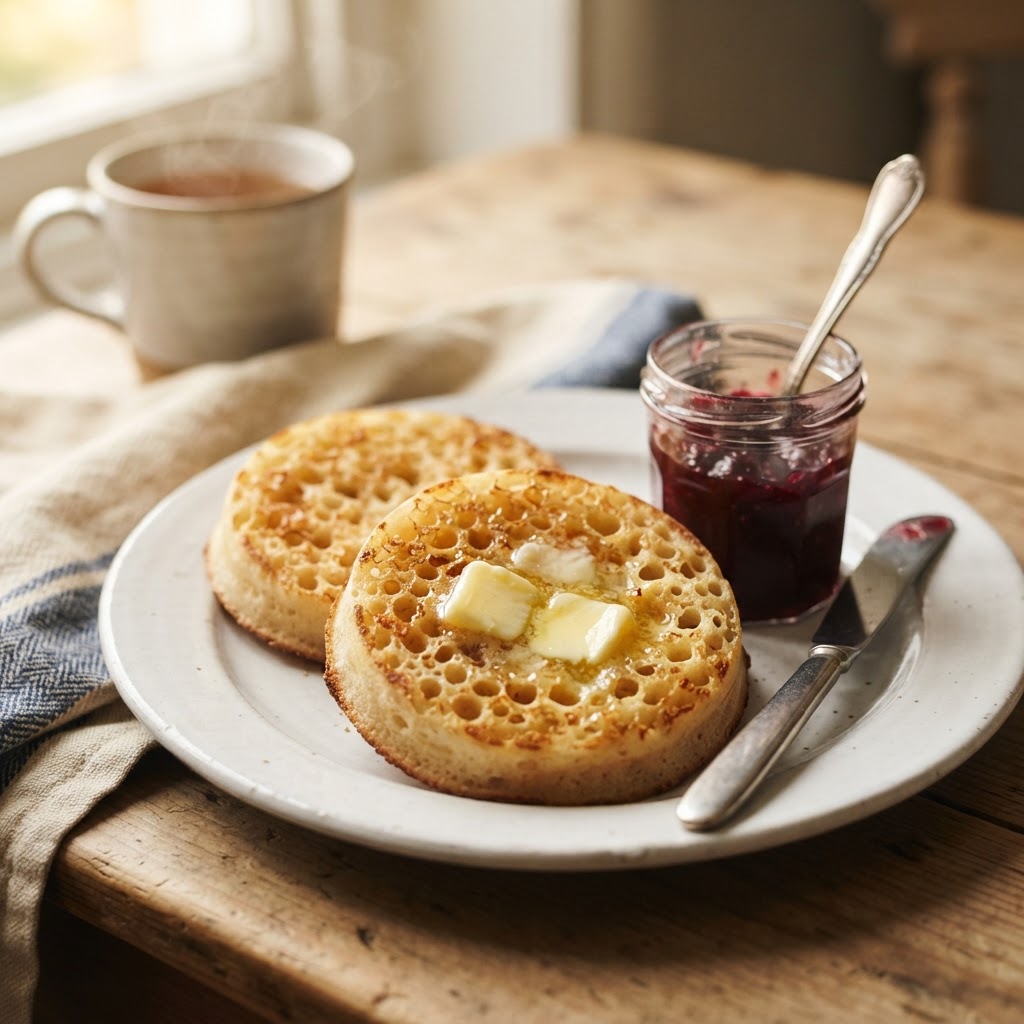
Crumpets are one of the most popular breakfast and teatime treats in Britain — soft, spongy, yeasted griddle cakes with a distinctive flat top covered in small holes that act as reservoirs for melting butter. The texture is unique in all of baking — the outside is slightly crisp while the inside is soft, springy, and honeycombed with holes that soak up butter and jam like a sponge. Crumpets are a staple of the British breakfast table and afternoon tea, traditionally served toasted with a generous slathering of butter.
The history of crumpets dates back to at least the 17th century, though the earliest versions were quite different from the modern crumpet. The original crumpets were hard, flat, biscuit-like pancakes made from a buckwheat flour batter. Over time, the recipe evolved to use wheat flour and yeast, and the addition of baking soda (which became commercially available in the 19th century) gave crumpets their characteristic spongy, holey texture. The holes are formed by the carbon dioxide gas produced by the yeast and baking soda, which rises through the batter as it cooks on the griddle. Crumpets are cooked in metal rings (called crumpet rings) on a griddle or flat pan, which gives them their characteristic round shape and flat top.
Crumpets are frequently confused with English muffins, but they are quite different. Crumpets are made from a wet batter (like a pancake) and are cooked on only one side, which creates the characteristic flat, holey top. English muffins are made from a drier dough (like bread) and are split and toasted before eating. Crumpets are softer and milder in flavor, with a spongy, holey texture, while English muffins are bread-like with a more substantial chew. Both are delicious, but crumpets have a unique texture that is unlike any other baked good.
Ingredients (makes about 10 crumpets):
The Batter: - ⅞ cup warm water (105–115°F / 40–115°F) - ⅞ cup warm milk (105–115°F / 40–115°F) - 1 packet (2¼ teaspoons) active dry yeast - 1 teaspoon sugar - 8 ⅞ oz all-purpose flour - ½ teaspoon salt - ½ teaspoon baking soda (dissolved in 2 tablespoons warm water) - Vegetable oil or melted butter (for greasing the rings and griddle)
Equipment: - Crumpet rings (or metal pastry rings, or clean tuna cans with both ends removed — 3-inch / 2 ⅞ in diameter) - A griddle or large flat-bottomed skillet
Making the Batter: In a bowl, combine the warm water, warm milk, yeast, and sugar. Let stand for 5 minutes until foamy. Add the flour and salt. Whisk vigorously for 2–3 minutes until the batter is smooth and free of lumps — the batter should be the consistency of a thick pancake batter. Cover with plastic wrap and let rise in a warm place for 1 hour until bubbly and doubled in size.
After the batter has risen, dissolve the baking soda in 2 tablespoons of warm water and stir it into the batter. The batter will foam and bubble vigorously. Let stand for 15 minutes — the batter should be light, airy, and covered in bubbles.
Cooking the Crumpets: Lightly grease the griddle and the insides of the crumpet rings with oil or melted butter. Place the rings on the griddle and preheat over medium-low heat (the griddle should be hot enough that a drop of batter sizzles gently, but not so hot that the crumpets brown too quickly — medium-low is essential).
Fill each ring about ½ to ⅔ full with batter. Do not overfill — the crumpets will rise as they cook. Cook for 5–7 minutes until the top is set and covered with bubbles/holes that have burst and dried. The top should look dry and spongy, with many small holes. The bottom should be golden brown.
Carefully remove the rings (use tongs — they will be hot). If the crumpets stick to the rings, run a knife around the inside edge. The crumpets do not need to be flipped — they are cooked on only one side, which is what creates the characteristic flat, holey top.
Remove the crumpets from the griddle and repeat with the remaining batter, re-greasing the rings between each batch.
Toasting and Serving: Crumpets are best toasted before serving — this crisps the top and creates a wonderful contrast between the crisp exterior and the soft, spongy interior. Toast under the broiler or in a toaster (carefully — the holes can catch on toaster elements). Serve immediately with a generous slathering of butter — the butter should melt into the holes and pool on top. Top with jam, honey, or lemon curd as desired.
The Mimosa Pairing Logic: The warm, yeasty, buttery character of crumpets calls for a mimosa with bright acidity that cuts through the butter while complementing the subtle, bready flavors. A classic orange mimosa is the most natural pairing — the citrus refreshes the palate and the champagne's effervescence cleanses the rich, buttery coating. A lemon verbena mimosa is inspired — the lemony, floral character creates a beautiful resonance with the lemon curd that often accompanies crumpets, and the acidity cuts through the butter beautifully. For a more structured pairing, a lavender elderflower mimosa creates a gentle, floral counterpoint that echoes the English teatime tradition. Avoid very sweet tropical mimosas — they overwhelm the subtle, delicate flavor of the crumpets.
Reference Links: - Crumpet history: Wikipedia - Crumpets vs English muffins: Utah Public Radio - Crumpet recipe: BBC Good Food - Traditional crumpet technique: Yesterdish
Make-Ahead: The batter can be made the night before and refrigerated after the first rise — let it come to room temperature and add the baking soda just before cooking. The cooked crumpets can be stored at room temperature for up to 2 days (in an airtight container) or frozen for up to 1 month. Reheat by toasting. Crumpets are always toasted before serving, even when fresh.
Pro Tips: The batter must be the right consistency — too thick and the holes won't form; too thin and the crumpets will be flat and dense. It should be like a thick pancake batter that slowly falls off a spoon. The griddle temperature is critical — too hot and the crumpets brown before the top sets and forms holes; too low and they cook too slowly and become dense. Medium-low is the sweet spot. Do not overfill the rings — the batter rises significantly as it cooks, and overfilling produces thick, doughy crumpets rather than the desired thin, holey ones. The baking soda must be added just before cooking — it creates the gas that forms the holes, and its effect diminishes quickly. Do not flip the crumpets — cooking on only one side is what creates the characteristic flat, holey top. Crumpets must always be toasted before serving, even when freshly made — toasting crisps the top and creates the essential contrast between the crisp exterior and soft, spongy, buttery interior.
Rate this recipe
Be the first to rate this recipe
to submit your rating.
Recent Posts

Couscous Royale: North Africa's Grand Platter of Lamb, Chicken, and Merguez
October 14, 2026

Seattle Cream Cheese Dog Bites: Hadley Long's 1989 Pioneer Square Invention
October 14, 2026

Khao Soi: Chiang Mai's Northern Thai Coconut Curry Noodles
October 13, 2026

Korean Bibimbap: Jeonju's Joseon Dynasty Mixed Rice
October 11, 2026

Spaghetti alla Carbonara: Rome's World War II Pasta of Eggs, Guanciale, and Pecorino
October 9, 2026