Brioche Pain Perdu with Salted Caramel & Crème Fraîche
June 13, 2026
Pain Perdu — "lost bread" in French — is the original French toast, conceived as a vehicle for reviving stale bread that would otherwise go to waste. The French version differs from its American counterpart in one important respect: restraint. Where American French toast often reaches for sweetness, Pain Perdu achieves its richness through technique — a custard soak made with cream, eggs, and vanilla, pan-fried in brown butter until lacquered and golden — and then finishes with contrasting elements rather than competing sweetness.
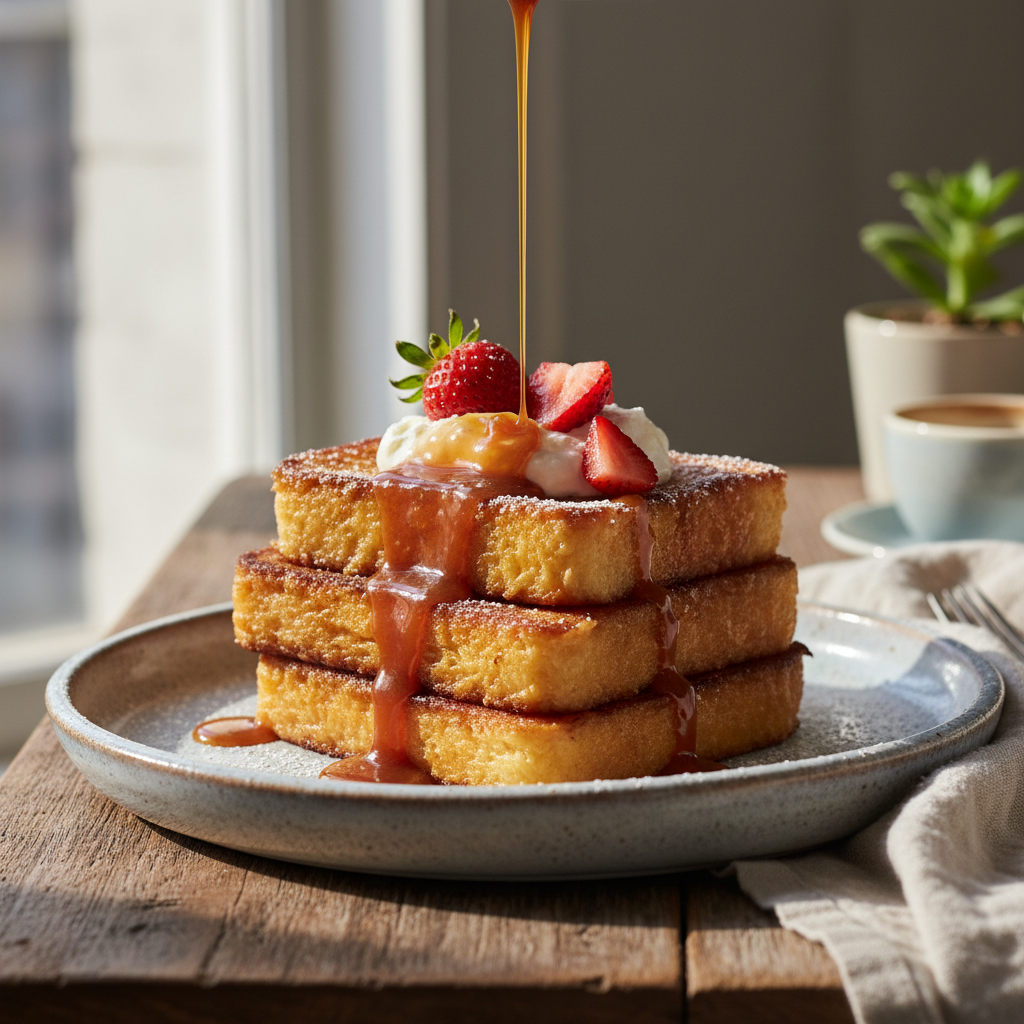
This version uses brioche (the natural choice for its butter and egg richness), pairs the caramelized toast with a salted caramel sauce that has genuine depth of flavor from the dark amber caramelization stage, and serves it alongside cool crème fraîche whose acidity cuts through the richness in a way that cold butter or maple syrup cannot achieve. Fresh strawberries provide a bright, seasonal counterpoint.
Pain Perdu is documented in French cooking as early as the 14th century. The dish appears in *Le Ménagier de Paris* (1393) under the name "tostées dorées" — gilded toasts. Its evolution through centuries of French home cooking has produced dozens of regional variations, from the Alsatian *Arme Ritter* (poor knights) to the elaborate café preparations of Paris bistros.
About Brown Butter (Beurre Noisette)
Brown butter — *beurre noisette* ("hazelnut butter" in French, for the nutty aroma it develops) — is one of the most transformative simple techniques in French cooking. As butter heats past its smoke point, the milk solids caramelize and develop Maillard reaction compounds that create a complex, deeply nutty, almost toffee-like flavor entirely absent from melted butter. It takes approximately 4 minutes and elevates any pan-fried preparation dramatically. Julia Child documented it extensively as a foundational French sauce.
Ingredients (serves 4):
The Brioche: - 8 thick slices brioche (1½ inches each), ideally 1–2 days old - 4 tablespoons unsalted butter (for brown butter frying)
Custard Soak: - 4 large eggs - ¾ cup heavy cream - ¼ cup whole milk - 2 tablespoons granulated sugar - 1 teaspoon vanilla bean paste - ½ teaspoon orange zest - Pinch of fine sea salt - Pinch of freshly grated nutmeg
Salted Caramel Sauce: - 1 cup granulated sugar - 6 tablespoons unsalted butter, at room temperature, cubed - ½ cup heavy cream, warm - 1 teaspoon flaky sea salt (Maldon recommended) - ½ teaspoon vanilla extract
To Serve: - 1 cup crème fraîche (full-fat) - 2 cups fresh strawberries, hulled and halved - Powdered sugar for dusting - Fresh mint sprigs
Salted Caramel Sauce (Make Ahead): In a heavy saucepan with light-colored interior (so you can see the color), heat sugar over medium heat without stirring. After 3–4 minutes, the edges will begin to melt and turn amber. Carefully swirl the pan (do not stir) until all the sugar has melted and the caramel is a deep amber color — the color of aged whiskey. Working quickly, add butter all at once (the mixture will bubble violently). Whisk until butter is fully incorporated. Remove from heat. Add warm cream in a slow, steady stream while whisking. Add flaky salt and vanilla. Strain into a jar.
Caramel keeps at room temperature for 2 weeks and refrigerated for 1 month. Warm gently before serving.
Custard Soak: Whisk eggs, heavy cream, milk, sugar, vanilla, orange zest, salt, and nutmeg in a wide, shallow baking dish until completely smooth.
Soak brioche slices for 2 minutes per side, pressing gently to encourage absorption. The brioche should feel heavy and fully saturated. If any slices seem dry, soak a third time.
Brown Butter French Toast: In a large skillet or griddle over medium heat, melt 2 tablespoons of butter. Continue cooking, swirling occasionally, until the butter foams, the foam subsides, and the milk solids at the bottom turn deep golden brown and smell nutty — approximately 3–4 minutes. This is the brown butter.
Add the soaked brioche slices (in batches — do not crowd). Cook 3–4 minutes without moving until the underside is deeply golden and caramelized. Flip and cook 2–3 minutes more. The second side will be equally golden but with a slightly different pattern. Add fresh butter for each batch and repeat the brown butter process.
Keep finished slices warm in a 200°F oven on a wire rack while you complete the batches.
Assembly: Stack two slices of Pain Perdu per person on a warm plate. Spoon warm salted caramel sauce generously over and alongside — let it pool on the plate. Add a generous dollop of cold crème fraîche slightly offset from the Pain Perdu. Arrange fresh strawberry halves around or over the top. Dust lightly with powdered sugar. A sprig of fresh mint alongside.
The Pairing: Brioche Pain Perdu with salted caramel is one of the richest brunch dishes in this collection — it pairs best with a dry, acidic sparkling wine that can cut through the butter and caramel. A glass of Champagne Brut, a Blood Orange Mimosa, or the Cava Blood Orange Aperol Mimosa are all exceptional companions.
Variations: - Pain Perdu with Raspberry Coulis: Replace caramel with a fresh raspberry sauce (14 ⅛ oz raspberries, 3 tablespoons sugar, 1 tablespoon lemon juice, cooked and strained) - Pain Perdu Normand: A Normandy-inspired version with caramelized apples, calvados, and crème fraîche - Savory Pain Perdu: Omit sugar from the custard, use gruyère inside the brioche, and serve with a fried egg and small salad
Reference Links: - Pain Perdu history and technique: Le Cordon Bleu - Salted caramel science: Serious Eats - Brown butter (beurre noisette) technique: Food52 - Julia Child on French toast: Julia Child Foundation
Pro Tips: The salted caramel sauce is the hardest element to make well — the transition from "not yet done" to "burnt" happens in approximately 30 seconds once the caramel reaches the deep amber stage. Watch it constantly and remove from heat the moment it reaches the color of aged honey. A jar of pre-made salted caramel sauce (such as Fran's Salted Caramel Sauce, available online) is an entirely acceptable substitute. Day-old brioche is essential; fresh brioche absorbs the custard too quickly and can become unworkably wet.
Rate this recipe
Be the first to rate this recipe
to submit your rating.
Recent Posts

Couscous Royale: North Africa's Grand Platter of Lamb, Chicken, and Merguez
October 14, 2026

Seattle Cream Cheese Dog Bites: Hadley Long's 1989 Pioneer Square Invention
October 14, 2026

Khao Soi: Chiang Mai's Northern Thai Coconut Curry Noodles
October 13, 2026

Korean Bibimbap: Jeonju's Joseon Dynasty Mixed Rice
October 11, 2026

Spaghetti alla Carbonara: Rome's World War II Pasta of Eggs, Guanciale, and Pecorino
October 9, 2026