Boudin and Eggs: The Cajun Brunch from the Louisiana Boucherie Tradition
April 14, 2026
In 1926, Miss Daisy Broussard began selling boudin at Lafayette's Mouton Mercantile Co., and in 1939 the Lafayette Daily Advertiser listed boudin among the "Rice Dishes of Louisiana," the first written record of the Cajun pork-and-rice sausage in the state. The sausage was older than the record. It was born of the boucherie, the communal pig butchering at the center of Cajun community life, where families gathered to use every part of the animal and the pork, liver, and scraps were cooked with rice, onions, and seasonings and stuffed into casings. The Cajuns who made it were the French Acadians, expelled from Nova Scotia by the British in 1755, who rebuilt their culture in the bayous and prairies of southwestern Louisiana and adapted their French cooking to the land they found.
Boudin is a category of sausage found in several French-speaking cultures, but in Louisiana, "boudin" means boudin blanc — a unique Cajun creation made from a mixture of cooked pork, rice, onions, peppers, and seasonings, stuffed into sausage casings. The Cajun boudin is distinct from the French boudin blanc (which is made with milk and no rice) and from the French boudin noir (blood sausage). The addition of rice is the defining characteristic of Cajun boudin, and it reflects the ingenuity of the Cajun people — rice was abundant and inexpensive, and adding it to the sausage was a way to stretch the meat and feed more people.
The history of Cajun boudin traces back to the boucherie — the traditional communal pig butchering that was a central event in Cajun community life. During a boucherie, families would gather to slaughter a pig and use every part of the animal. Boudin was one of the products of the boucherie — the pork, liver, and scraps were cooked with rice, onions, and seasonings, then stuffed into casings. The first written record of boudin with rice in Louisiana appeared in 1939 in the Lafayette Daily Advertiser, where boudin was listed among "Rice Dishes of Louisiana," though the dish was certainly being made long before that.
The Cajun boudin tradition was shaped by the "Creolization process" — a mixing of Native American, Spanish, Afro-Caribbean, French, and German influences. French colonists brought the boudin tradition from France (where boudin noir and boudin blanc date back to the 1300s). German immigrants, who arrived in Louisiana in the 1720s, brought expert sausage-making skills. The Acadians, expelled from Nova Scotia by the British in 1755, settled in southwestern Louisiana and adapted their French cooking to the local ingredients. The rice that characterizes Cajun boudin was introduced by German settlers who helped grow the rice industry in the 1870s–1890s.
Boudin became commercially available in the early 20th century. Miss Daisy Broussard sold boudin at Lafayette's Mouton Mercantile Co. in 1926. Arneastor Johnson made commercial sales take off in the 1940s at Johnson's Grocery in Eunice. By the 1950s and 1960s, "Cajun," "Hot," or "Country Boudin" had become a staple of regional food. Today, the towns of Acadiana take their boudin pride seriously — Scott was declared the "Boudin Capital of the World" in 2012, Jennings called itself the "Boudin Capital of the Universe," and Broussard went bigger with "Intergalactic Boudin Capital of Positive Infinity."
The key to a great boudin is the "squeezability" — the quality that locals lovingly use to judge boudin. A proper boudin should be moist and tender, not dry and crumbly. The rice should be fully cooked and melded with the pork, and the seasonings — green onions, parsley, cayenne, and black pepper — should be present but not overwhelming. The casing should snap when you bite into it. Boudin can be poached, steamed, grilled, or smoked, but for boudin and eggs, it's typically pan-seared or grilled until golden and crispy on the outside, with the filling warm and soft inside.
Our Mimosavated version uses store-bought Cajun boudin (with instructions for making your own if you're adventurous), pan-seared and served with fried eggs, toast, and hot sauce.
Ingredients (serves 4):
The Boudin: - 4 links of Cajun boudin blanc (about 14 ⅛ oz total — available from Cajun grocers or online; see note) - 1 tablespoon vegetable oil (for pan-searing)
The Eggs: - 8 large eggs - 1 tablespoon unsalted butter (or vegetable oil) - Salt and black pepper to taste
The Toast: - 8 slices of thick-cut bread (French bread or sourdough) - 2 tablespoons unsalted butter (for the toast)
Garnishes: - Hot sauce (Tabasco, Crystal, or your favorite Louisiana hot sauce) - Creole mustard or spicy brown mustard - 2 spring onions (scallions), sliced
Pan-Searing the Boudin: If the boudin is in links, you can cook it in the casings or remove the casings and form the filling into patties. For pan-searing, leave the casings on. Heat the oil in a large skillet over medium heat. Add the boudin links and cook for 8–10 minutes, turning occasionally, until golden brown and crispy on all sides and heated through. The casing should be browned and slightly crisp. Remove from the skillet and let rest for 2 minutes before serving.
*(Alternative: You can also grill the boudin over medium heat for 10–12 minutes, turning occasionally, until browned and heated through. Or, remove the filling from the casing and form it into patties, then pan-fry the patties for 3–4 minutes per side until golden and crispy.)*
Frying the Eggs: In a separate skillet, heat the butter over medium heat. Crack the eggs into the skillet — fry 2 eggs per person. Cook to your preference: sunny-side up (3 minutes, runny yolks), over-easy (flip and cook 30 seconds), or over-medium (flip and cook 1 minute). Season with salt and pepper.
Making the Toast: Toast the bread slices until golden. Butter the toast while warm.
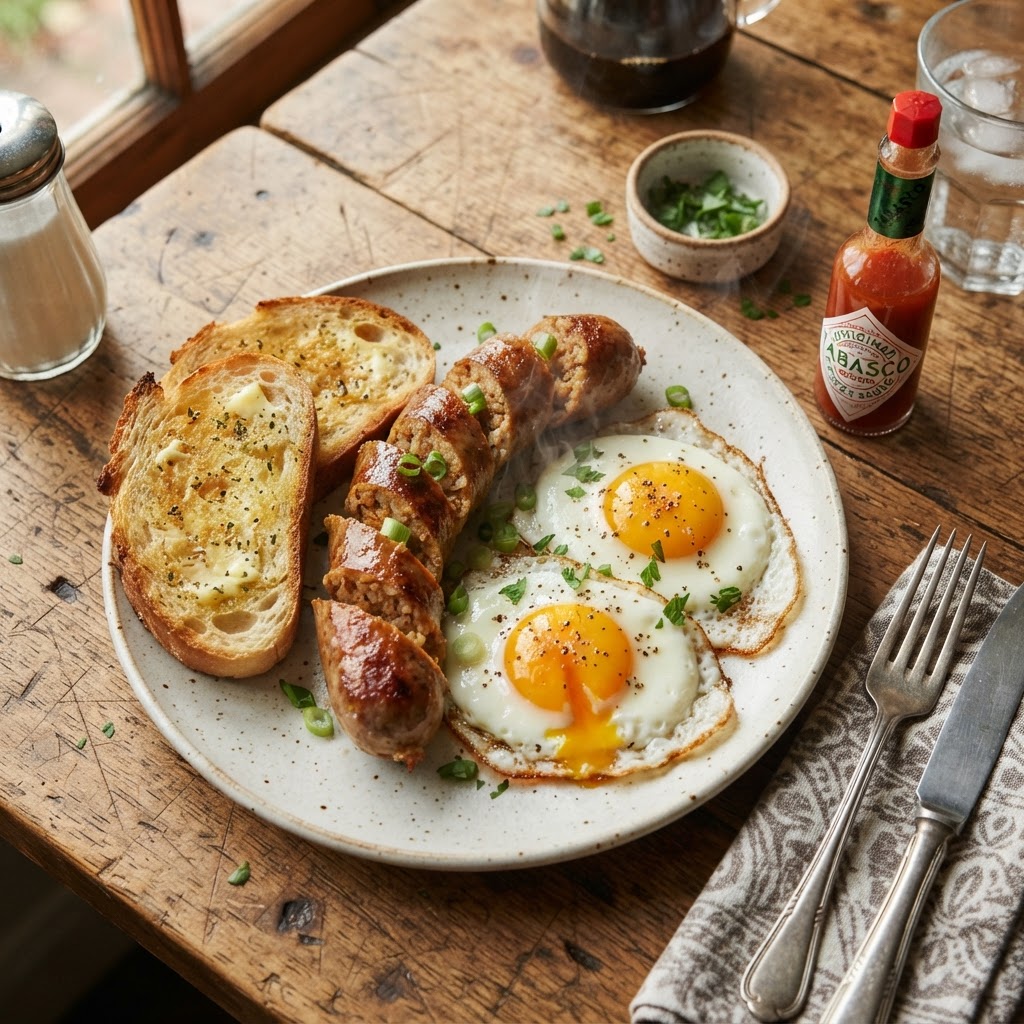
Serving: Place 1–2 boudin links on each plate, alongside 2 fried eggs. Add 2 slices of buttered toast. Pass the hot sauce, Creole mustard, and sliced scallions at the table. To eat, cut into the boudin — the casing should snap and the filling should be warm, moist, and savory. The combination of the rich, savory boudin, the runny egg yolk, the buttery toast, and the fiery hot sauce is one of the great Cajun breakfast experiences.
*(Note on making your own boudin: To make authentic Cajun boudin at home, you need pork shoulder, pork liver, long-grain rice, onions, bell peppers, celery, green onions, parsley, and Cajun seasonings. The pork and liver are cooked, then ground and mixed with cooked rice and seasonings, and stuffed into casings. This is a project that requires a meat grinder and sausage casings. For most home cooks, purchasing quality boudin from a Cajun grocer or online source is the best option.)*
The Mimosa Pairing Logic: Boudin and eggs is savory, spicy, and rich with pork and rice. The ideal mimosa pairing is a classic Prosecco mimosa — orange juice and Prosecco. The bright, acidic citrus cuts through the richness of the boudin and the egg yolk, while the Prosecco's effervescence cleanses the palate between bites. A blood orange mimosa is also excellent — the slightly bitter blood orange complements the spicy, savory boudin. Avoid heavy or sweet mimosas — the dish is savory and spicy, and you need something bright and acidic to balance it.
Reference Links: - Boudin on Wikipedia (Cajun boudin blanc, pork, rice, boucherie): Wikipedia - The Secret Behind Authentic Cajun Boudin Sausage (Louisiana boucherie tradition): Best Stop in Scott - What Is Boudin? Louisiana's Beloved Cajun Sausage Explained (Acadian settlers): Gallier NOLA - Southern Boudin Trail (boudin, Interstate 10, Louisiana): Southern Foodways Alliance - Boudin entry (French roots, 1300s, Lewis and Clark, 1805, Creolization): 64 Parishes
Make-Ahead: The boudin can be purchased up to 1 week ahead and refrigerated — cook just before serving. Uncooked boudin can be frozen for up to 3 months — thaw overnight in the refrigerator before cooking. The eggs should be fried just before serving. The toast should be made just before serving. Assemble at the last minute — the dish is at its best when the boudin is hot and crispy, the eggs are freshly fried, and the toast is warm and buttered. Leftover cooked boudin can be refrigerated for up to 3 days and reheated in a 347°F/350°F oven for 5 minutes — the casing won't be as crisp, but the filling will still be delicious.
Pro Tips: Buy quality boudin — the quality of the boudin determines the quality of the dish. Look for boudin from a reputable Cajun source — it should be moist, well-seasoned, and have a good balance of pork, rice, and seasonings. If you can't find Cajun boudin locally, order it online from a Louisiana source. Don't overcook the boudin — it should be heated through and golden on the outside, but the casing shouldn't split or the filling dry out. Pan-sear over medium heat — too high and the casing burns before the filling is heated through; too low and it doesn't get crispy. Let the boudin rest for 2 minutes after cooking — this allows the filling to settle and makes it easier to slice. Fry the eggs sunny-side up or over-easy — the runny yolk mixing with the boudin is one of the great moments of the dish. Use Louisiana hot sauce — Tabasco, Crystal, or Louisiana brand are the traditional accompaniments; they have the right vinegar tang and heat level. Don't skip the toast — you need something to soak up the egg yolk and the boudin juices. Serve immediately — boudin is at its best when hot and freshly cooked, and the eggs are at their best when the yolks are still runny.
Rate this recipe
Be the first to rate this recipe
to submit your rating.
Recent Posts

Couscous Royale: North Africa's Grand Platter of Lamb, Chicken, and Merguez
October 14, 2026

Seattle Cream Cheese Dog Bites: Hadley Long's 1989 Pioneer Square Invention
October 14, 2026

Khao Soi: Chiang Mai's Northern Thai Coconut Curry Noodles
October 13, 2026

Korean Bibimbap: Jeonju's Joseon Dynasty Mixed Rice
October 11, 2026

Spaghetti alla Carbonara: Rome's World War II Pasta of Eggs, Guanciale, and Pecorino
October 9, 2026