Boeuf Bourguignon (Burgundy Beef Stew with Red Wine, Mushrooms, and Pearl Onions)
June 20, 2026
Boeuf Bourguignon originated in the Burgundy region of eastern France, where peasant cooks traditionally braised tough cuts of beef in the local red wine to tenderize them and extract maximum flavor. What began as a rustic farmhouse stew was codified by Auguste Escoffier in *Le Guide Culinaire* (1903), and it was Julia Child who brought the dish to the American consciousness in *Mastering the Art of French Cooking* (1961), where she called it "the most famous of all French beef stews." Child's version, which she famously prepared on her television show *The French Chef*, became the definitive recipe for generations of American home cooks and remains the standard by which all Boeuf Bourguignon is judged.
It is cubed beef braised slowly in an entire bottle of Burgundy red wine with lardons (salt pork or bacon), pearl onions, mushrooms, and a bouquet garni until the meat is fork-tender and the sauce is deep, dark, and intensely flavored. Her recipe introduced several key techniques that distinguish a great Bourguignon from a merely good one: marinating the beef in red wine overnight, browning the beef in batches, browning the lardons separately to render their fat, and cooking the pearl onions and mushrooms separately so they retain their individual character and flavor.
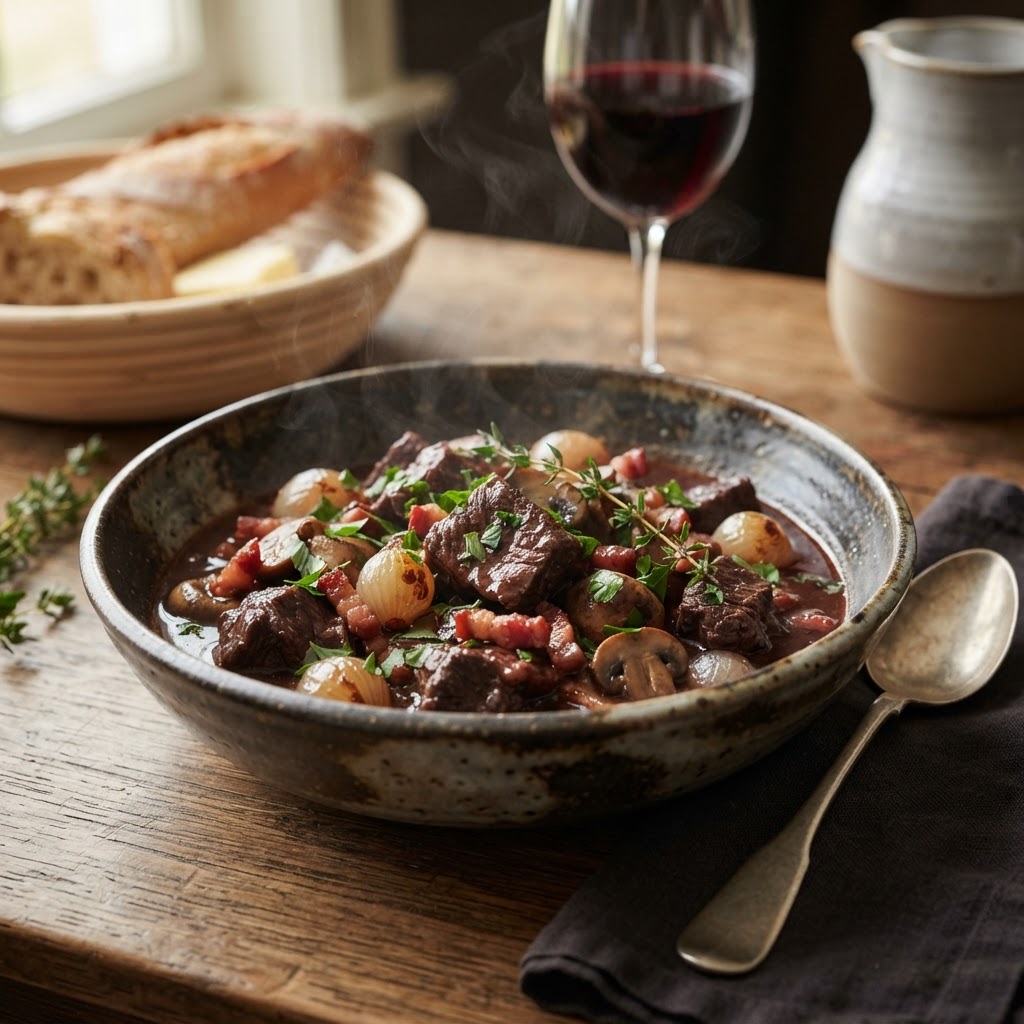
The essence of a great Boeuf Bourguignon is the sauce, thick, dark, glossy, and complex, with the red wine reduced to a concentrated essence that coats the meat in a luxurious glaze. The meat should be fork-tender but still hold its shape, and each component, beef, lardons, onions, mushrooms, should be identifiable and distinct. This is not a uniform, mushy stew but a composed dish where each ingredient retains its individual character within a unifying sauce.
Ingredients (serves 8–10 as a main course):
The Beef and Marinade: - 3 ⅓ lb beef chuck (or boneless short ribs), cut into 2-inch cubes - 1 bottle (3 ⅛ cups) full-bodied red Burgundy (or Pinot Noir — the wine should be good enough to drink, but not expensive) - 2 carrots, sliced - 1 large onion, sliced - 4 garlic cloves, smashed - 1 bouquet garni (4 thyme sprigs, 2 bay leaves, parsley stems) - 2 tablespoons olive oil
The Lardons: - 7 oz slab bacon or salt pork, cut into lardons (½-inch thick sticks)
The Braise: - 4 tablespoons unsalted butter - 2 tablespoons olive oil - 2 tablespoons all-purpose flour - 2 tablespoons tomato paste - 1 ⅔ cups beef stock - 7 oz pearl onions (or small boiling onions), peeled - 1 bouquet garni (additional thyme, bay leaves, parsley stems) - Salt and pepper
Garnish (cooked separately): - 8 ⅞ oz cremini mushrooms, quartered - 7 oz pearl onions, peeled (or use the ones from the braise) - 2 tablespoons butter - 1 tablespoon olive oil - 1 tablespoon fresh parsley, chopped - 1 tablespoon fresh thyme leaves
Garnish and Serve: - Crusty bread or mashed potatoes - Egg noodles (traditional French accompaniment) - Fresh parsley, chopped
Day 1 — Marinating the Beef: In a large non-reactive bowl or container, combine the cubed beef, sliced carrots, sliced onion, smashed garlic, bouquet garni, and the entire bottle of red wine. Cover and refrigerate at least 8 hours, ideally 24 hours. The marinade tenderizes the meat and infuses it with the deep, complex flavor of the Burgundy wine.
Day 2 — Preparing the Lardons: In a large Dutch oven, cook the lardons over medium heat for 10 minutes, stirring occasionally, until they have rendered their fat and are lightly browned but not crisp. Remove the lardons with a slotted spoon and set aside. Drain the bacon fat from the pot but reserve it — you will use it for browning the beef.
Browning the Beef: Remove the beef from the marinade and pat completely dry with paper towels — wet beef will not brown. Strain the marinade, reserving the liquid and the vegetables separately. Toss the beef cubes in the seasoned flour.
Heat 2 tablespoons of the reserved bacon fat with 1 tablespoon olive oil in the Dutch oven over high heat. Working in batches (3–4 pieces at a time — do not crowd), brown the beef on all sides until deeply golden, 3–4 minutes per batch. Remove to a plate. Crowding the pan drops the temperature and causes the meat to steam rather than sear — take the time to brown in small batches.
Building the Braise: Return all the browned beef to the pot. Add the tomato paste and cook 1 minute, stirring to coat the meat. Add the reserved marinade vegetables (carrots, onions, garlic). Add the reserved lardons. Pour in the strained marinade liquid. Add enough beef stock to just barely cover the meat. Add the bouquet garni. Bring to a simmer on the stovetop.
Cover with a tight-fitting lid and transfer to a 325°F (320°F) oven. Braise for 2.5–3 hours, checking every 45 minutes and adding more stock if the liquid level drops too low. The meat should be fork-tender — a fork should pierce it with no resistance.
Cooking the Garnish Separately (the Julia Child method): While the beef braises, prepare the mushrooms and pearl onions separately so they retain their individual character. For the pearl onions: heat 1 tablespoon butter in a skillet. Add the peeled onions and cook over medium heat 10 minutes, rolling them occasionally, until golden on all sides. Add ½ cup of water, cover, and simmer 10 minutes until tender. For the mushrooms: heat 1 tablespoon butter and 1 tablespoon olive oil in a large skillet over high heat. Add the quartered mushrooms and cook 5 minutes until golden and their liquid has evaporated. Set both aside.
Finishing the Sauce: When the beef is done, remove the pot from the oven. Remove the bouquet garni and discard. Using a slotted spoon, remove the beef and lardons to a serving platter. Strain the braising liquid through a fine sieve into a saucepan, pressing hard on the vegetables to extract all their flavor. Skim the fat from the surface. Bring to a simmer and reduce by about one-third until the sauce coats the back of a spoon in a thick, glossy layer. Taste and adjust seasoning. Return the beef, lardons, mushrooms, and pearl onions to the sauce. Simmer gently 5 minutes to heat through.
Service: Serve in shallow bowls over mashed potatoes, egg noodles, or with crusty bread. Garnish with fresh parsley and thyme. The sauce should be the star — dark, rich, complex, and glossy.
The Mimosa Pairing Logic: The rich, deep, wine-braised character of Boeuf Bourguignon calls for a mimosa with enough depth and complexity to stand up to the bold flavors. A classic orange mimosa is the most natural pairing — the citrus brightens the palate and the champagne's toasty notes mirror the braised, caramelized character of the beef. A blood orange mimosa is exceptional — the slight bitterness of the blood orange complements the tannins of the red wine sauce. For a more structured pairing, a fig honey champagne mimosa creates a beautiful resonance with the deep, caramelized, slow-cooked flavors of the dish. Avoid very light, delicate mimosas — they are overwhelmed by the bold, robust character of the Bourguignon.
Reference Links: - Julia Child's Beef Bourguignon: Garlic & Zest - Boeuf Bourguignon — Wikipedia: Wikipedia - Traditional French beef stew: Serious Eats - Julia Child — Mastering the Art of French Cooking: Penguin Random House
Make-Ahead: Boeuf Bourguignon is always better on the second day — the flavors deepen and meld overnight. Make it 1–3 days ahead, refrigerate, and reheat gently on the stovetop. In fact, it is traditional in Burgundy to make the stew a day ahead and let it rest. The garnish (mushrooms and pearl onions) should be cooked separately and added when reheating, so they retain their individual character.
Pro Tips: The marination step is the single most important technique — overnight marinating in red wine tenderizes the meat, infuses it with deep flavor, and the alcohol helps extract fat-soluble flavor compounds from the aromatics. The beef must be patted bone-dry before searing — wet beef steams rather than sears and never develops the Maillard crust that forms the flavor foundation. Browning in small batches is non-negotiable — crowding the pan drops the oil temperature and produces gray, steamed beef rather than brown, seared beef. Cooking the mushrooms and pearl onions separately (rather than in the stew) is the Julia Child technique that distinguishes a great Bourguignon from a good one — it ensures each component retains its individual texture and flavor rather than dissolving into the stew. Straining and reducing the sauce at the end is essential — it removes the muddy, broken-down vegetables and concentrates the sauce into a glossy, luxurious glaze.
Rate this recipe
Be the first to rate this recipe
to submit your rating.
Recent Posts

Couscous Royale: North Africa's Grand Platter of Lamb, Chicken, and Merguez
October 14, 2026

Seattle Cream Cheese Dog Bites: Hadley Long's 1989 Pioneer Square Invention
October 14, 2026

Khao Soi: Chiang Mai's Northern Thai Coconut Curry Noodles
October 13, 2026

Korean Bibimbap: Jeonju's Joseon Dynasty Mixed Rice
October 11, 2026

Spaghetti alla Carbonara: Rome's World War II Pasta of Eggs, Guanciale, and Pecorino
October 9, 2026