Baklava al Moscato
July 4, 2026
By the fifteenth century, the pastry chefs of the Ottoman imperial kitchens in Istanbul's Topkapı Palace had perfected a method for stretching dough to tissue-thin transparency, and on that foundation they built the baklava served to the Sultan and his court. The earliest layered bread-and-nut desserts are far older, dating to the Assyrian Empire in the eighth century BC, where bakers layered flatbreads with chopped nuts and honey. But the baklava made with paper-thin filo is a product of the Ottoman Empire, and the word *filo* itself is Greek for "leaf," a sign of the Greek cooks in the empire who are often credited with developing the delicate dough.
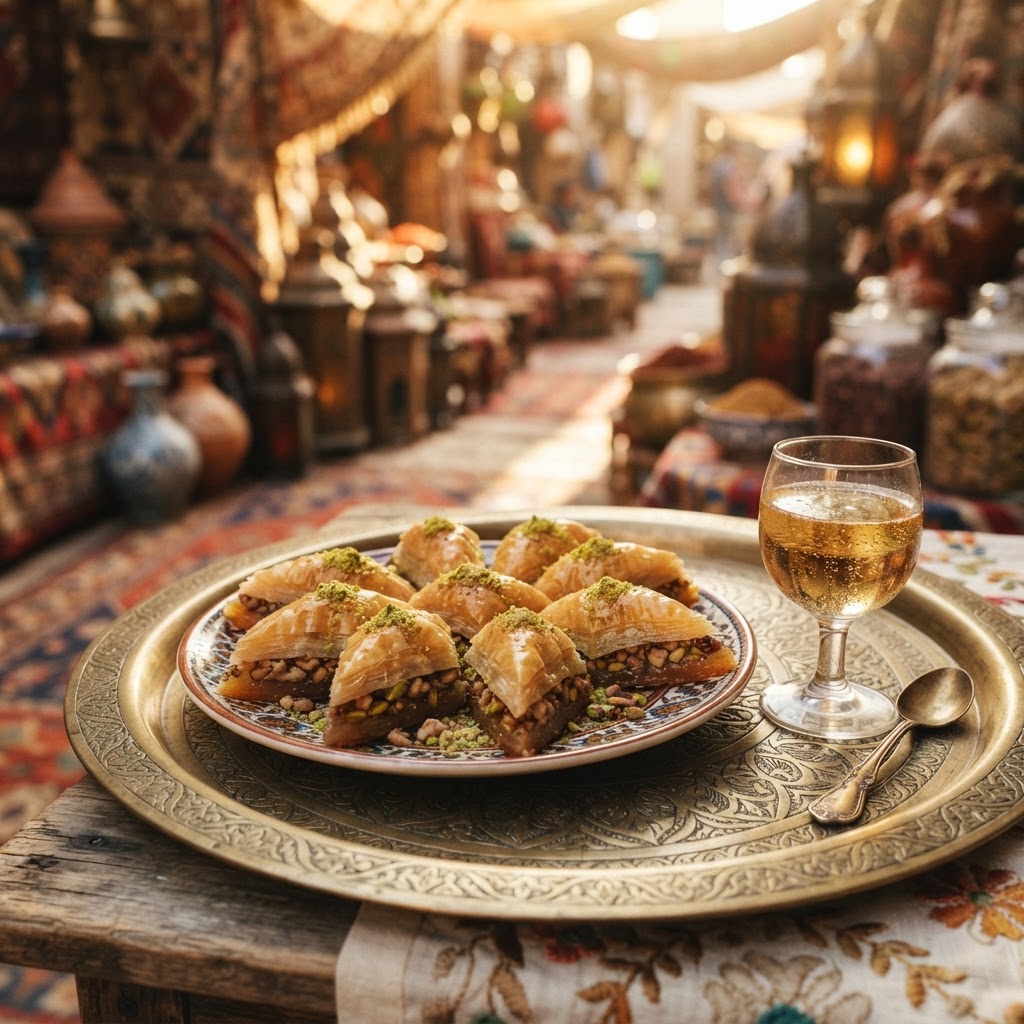
Today baklava is prepared differently across the region. The Turkish version uses pistachios and a light sugar syrup. The Greek version uses walnuts and honey with cinnamon and cloves. The Lebanese and Syrian versions use pistachios, walnuts, and sometimes pine nuts, with a syrup scented with rosewater or orange blossom. All are authentic.
Our Mimosavated version replaces the traditional honey or sugar syrup with a Moscato d'Asti syrup, the fragrant, lightly sparkling sweet wine from Piedmont, reduced to a glaze and infused with orange blossom water. The Moscato adds peach and orange-blossom notes against the nuts and filo, and the wine's natural acidity keeps the syrup from cloying.
Ingredients (makes 24 pieces):
The Phyllo and Nuts: - 14 ⅛ oz package of phyllo dough (thawed if frozen) - 10.6 oz mixed nuts (pistachios, walnuts, or a combination — about 5 ¼ oz pistachios, 5 ¼ oz walnuts), finely chopped - 8 ⅞ oz unsalted butter, melted - 1 teaspoon ground cinnamon - ½ teaspoon ground cardamom (optional) - A pinch of salt
The Moscato Syrup: - 1 ¼ cups Moscato d'Asti - 7 oz granulated sugar - 3 ½ oz honey - 2 tablespoons lemon juice - 1 strip of orange zest - 1 strip of lemon zest - 1 tablespoon orange blossom water (acqua di fiori d'arancio) - 2 whole cloves
Preparing the Nuts: Preheat the oven to 356°F (350°F). Toast the pistachios and walnuts separately on baking sheets for 8–10 minutes until fragrant. Let cool, then chop finely by hand or pulse in a food processor — don't over-process or you'll get nut butter. Toss with the cinnamon, cardamom, and salt.
Assembling the Baklava: Brush a 23x13 in (9x13 inch) baking dish with melted butter. Unroll the phyllo dough and keep it covered with a damp towel at all times — phyllo dries out in seconds and becomes brittle and unworkable.
Lay one sheet of phyllo in the dish and brush lightly with melted butter. Repeat with 7 more sheets, buttering each one. Spread half of the nut mixture evenly over the phyllo. Layer 4 more buttered sheets, then the remaining nut mixture. Top with 8 more buttered sheets, buttering each one. You should have about 20 sheets total — 8 on the bottom, 4 in the middle, 8 on top.
With a sharp knife, score the baklava into 24 pieces — cut all the way through to the bottom. Cut diagonally to create the classic diamond shapes, or cut straight lines for squares. A diagonal cut gives the most beautiful presentation.
Baking: Bake for 45–50 minutes, until the top is deep golden brown and crisp. The baklava should be thoroughly baked — underbaked phyllo is soggy and unpleasant.
Making the Moscato Syrup: While the baklava bakes, combine the Moscato, sugar, honey, lemon juice, citrus zests, and cloves in a saucepan. Bring to a boil, then reduce heat and simmer for 15 minutes until the syrup thickens slightly. Remove from heat, remove the zests and cloves, and stir in the orange blossom water. The syrup should be warm, not hot, when poured.
Finishing: As soon as the baklava comes out of the oven, pour the warm Moscato syrup evenly over the entire surface. It will bubble and sizzle — this is correct. The hot phyllo absorbs the syrup, becoming crisp on top and soft and syrupy underneath. Let cool completely at room temperature — at least 4 hours — before cutting and serving. Do not refrigerate; the phyllo will go soggy.
Serving: Cut along the scored lines. Serve in small cupcake liners or on a decorative plate. Baklava is rich; one or two pieces is a generous portion. A glass of Moscato d'Asti or strong Turkish coffee alongside is traditional.
The Mimosa Pairing Logic: Since the syrup is made with Moscato d'Asti, pair with a peach bellini mimosa — peach purée and Prosecco. The peach echoes the Moscato and the orange blossom water, while the Prosecco adds sparkle. A lavender elderflower mimosa is also excellent — the floral notes complement the nuts, spices, and orange blossom. Avoid heavy or bitter mimosas — baklava is sweet and nutty, and you need something light and floral.
Reference Links: - Baklava on Wikipedia (Ottoman origins): Wikipedia - The Sticky History of Baklava (Smithsonian): Smithsonian Magazine - Is Baklava Greek or Turkish? The Real Origin: Alba Hausa - The Long, Contested History of Baklava: Jungle Jim's - Moscato d'Asti wine guide: Wine Folly
Make-Ahead: Baklava can be made up to 2 weeks ahead and stored in an airtight container at room temperature. It actually improves after a day — the syrup continues to soak into the phyllo and the flavors meld. Do not refrigerate — refrigeration makes the phyllo soggy. Baklava can also be frozen for up to 3 months — thaw at room temperature. The Moscato syrup can be made ahead and gently rewarmed.
Pro Tips: Keep the phyllo covered with a damp towel at all times while working — dried-out phyllo shatters and is impossible to work with. Butter every single sheet — this is what creates the flaky, crisp layers. Don't skimp. Toast the nuts before using — raw nuts lack the depth and warmth that toasted ones bring. Score the baklava before baking, not after — cutting through baked phyllo without pre-scoring will shatter it. Pour the syrup over the hot baklava — the temperature differential is what allows the phyllo to absorb the syrup while staying crisp on top. Let it cool completely — cutting warm baklava will crush the layers. Use a very sharp knife and cut firmly.
Rate this recipe
Be the first to rate this recipe
to submit your rating.
Recent Posts

Couscous Royale: North Africa's Grand Platter of Lamb, Chicken, and Merguez
October 14, 2026

Seattle Cream Cheese Dog Bites: Hadley Long's 1989 Pioneer Square Invention
October 14, 2026

Khao Soi: Chiang Mai's Northern Thai Coconut Curry Noodles
October 13, 2026

Korean Bibimbap: Jeonju's Joseon Dynasty Mixed Rice
October 11, 2026

Spaghetti alla Carbonara: Rome's World War II Pasta of Eggs, Guanciale, and Pecorino
October 9, 2026