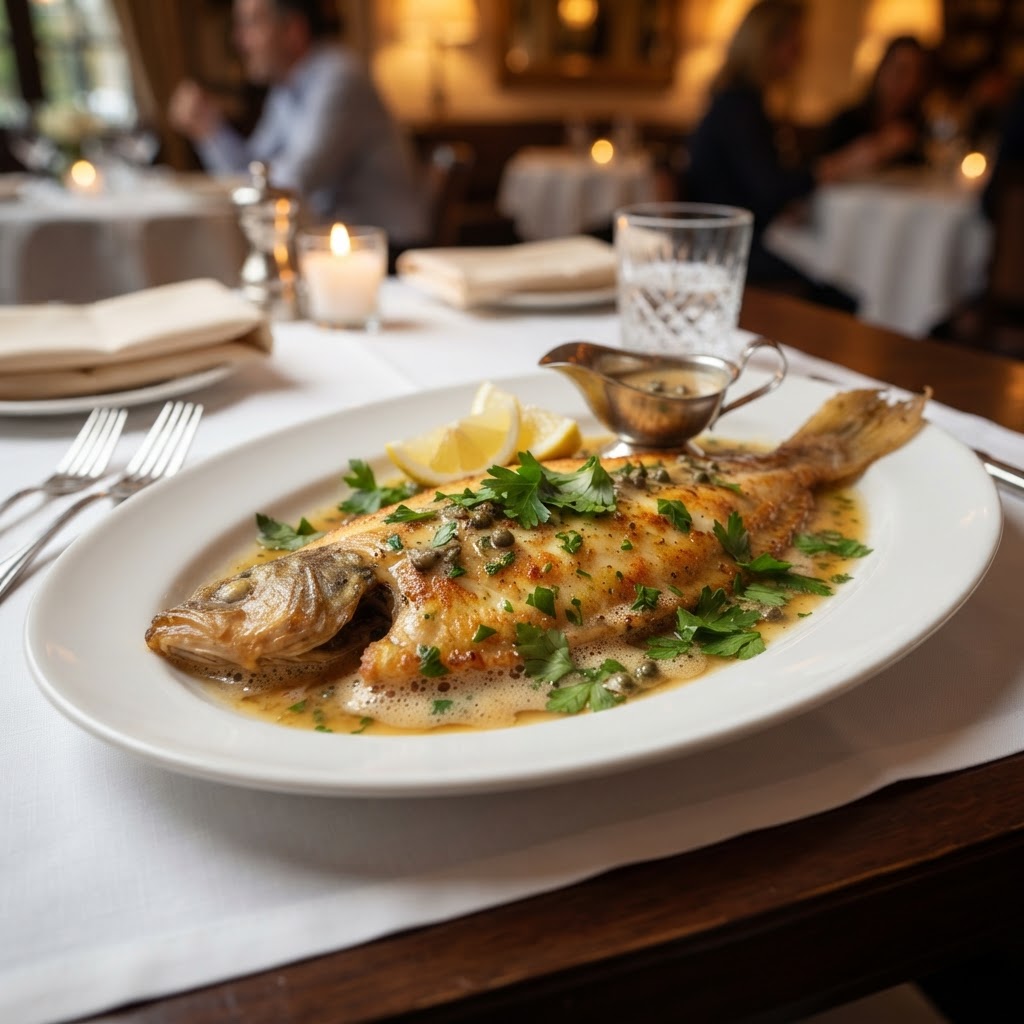
Baked Dover Sole Meunière (Whole Sole in Brown Butter, Lemon, and Parsley)
July 9, 2026
Sole Meunière is one of the most elegant and celebrated preparations in all of French cuisine — a whole sole fish, dredged in flour, pan-fried in butter until golden, then finished with a nutty brown butter (beurre noisette), fresh lemon juice, and parsley. The dish is named "meunière" after the French word for "miller's wife" — a reference to the light flour dredge that is the defining characteristic of the preparation. The miller's wife, who had access to the finest flour, dusted the fish with it before frying, creating a delicate golden crust that seals in the moisture and provides a surface for the butter and lemon sauce to cling to.
Sole meunière has been prepared since at least the time of King Louis XIV (1638–1715), and it has been a fixture of French bistro and fine-dining menus for centuries. The dish achieved particular fame through Julia Child, who had her first truly transformative French meal at La Couronne restaurant in Rouen on November 3, 1948 — a meal that began with sole meunière and changed the course of her life and American cooking. In her memoir "My Life in France," Child wrote: "It was the most exciting meal of my life... The sole was so perfectly fresh, so perfectly cooked — it had been sautéed in butter and lemon and parsley — it was absolutely divine." That single dish set Child on the path to writing "Mastering the Art of French Cooking" and launching "The French Chef," and sole meunière became the dish that introduced America to the possibilities of French cuisine.
The traditional fish for sole meunière is Dover sole (Solea solea) — a flatfish found in the cold waters of the North Atlantic and Mediterranean. Dover sole is considered the finest sole in the world, prized for its firm, meaty texture and delicate, sweet flavor. The fish is cooked on the bone, which preserves its moisture and flavor, and served whole — the fillets are removed from the bone at the table by the diner or the server, which is part of the ceremony of the dish. (If Dover sole is unavailable, grey sole, lemon sole, or petrale sole can be substituted, though none matches the quality of true Dover sole.)
Ingredients (serves 4 as a main course or 6 as a first course): - 4 whole Dover sole (or grey sole, lemon sole, petrale sole), scaled, gutted, and trimmed — ask the fishmonger to "skin the dark side" (the top side) and trim the fins, but leave the white side skin on for structural integrity - 5 ¼ oz all-purpose flour, seasoned with salt and pepper (for dredging) - 7 oz unsalted butter (European-style, 84% fat — the butter is the sauce, so it must be excellent) - 2 tablespoons olive oil (to prevent the butter from burning) - 2 lemons (1 for juice, 1 for garnish) - 1 large bunch fresh flat-leaf parsley, very finely chopped (about ½ cup) - 4 tablespoons capers, rinsed (optional — for a sauce meunière variation) - Salt and freshly ground black pepper
Garnish: - Lemon wedges - Fresh parsley sprigs - Flaky sea salt
Preparing the Sole: Pat each sole completely dry with paper towels — dry fish sears properly and develops a golden crust; wet fish steams and becomes soggy. Season both sides with salt and pepper. Dredge lightly in seasoned flour, shaking off all excess — the fish should have the thinnest possible dusting of flour, not a thick coating. Too much flour creates a pasty, gummy layer rather than a crisp, golden one.
Clarifying the Butter (Optional but Recommended): For the most refined result, clarify half the butter: melt 3 ½ oz butter slowly in a saucepan, skim the foam from the surface, and pour off the clear yellow butterfat, leaving the white milk solids behind. Clarified butter has a higher smoke point and allows you to fry the fish at a higher temperature without burning. The remaining 3 ½ oz of whole butter will be used for the brown butter sauce.
Pan-Frying the Sole: Heat 2 tablespoons olive oil and 1 ¾ oz of the clarified butter (or whole butter) in a large skillet over medium-high heat. When the butter foams and just begins to brown, carefully add one sole (work in batches — the fish must not be crowded). Cook 3–4 minutes per side, using a thin spatula to turn the fish gently. The sole is done when it is golden brown on both sides and the flesh flakes easily when tested with a fork. Remove to a warmed serving platter and keep warm. Repeat with the remaining sole, adding more butter as needed.
The Brown Butter (Beurre Noisette): After all the sole is cooked, wipe the skillet clean. Add the remaining 3 ½ oz of whole butter to the clean skillet over medium heat. Cook, swirling constantly, until the foam subsides and the butter turns a deep golden-amber color with a nutty, toasted aroma — about 3–4 minutes. Watch carefully — the butter goes from perfectly browned to burnt in seconds. The milk solids should be golden brown, not dark brown or black.
Remove from heat immediately. Add the juice of 1 lemon (this stops the cooking and creates a bright, emulsified sauce). Add the finely chopped parsley and capers (if using). The sauce should be golden, glossy, and fragrant with nutty butter, lemon, and parsley.
Service: Arrange the sole on warmed plates. Spoon the brown butter sauce generously over each fish. Garnish with lemon wedges and parsley sprigs. Serve immediately — the sauce must be poured at the last moment so the fish is still hot and the butter is still bubbling.
To eat: use a knife to make a cut along the backbone from head to tail. Slide the knife under the top fillet and lift it off the bone in one piece. Then lift the backbone away to reveal the bottom fillet. Each sole yields two fillets.
The Mimosa Pairing Logic: The delicate, buttery, nutty character of sole meunière calls for a mimosa with bright acidity that cuts through the richness of the brown butter while complementing the lemon and parsley. A classic orange mimosa is the most natural pairing — the citrus echoes the lemon in the sauce and the champagne's acidity balances the butter. A lemon verbena mimosa is inspired — the lemony, floral character creates a beautiful resonance with the lemon in the sauce and adds an aromatic dimension. For a more structured pairing, a grapefruit rosemary mimosa provides a bright, slightly bitter counterpoint that refreshes the palate between bites of the rich, buttery fish. Avoid very sweet tropical mimosas — they overwhelm the delicate, subtle flavor of the sole.
Reference Links: - Sole Meunière recipe: Serious Eats - Sole Meunière history: Philosokitchen - Julia Child's sole meunière story: Smithsonian Magazine - Dover sole guide: Monterey Bay Aquarium Seafood Watch - Brown butter (beurre noisette) technique: The Spruce Eats
Make-Ahead: Sole meunière cannot be made ahead — it must be cooked and served immediately. The sole can be purchased and trimmed up to 4 hours ahead and kept refrigerated. The parsley can be chopped ahead. The lemon can be juiced ahead. But the frying and sauce-making must be done à la minute — the dish takes less than 15 minutes to cook and should be served while the butter is still bubbling.
Pro Tips: Dover sole is the authentic choice and is worth seeking out — its firm, meaty texture and delicate, sweet flavor are unmatched by other sole varieties. The fish must be bone-dry before dredging — wet fish produces a soggy, gummy coating rather than a crisp, golden one. The flour dredge must be minimal — the fish should have the thinnest possible dusting, not a thick, breaded coating. This is meunière, not fried fish. The butter must be watched constantly during browning — it goes from golden and nutty to dark and bitter in seconds, and once it burns, it cannot be saved. Adding the lemon juice off the heat stops the browning immediately and creates a bright, emulsified sauce. The sole should be cooked on the bone — the bone preserves moisture and flavor, and cooking fillets separately produces a noticeably inferior result. The dish must be served immediately — the brown butter sauce separates and the fish cools within minutes, so have everything else ready before you begin cooking.
Rate this recipe
Be the first to rate this recipe
to submit your rating.
Recent Posts

Couscous Royale: North Africa's Grand Platter of Lamb, Chicken, and Merguez
October 14, 2026

Seattle Cream Cheese Dog Bites: Hadley Long's 1989 Pioneer Square Invention
October 14, 2026

Khao Soi: Chiang Mai's Northern Thai Coconut Curry Noodles
October 13, 2026

Korean Bibimbap: Jeonju's Joseon Dynasty Mixed Rice
October 11, 2026

Spaghetti alla Carbonara: Rome's World War II Pasta of Eggs, Guanciale, and Pecorino
October 9, 2026