Baked Alaska with Champagne Sabayon
June 13, 2026
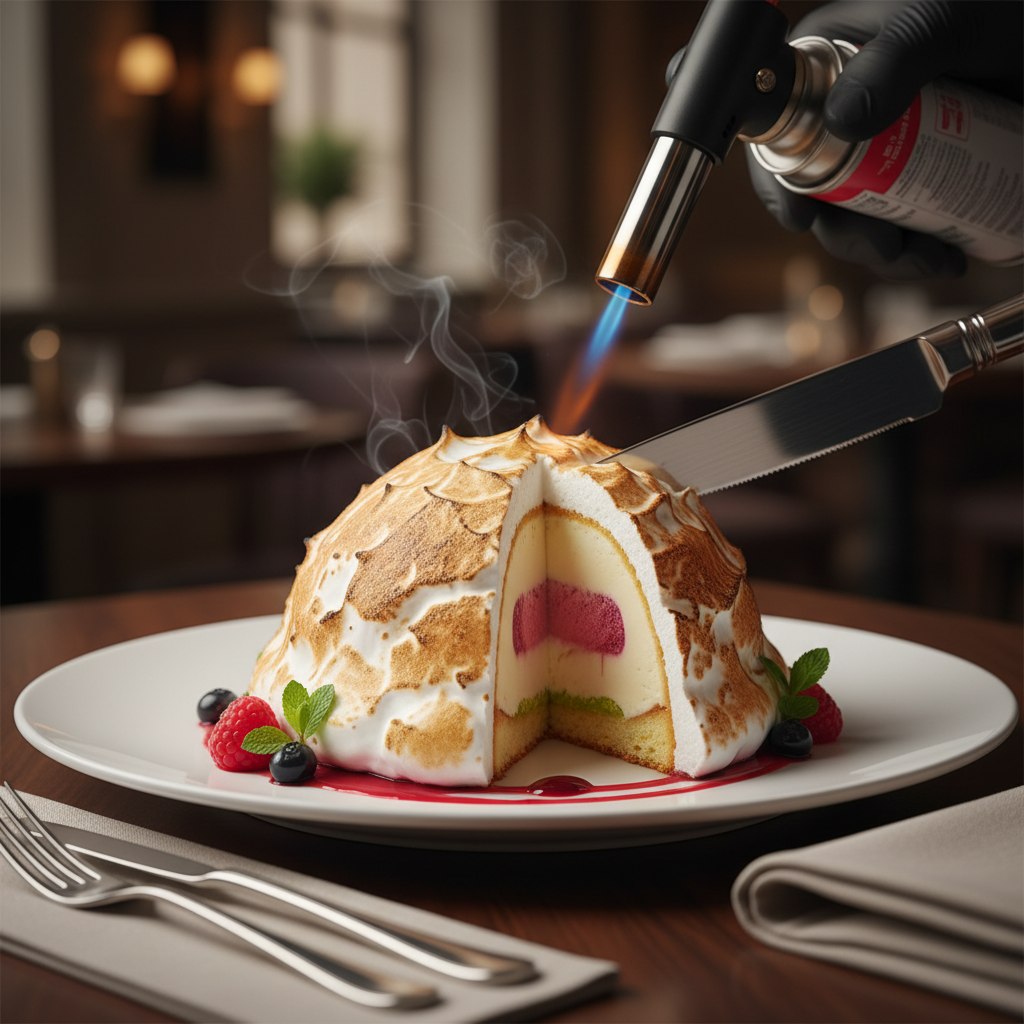
Baked Alaska — a dome of ice cream encased in cake and coated in Italian meringue, baked or torched until the exterior is golden — is one of the great theatrical desserts of the 19th century American fine dining tradition. The dish was created at Delmonico's restaurant in New York City in 1867, named to celebrate the American purchase of Alaska from Russia. The "impossible" paradox of hot meringue and frozen ice cream captured the imagination of the dining public immediately, and it has remained one of the most dramatic dessert presentations ever conceived.
The modern interpretation — individual Baked Alaskas with a core of premium ice cream (choose one or two complementary flavors: vanilla and raspberry, or vanilla and passion fruit), a thin layer of génoise sponge, and a tall swirl of Italian meringue torched at the table — is the dessert that produces the most dramatic and memorable reaction of any course on the menu. Champagne sabayon alongside adds one further layer of luxury.
Ingredients (serves 12 individual Baked Alaskas):
Génoise Sponge Base: - 4 large eggs, at room temperature - 4 ¼ oz granulated sugar - 4 ¼ oz all-purpose flour, sifted - 1 oz unsalted butter, melted and cooled - Pinch of salt - 1 teaspoon vanilla extract
Ice Cream Filling: - 1 quart premium vanilla bean ice cream - 1 pint raspberry or passion fruit sorbet - (or any two complementary flavors of exceptional quality — Häagen-Dazs, Salt & Straw, or artisan gelato)
Italian Meringue: - 4 large egg whites, at room temperature - 7 oz granulated sugar - ¼ cup water - Pinch of cream of tartar
Champagne Sabayon: - 6 egg yolks - 4 ¼ oz superfine sugar - ⅞ cup quality Champagne or Prosecco - 2 tablespoons Grand Marnier
Génoise: Preheat oven to 375°F. Whisk eggs and sugar over a bain-marie until the mixture reaches 110°F and doubles in volume. Remove from heat, beat with an electric mixer on high until cool, tripled in volume, and falls in a thick ribbon. Sift flour and salt over the mixture in three additions, folding gently. Fold in melted butter and vanilla. Spread ½ inch thick on a parchment-lined sheet pan. Bake 8–10 minutes until golden and springy. Cool completely. Cut into 3-inch rounds (or squares). (Can be made 2 days ahead; wrap airtight.)
Ice Cream Domes (24+ hours ahead): Line 12 small hemisphere molds or small rounded bowls (approximately 3-inch diameter) with plastic wrap. Fill with softened ice cream and sorbet in two layers. Smooth the top. Press a sponge round onto each. Cover tightly, freeze until solid — at least 6 hours, ideally overnight.
Italian Meringue: Combine sugar and water in a saucepan, bring to 240°F (soft-ball stage). Meanwhile, beat egg whites and cream of tartar to soft peaks. With the mixer running, pour the hot sugar syrup in a thin, steady stream down the side of the bowl. Beat on high until meringue is stiff, glossy, and the bowl feels cool — about 5–7 minutes. Use immediately.
Assembly: Unmold ice cream domes (still frozen solid) onto the sponge bases, sponge-side down on a chilled plate or tray. Working quickly, cover each with a thick, swirling layer of Italian meringue, ensuring the entire surface is sealed with no gaps — the meringue is the insulator that protects the ice cream. Return to the freezer for at least 30 minutes (up to 8 hours). (This is the make-ahead holding point.)
Champagne Sabayon (make to order or within 30 minutes of service): Whisk egg yolks, sugar, and Champagne together in a heatproof bowl over a bain-marie of barely simmering water. Whisk vigorously and continuously for 8–10 minutes until the mixture triples in volume, becomes pale and airy, and holds a thick ribbon. Add Grand Marnier. Remove from heat. Serve warm immediately.
Service: Using a kitchen blowtorch, brown the meringue to deep golden with dark spots in a smooth, rotating motion. The blowtorch flame should be moving constantly to avoid burning in one spot. Alternatively, place under a very hot broiler for 2–3 minutes, watching constantly.
Plating: Spoon warm Champagne sabayon into a small pitcher or onto the plate around the Alaska. Present at the table.
Reference Links: - Italian meringue technique: Serious Eats - Génoise sponge (Julia Child method): Julia Child Foundation - Champagne sabayon (zabaglione): Food & Wine
Event Timing: The assembled, unbrowned Baked Alaskas can be held in the freezer for up to 8 hours. Brown with a blowtorch at the table or immediately before service. The sabayon must be made within 30 minutes of service.
Pro Tips: The meringue insulation is what makes this dessert physically possible — it is an excellent thermal insulator, and a thick, complete coating with no gaps will keep the ice cream frozen for several minutes even under a broiler. The drama is the point: torch or broil at the table if possible. The reaction from guests when the meringue browns and the interior emerges still frozen never disappoints.
Rate this recipe
Be the first to rate this recipe
to submit your rating.
Recent Posts

Couscous Royale: North Africa's Grand Platter of Lamb, Chicken, and Merguez
October 14, 2026

Seattle Cream Cheese Dog Bites: Hadley Long's 1989 Pioneer Square Invention
October 14, 2026

Khao Soi: Chiang Mai's Northern Thai Coconut Curry Noodles
October 13, 2026

Korean Bibimbap: Jeonju's Joseon Dynasty Mixed Rice
October 11, 2026

Spaghetti alla Carbonara: Rome's World War II Pasta of Eggs, Guanciale, and Pecorino
October 9, 2026