The Australian Finger Lime Champagne Mimosa
September 19, 2026
The Australian finger lime (Citrus australasica) is a thorny shrub of the subtropical rainforests of northeastern New South Wales and southeastern Queensland, where its caviar-like pearls of juice have been gathered and used by Aboriginal peoples for thousands of years. The fruit is unlike any other citrus: instead of segmented pulp, its flesh is composed of tiny, glistening, spherical vesicles that burst on the tongue with a sharp, aromatic lime flavor. Aboriginal Australians long called it "bush caviar," using the juice for hydration in the rainforest and applying it to cuts and infections for its antimicrobial properties. In recent decades, the finger lime has moved from a wild bushfood to a sought-after ingredient on restaurant menus and cocktail lists worldwide, though its deepest roots remain Aboriginal.
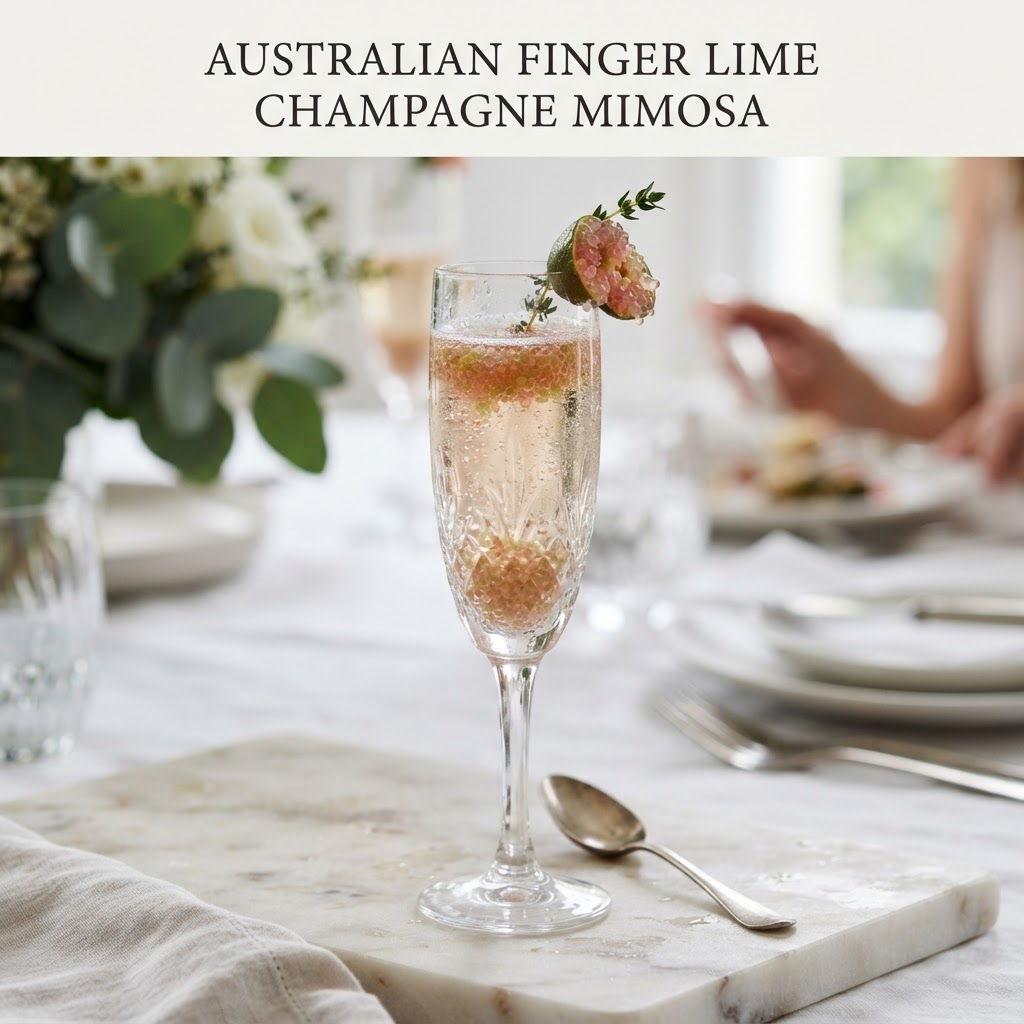
The finger lime's "caviar" structure makes it a natural cocktail garnish of extraordinary visual drama — the tiny pearls, in shades from pale green to vivid pink, float and suspended in the bubbles of a Champagne mimosa, releasing their sharp, aromatic lime flavor with every sip. It is a mimosa that is as much about texture and visual spectacle as it is about flavor.
About Finger Limes
The finger lime (Citrus australasica) is a member of the Rutaceae family, native to the subtropical rainforests of the border ranges between New South Wales and Queensland. The fruit is elongated and finger-shaped, up to four inches long, with a skin that ranges from green to yellow to deep purple-black. The pulp vesicles (the "caviar") come in colors from pale green to vivid pink and deep red, depending on the cultivar. Finger limes are now cultivated commercially in Australia and, increasingly, in California, with a season that runs roughly from late autumn through spring. Reference: Citrus australasica — Wikipedia
Finger Lime Macerado (infused base): - 1 cup fresh finger lime pearls (from 6–8 finger limes) plus the juiced halves - ½ cup sugar - ½ cup water
Halve the finger limes crosswise and gently squeeze the pearl-like vesicles out into a bowl (a gentle rolling pressure releases them). Reserve the pearls for garnish. Place the squeezed halves and any broken pearls in a small saucepan with the sugar and water. Heat gently, stirring, until the sugar dissolves. Remove from heat and steep 30 minutes. Strain, discarding the rinds. Cool. The syrup will be a tart, aromatic lime syrup. Refrigerate for up to 1 week.
Ingredients (serves 6): - 3 oz finger lime macerado syrup (above — ½ oz per serving) - 3 oz fresh lemon juice (½ oz per serving) - 1 bottle (25 oz chilled Champagne Brut NV or Blanc de Blancs (Blanc de Blancs — such as Pierre Peters Cuvée de Réserve — provides the crisp, citrus-mineral character that lets the finger lime's aromatic sharpness shine) - 1–2 tablespoons whole finger lime pearls (in mixed colors, if available) for garnish - Optional: a pinch of flaky sea salt on the foam
Instructions: Combine the finger lime macerado syrup and lemon juice. Chill thoroughly. Chill Champagne flutes for 5 minutes. Pour 1 oz of the finger lime-lemon blend into each flute. Top slowly with chilled Champagne, pouring down the side. Float a teaspoon of whole finger lime pearls into each glass — the tiny, glistening pearls will suspended in the bubbles, releasing their sharp lime flavor with each sip. Garnish with a pinch of flaky sea salt on the foam if using.
For a Mimosa Bar (serves 12): - 6 oz finger lime macerado syrup - 6 oz fresh lemon juice - 2 bottles Champagne Brut or Blanc de Blancs, chilled - Whole finger lime pearls in mixed colors for garnish
Variations: - Use pink or red-fleshed finger lime cultivars for a dramatic color contrast in the glass. - Replace Champagne with sparkling rosé for a softer, fruitier backdrop that contrasts the finger lime's sharpness. - Add ½ oz of gin (Hendrick's or The Botanist) per serving for a Finger Lime Gin Mimosa — the gin's botanicals echo the finger lime's aromatic complexity.
Mimosa Pairing Logic: The finger lime's sharp, aromatic citrus character calls for a lean, mineral Champagne whose own citrus notes resonate with the fruit. The bubbles lift the pearl vesicles and release their flavor on the palate. For a related pour, the Cucumber Mint Mimosa is the fresh-herb cousin, and the Kiwi Mint Mimosa shares the green-fresh-over-bubbles logic.
Reference Links: - Citrus australasica (finger lime, native Australian rainforest): Wikipedia - Australian Finger Lime (growing native plants, Aboriginal use): Australian National Botanic Gardens
Make-Ahead: Finger lime macerado syrup (1 week, refrigerated). Whole finger lime pearls (3 days, refrigerated in an airtight container). Assemble per glass just before serving.
Pro Tips: Extracting finger lime pearls takes a gentle touch: roll the fruit first to loosen the vesicles, then halve crosswise and apply gentle pressure; too much force crushes the pearls into pulp. The pearls are the visual and textural heart of this drink, so handle them carefully and float them whole into each glass. Mixed-color cultivars (pale green and vivid pink) create the most dramatic effect. Blanc de Blancs Champagne is the right pour here, as its lean, citrus-mineral character lets the finger lime's aromatic sharpness take center stage where a fuller wine would mask it. The flaky sea salt is not decorative; it amplifies the citrus oils and rounds the sharpness.
Rate this recipe
Be the first to rate this recipe
to submit your rating.
Perfect Mimosa Pairings
Mimosas that pair perfectly with this dish
Recent Posts

Couscous Royale: North Africa's Grand Platter of Lamb, Chicken, and Merguez
October 14, 2026

Seattle Cream Cheese Dog Bites: Hadley Long's 1989 Pioneer Square Invention
October 14, 2026

Khao Soi: Chiang Mai's Northern Thai Coconut Curry Noodles
October 13, 2026

Korean Bibimbap: Jeonju's Joseon Dynasty Mixed Rice
October 11, 2026

Spaghetti alla Carbonara: Rome's World War II Pasta of Eggs, Guanciale, and Pecorino
October 9, 2026