Arepas with Eggs: The Pre-Columbian Corn Cake of Colombia and Venezuela
July 13, 2026
The arepa — a golden, griddled cornmeal cake with a crispy exterior and a soft, pillowy interior — is one of the oldest and most popular foods in Colombia and Venezuela. Stuffed with eggs, cheese, beans, meat, or any combination of fillings, the arepa is a daily staple, a breakfast tradition, and a pre-Columbian legacy that has survived for thousands of years.
The arepa is a pre-Columbian dish, originating with the indigenous peoples of the region that is now Colombia, Panama, and Venezuela. Archaeological evidence suggests that the arepa has been made for nearly 3,000 years — the indigenous Timoto-Cuica people and other tribes in the region were grinding maize (corn) on stone metates and forming the dough into flat cakes long before European contact. The name "arepa" is believed to come from the word "erepa" in the language of the Cumanagoto people (an indigenous group of Venezuela), meaning "corn bread." The arepa was a staple of indigenous diets for millennia, and when the Spanish arrived in the 16th century, they adopted the food and it became a cornerstone of the colonial diet as well.
The key ingredient in an arepa is masa de maíz — corn dough — traditionally made by soaking dried corn in an alkaline solution (a process called nixtamalization) and grinding it into dough. Today, most arepas are made with pre-cooked cornmeal (harina de maíz precocida, such as P.A.N. brand), which makes the process much simpler while still producing an authentic result. The dough is simply cornmeal, water, and salt — shaped into patties and griddled until golden and crispy on both sides, then often finished in the oven for a few minutes to puff them up.
The arepa is split open and stuffed with fillings, and the possibilities are endless. In Venezuela, the most traditional breakfast arepa is the Reina Pepiada — stuffed with a chicken and avocado salad. In Colombia, arepas are often served simpler, sometimes just with butter and cheese, or as a side dish. For brunch, one of the most satisfying fillings is scrambled eggs with cheese — the warm, crispy arepa cradling soft, fluffy eggs and melting cheese is a perfect morning meal. Other popular brunch fillings include perico (Venezuelan scrambled eggs with tomatoes and onions), black beans and cheese, or shredded beef.
The arepa is so central to the identity of both Colombia and Venezuela that there is a friendly, ongoing debate between the two countries about who "owns" the arepa. The truth is that the arepa predates both modern nations — it belongs to the indigenous peoples who invented it millennia ago. Both countries have their own styles: Colombian arepas tend to be thinner and are often made with white corn, while Venezuelan arepas are thicker and more commonly made with yellow corn, split open and generously stuffed.
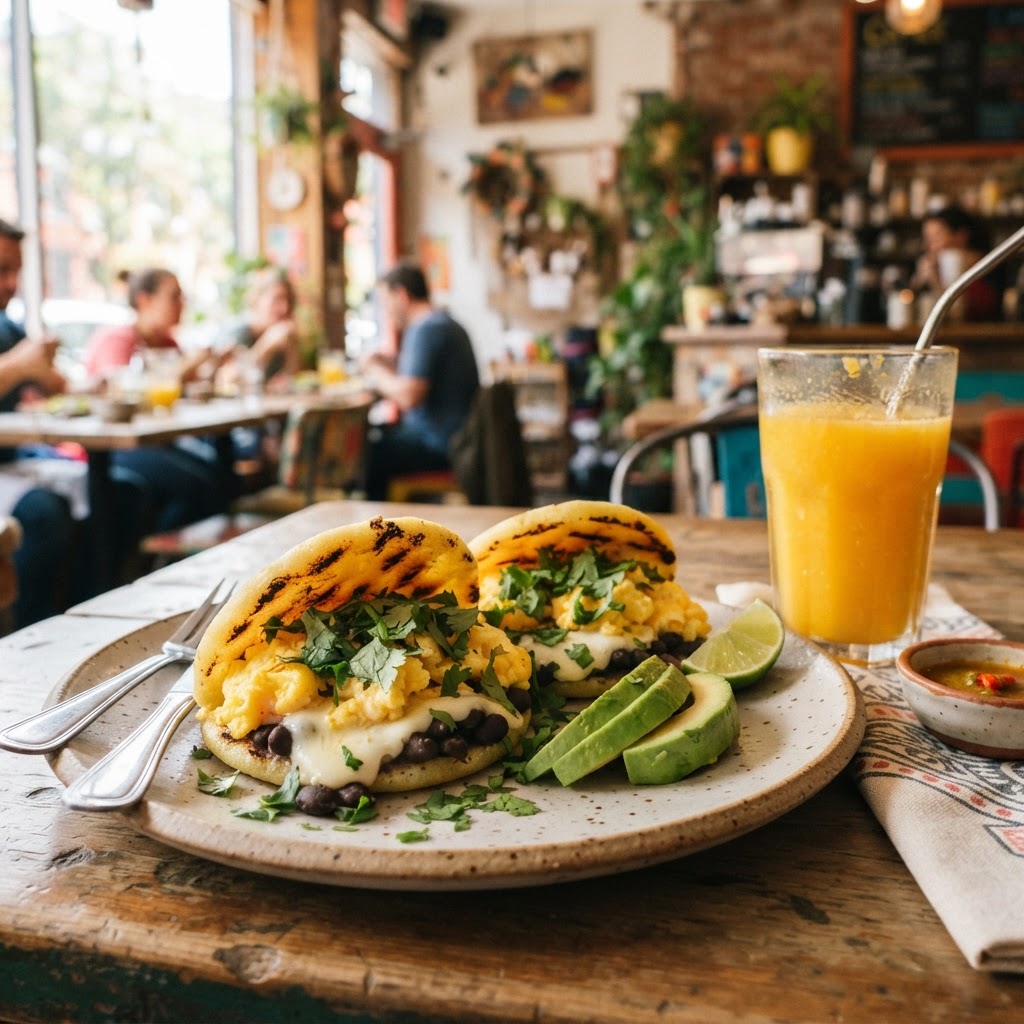
Our Mimosavated version makes classic Venezuelan-style arepas — thick, split open, and stuffed with scrambled eggs, white cheese, and black beans — and pairs them with a bright, refreshing mimosa.
Ingredients (serves 4):
The Arepas: - 8 ⅞ oz pre-cooked white cornmeal (harina de maíz precocida, such as P.A.N. brand) - 1 ¼ cups warm water - 1 teaspoon salt - 2 tablespoons vegetable oil (for the dough) - 2–3 tablespoons vegetable oil (for griddling)
The Filling — Scrambled Eggs with Cheese: - 6 large eggs - 3 ⅓ tbsp milk - 1 tablespoon butter - 3 ½ oz white cheese (queso blanco, feta, or mozzarella), crumbled or grated - Salt and pepper to taste - 2 tablespoons fresh cilantro, chopped (for garnish)
The Optional Fillings: - 7 oz cooked black beans (canned, drained and warmed) - 1 avocado, sliced - Hot sauce, for serving
Making the Arepa Dough: In a large bowl, combine the pre-cooked cornmeal and salt. Gradually add the warm water, stirring with your hands or a spoon, until the dough comes together. Knead for 2–3 minutes until smooth and pliable — the dough should be soft and not crack when you press it. If it's too dry, add a little more water; if too wet, add a little more cornmeal. Stir in 2 tablespoons of oil. Let the dough rest for 5 minutes.
Shaping the Arepas: Divide the dough into 8 equal pieces (about 2 ⅛ oz each). Roll each piece into a ball, then flatten between your palms into a disc about 4 inches in diameter and ⅓ in (½ inch) thick. Smooth the edges with your fingers to prevent cracking.
Griddling the Arepas: Heat 2–3 tablespoons of oil in a large non-stick skillet over medium heat. Place the arepas in the pan — don't crowd them, cook in batches. Cook for 5–7 minutes per side, until golden brown and crispy on both sides. The arepas should have a nice crust but still be slightly soft when you press them.
Transfer the griddled arepas to a 356°F (350°F) oven and bake for 10 minutes — this finishes cooking the inside and gives them a slight puff. Remove from the oven.
Making the Scrambled Eggs: In a bowl, whisk together the eggs, milk, salt, and pepper. Heat the butter in a non-stick skillet over low-medium heat. Pour in the eggs and cook gently, stirring slowly with a spatula, until soft curds form — about 3–4 minutes. Don't overcook — the eggs should be soft and creamy. Remove from heat and gently fold in the crumbled cheese.
Assembling: Using a sharp knife, carefully slice each arepa horizontally about three-quarters of the way through — like a pita pocket. Open it gently. Fill each arepa generously with the scrambled eggs and cheese. Add black beans, sliced avocado, and hot sauce if desired. Garnish with fresh cilantro.
Serving: Serve immediately, while the arepas are warm and crispy and the eggs are soft and cheesy. Eat with your hands — that's the traditional way.
The Mimosa Pairing Logic: Arepas with eggs are savory, hearty, and comforting. The ideal mimosa pairing is a classic Prosecco mimosa — orange juice and Prosecco. The bright, acidic citrus cuts through the richness of the cheese and the eggs, while the Prosecco's effervescence provides a refreshing contrast. A mango mimosa is also excellent — the tropical mango complements the Latin American flavors of the dish. Avoid heavy or bitter mimosas — the dish is warm and comforting, and you need something bright and refreshing to balance it.
Reference Links: - Arepa on Wikipedia (pre-Columbian, Colombia/Venezuela/Panama): Wikipedia - This Food in History: Arepas (pre-Columbian, Timoto-Cuica): Uncultured Palate - Cooking our Culture: Arepas from Colombia (pre-Columbian origins): The Park Community - Cooking Heritage: Colombian-Venezuelan Arepas (indigenous origins): WSAV - History of Arepa Timeline (pre-Columbian, archaeology): History Maps
Make-Ahead: The arepa dough can be made up to 1 day ahead and refrigerated — let it come to room temperature before shaping. The shaped, uncooked arepas can be refrigerated for up to 4 hours before griddling. Cooked arepas can be kept warm in a 302°F/300°F oven for up to 30 minutes. The scrambled eggs should be made just before serving — they don't hold well. Reheat leftover arepas in a dry skillet over medium heat for 2 minutes per side to restore the crispness — do not microwave. The cooked arepas can be frozen for up to 1 month — reheat from frozen in a 356°F/350°F oven for 10–12 minutes, then split and fill.
Pro Tips: Use pre-cooked cornmeal (harina de maíz precocida) — regular cornmeal or corn flour will not work; the pre-cooked cornmeal is specifically processed for arepas and is essential. P.A.N. is the most common brand. The water should be warm — warm water helps the cornmeal absorb moisture evenly and produces a smoother, more pliable dough. Knead the dough well — under-kneaded dough will be crumbly and the arepas will crack. The dough should be smooth and hold together when you press it. Let the dough rest for 5 minutes — this allows the cornmeal to fully hydrate. Shape the arepas with damp hands — this prevents the dough from sticking and helps create a smooth surface. Don't make them too thick — very thick arepas won't cook through on the griddle; ⅓ in (½ inch) is ideal. The oven step is important — griddling alone won't fully cook the inside, and the oven gives them their characteristic slight puff. Cook the eggs gently — low heat and slow stirring produce soft, creamy curds; high heat makes them tough and rubbery. Split the arepas carefully — use a sharp knife and don't cut all the way through; you want a pocket, not two separate discs. Fill generously — the ratio of arepa to filling should be roughly equal, and the filling should be overflowing.
Rate this recipe
Be the first to rate this recipe
to submit your rating.
Recent Posts

Couscous Royale: North Africa's Grand Platter of Lamb, Chicken, and Merguez
October 14, 2026

Seattle Cream Cheese Dog Bites: Hadley Long's 1989 Pioneer Square Invention
October 14, 2026

Khao Soi: Chiang Mai's Northern Thai Coconut Curry Noodles
October 13, 2026

Korean Bibimbap: Jeonju's Joseon Dynasty Mixed Rice
October 11, 2026

Spaghetti alla Carbonara: Rome's World War II Pasta of Eggs, Guanciale, and Pecorino
October 9, 2026