Amaretti al Brachetto
June 6, 2026
In 1719, a cardinal from Milan visited the church of Saronno, a small town in Lombardy north of Milan. A young couple of the town welcomed him, and to mark the occasion they baked a batch of cookies from what they had on hand: sugar, egg whites, and apricot kernels. The cardinal was delighted and blessed the couple. The cookies stayed in Saronno, and the name they carry, *amaretti*, means "little bitter things" in Italian, a nod to the bittersweet character the apricot kernels give them.
The Lazzaroni family of Saronno began producing the cookies commercially in 1851, and Lazzaroni Amaretti di Saronno remains one of the oldest cookie brands in Italy, still wrapped in its characteristic tissue paper. A good amaretto is crisp on the outside and chewy within, intensely aromatic, the kind of cookie you eat with your eyes closed.
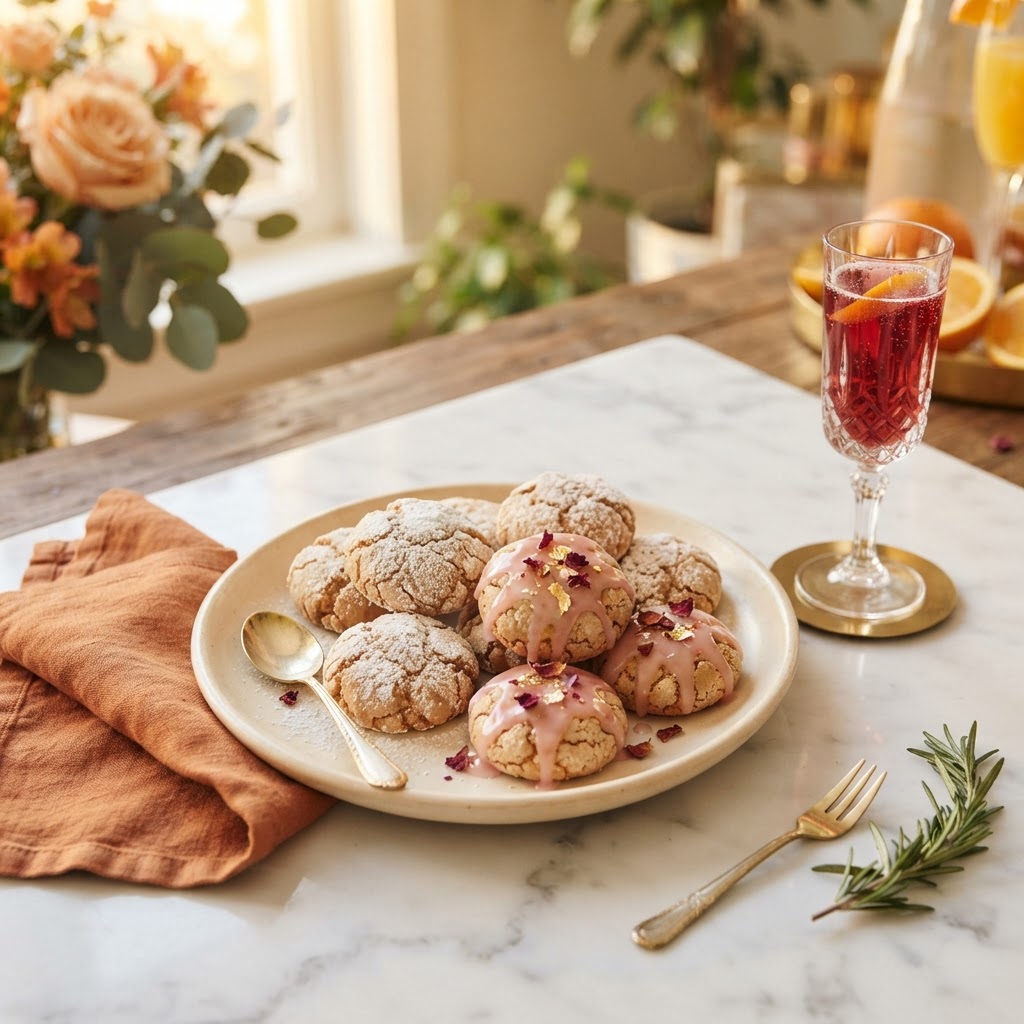
Our Mimosavated version keeps the traditional amaretto base and adds a Brachetto d'Acqui glaze, a reduction of the sweet, sparkling red wine from Piedmont brushed over the cookies while they are still warm. The glaze gives a glossy sheen, a hint of pink, and a delicate strawberry-rose aroma that plays against the almond's bittersweet intensity.
Ingredients (makes about 24 amaretti):
The Amaretti: - 10.6 oz almond flour (or finely ground blanched almonds) - 8 ⅞ oz granulated sugar - 3 large egg whites - 1 teaspoon almond extract (or ½ teaspoon bitter almond extract, if available) - 1 teaspoon vanilla extract - Zest of 1 lemon (unwaxed, organic) - A pinch of salt - Powdered sugar, for rolling
The Brachetto Glaze: - ⅔ cup Brachetto d'Acqui (sweet sparkling red wine) - 1 ¾ oz granulated sugar - 1 teaspoon cornstarch (to thicken)
Making the Amaretti: Preheat the oven to 320°F (325°F). Line two baking sheets with parchment paper.
In a large bowl, combine the almond flour, granulated sugar, lemon zest, and salt. Mix well. In a separate bowl, whisk the egg whites until they form soft peaks. Add the almond extract and vanilla extract to the egg whites. Gently fold the egg whites into the dry mixture until a soft, sticky dough forms.
Place the powdered sugar in a shallow bowl. Roll tablespoonfuls of dough into balls, then roll each ball in the powdered sugar until fully coated. The powdered sugar creates the characteristic crackly top as the cookies bake and spread. Place on the prepared baking sheets, leaving about 2 inches between each cookie.
Bake for 15-18 minutes, until the cookies are cracked on top, set at the edges, and still slightly soft in the center. They should be pale golden — don't let them brown too much or they'll become hard. Let cool on the baking sheet for 5 minutes, then transfer to a wire rack to cool completely.
Making the Brachetto Glaze: While the cookies are cooling, make the glaze. Pour the Brachetto d'Acqui into a small saucepan. Bring to a gentle simmer and reduce by half — about 10 minutes. Add the sugar and stir until dissolved. Mix the cornstarch with a tablespoon of cold water to make a slurry, then whisk it into the reduced Brachetto. Cook for 1 more minute, stirring constantly, until the glaze thickens to a syrupy consistency. Remove from heat and let cool slightly — it should be warm but not hot when you apply it.
Glazing the Amaretti: Using a small pastry brush, lightly brush the top of each cooled amaretto with the warm Brachetto glaze. The glaze should form a thin, glossy, slightly pink-tinted layer. Let the glaze set for about 30 minutes before serving — it will firm up to a beautiful satin finish.
The Mimosa Pairing Logic: The Brachetto glaze makes a raspberry mimosa the natural pairing — the raspberry echoes the Brachetto's strawberry-rose character. A rosé mimosa is also lovely, as the rosé's soft fruit complements the almond's bittersweet intensity. For something bolder, a peach mimosa adds a warm, stone-fruit sweetness that plays beautifully against the almond. The key is to choose a mimosa with enough fruit to complement the almond's intensity but enough acidity to balance the cookie's sweetness.
Reference Links: - Amaretti history and Saronno origins: Giadzy - History of the Italian amaretti biscuit: Robins and Sons - Brachetto d'Acqui wine guide: Wine Folly - Lazzaroni amaretti of Saronno: Wikipedia - Macaron vs. amaretti technique: King Arthur Baking
Make-Ahead: The amaretti dough can be made a day ahead and refrigerated; let it come to room temperature before shaping. The baked, unglazed amaretti can be stored in an airtight container for up to 2 weeks. The Brachetto glaze can be made up to 3 days ahead and refrigerated; gently reheat before using. Once glazed, the amaretti are best within 3-4 days — the glaze keeps the cookies softer than unglazed ones.
Pro Tips: The quality of the almond flour determines the quality of the amaretti. Use finely ground, blanched almond flour — coarse or unblanched almonds make the cookies gritty. The egg whites should be at room temperature and whipped to soft peaks, not stiff — over-whipped whites make the cookies tough. The powdered sugar coating is essential — it creates the crackly top. Don't skimp on it. The cookies will seem too soft when they come out of the oven; they firm up as they cool. Don't overbake — the center should remain slightly chewy. The Brachetto glaze should be applied warm — if it's too cool, it won't spread evenly. If it's too hot, it will soak into the cookies rather than sitting on top. If you can't find Brachetto d'Acqui, you can substitute a sweet rosé wine or a Moscato, though the flavor will be slightly different.
Rate this recipe
Be the first to rate this recipe
to submit your rating.
Recent Posts

Couscous Royale: North Africa's Grand Platter of Lamb, Chicken, and Merguez
October 14, 2026

Seattle Cream Cheese Dog Bites: Hadley Long's 1989 Pioneer Square Invention
October 14, 2026

Khao Soi: Chiang Mai's Northern Thai Coconut Curry Noodles
October 13, 2026

Korean Bibimbap: Jeonju's Joseon Dynasty Mixed Rice
October 11, 2026

Spaghetti alla Carbonara: Rome's World War II Pasta of Eggs, Guanciale, and Pecorino
October 9, 2026