Culture
The Venice Carnival: Masks, Mystery, and the Serenissima's Pre-Lenten Festival Revived in 1979
With medieval origins traced to a 1162 Venetian victory and a golden age in the Baroque era, the Venice Carnival was outlawed in 1797 and famously revived in 1979 — now drawing three million visitors a year to its masked spectacle.
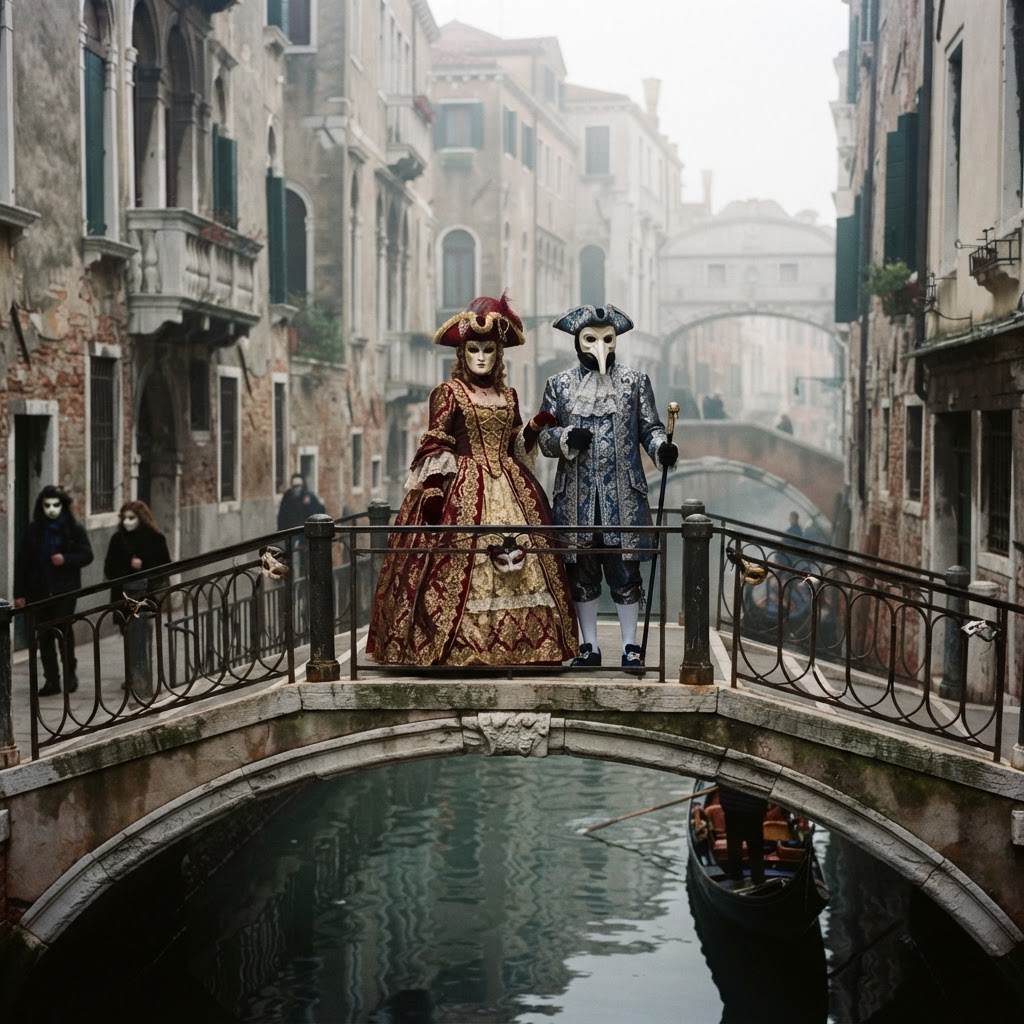
If you want to understand the Venetian genius for spectacle, come to Venice in the weeks before Lent. The Carnevale di Venezia — the Venice Carnival — is the annual pre-Lenten festival famous the world over for its elaborate masks and costumes, a tradition whose legend reaches back to the medieval Venetian Republic and whose modern form draws some three million visitors a year.
**Origins**
According to legend, the Carnival began after the Venetian Republic's military victory over the Patriarch of Aquileia, Ulrich II, in 1162, when the people gathered to dance in St. Mark's Square. As Wikipedia records, the festival became official during the Renaissance, reached its baroque height in the seventeenth and eighteenth centuries, and was famed for encouraging license and anonymity: under the mask, sumptuary laws were suspended, and Venetians of every class could mingle, gamble, and disguise themselves. Maskmakers — the mascherari — had their own guild, with a statute dated 1436. The earliest documented rules on masks date to the thirteenth century. But in 1797, under Habsburg rule, the festival was outlawed entirely and the use of masks forbidden. It reappeared only fitfully in the nineteenth century.
**The Revival**
After a long absence, the modern Carnival returned in 1979, when the Italian government sought to restore the history and culture of Venice and used the traditional Carnival as the centerpiece of its efforts. The redevelopment of the masks began among Venetian college students serving the tourist trade. Today the festival's centerpiece is the contest for "la maschera più bella" — the most beautiful mask — judged by a panel of international costume and fashion designers. Distinct styles of mask, each with its own history, are still worn: the Bauta, the Moretta, the Volto, the Gnaga.
**Why It Matters**
The Venice Carnival is the great masked festival of Europe — an event where a city becomes an open-air theatre and anonymity becomes an art form. Behind the masks lies a Venetian idea as old as the Republic itself: that for a few days a year, the hierarchies of rank could be set aside, and a person could be, simply, no one in particular.
**References**
- Wikipedia: Carnival of Venice — https://en.wikipedia.org/wiki/Carnival_of_Venice
- Venice Carnival (official) — https://carnevale.venezia.it/en/



Continue Reading


