Culture
The Van Gogh Museum: Amsterdam's Home to the World's Largest Van Gogh Collection
The Van Gogh Museum in Amsterdam, opened on 2 June 1973, holds the largest collection of Vincent van Gogh's work in the world — over 200 paintings, 500 drawings, and 750 letters. From the Sunflowers to The Bedroom, this is the definitive guide to the museum that preserves the legacy of art's most beloved painter.
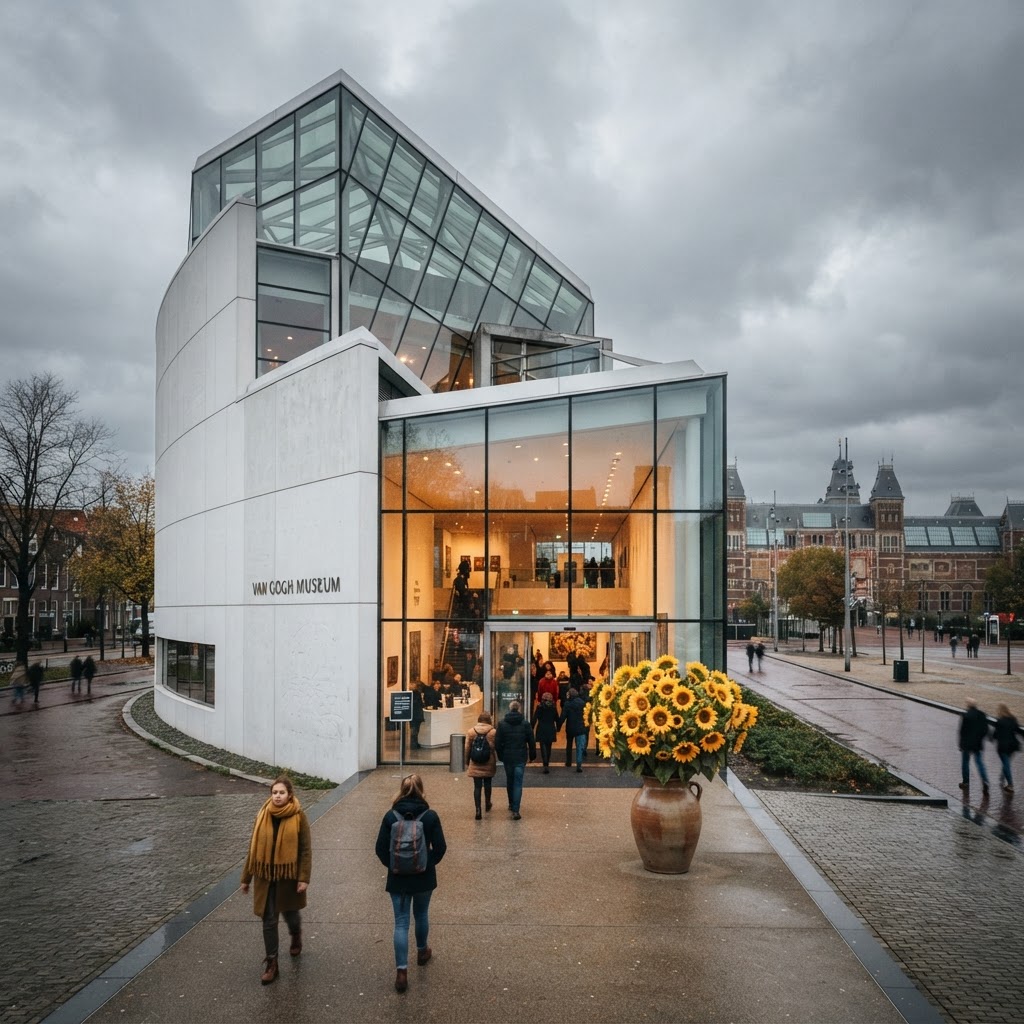
The Van Gogh Museum (vangoghmuseum.nl) in Amsterdam, the Netherlands, is dedicated to the life and work of the Dutch Post-Impressionist painter Vincent van Gogh (1853–1890) and is the most visited museum in the Netherlands, receiving approximately 2.1 million visitors annually. It holds the largest collection of Van Gogh's work in the world — over 200 paintings, 500 drawings, and 750 personal letters — assembled largely from the collection of Van Gogh's younger brother, the art dealer Theo van Gogh (1857–1891), and from the collection of Theo's widow, Jo van Gogh-Bonger.
The collection passed to Theo's son, Vincent Willem van Gogh (named after his uncle), who lent the works to the Stedelijk Museum in Amsterdam for decades before the Dutch state agreed to build a dedicated museum. The Van Gogh Museum opened on 2 June 1973, in a building designed by the De Stijl architect Gerrit Rietveld (1888–1964), who died before the building was completed. The building — a striking composition of white concrete and glass, with an elliptical staircase at its core — was Rietveld's last major work. An exhibition wing, designed by Kisho Kurokawa, was added in 1999. Reference: [Van Gogh Museum — History](https://www.vangoghmuseum.nl/en/visit/about-the-museum)
The Collection
The museum's collection is organised chronologically, tracing Van Gogh's artistic development from his early, dark Dutch-period works through the luminous paintings of his years in Paris, Arles, Saint-Rémy, and Auvers-sur-Oise. The progression is one of the most dramatic in art history: Van Gogh began painting seriously only at the age of 27 (in 1880) and produced his entire body of work in just ten years before his death at 37.
**The Potato Eaters (1885)** — Van Gogh's first major work, painted in the village of Nuenen in the Brabant region of the Netherlands. The dark, earthy palette and the depiction of a peasant family at their meagre meal reflect Van Gogh's early ambition to be a painter of rural life. The painting is a deliberate challenge to the polished Salon painting of the era.
**The Sunflowers (1888–89)** — the museum holds several of the celebrated series of sunflower paintings that Van Gogh made in Arles in the south of France, in anticipation of the arrival of his friend Paul Gauguin. The yellow-on-yellow compositions, made possible by the newly invented chrome yellow pigment, are among the most recognised paintings in the world. The museum's version of the Sunflowers (the third version, painted in January 1889) is one of its most celebrated works.
**The Bedroom (1888)** — Van Gogh's painting of his own bedroom in the Yellow House in Arles, painted in October 1888. The flattened perspective and the bold, clashing colours of the furniture and walls are characteristic of Van Gogh at the height of his powers. The museum holds the first of three versions of this painting.
**Wheatfield with Crows (1890)** — often, though incorrectly, identified as Van Gogh's last painting, this dramatic canvas — a stormy sky over a golden wheatfield with a flight of crows — was painted in July 1890, weeks before Van Gogh's death at Auvers-sur-Oise on 29 July 1890. It is one of the most powerful and debated paintings in the collection.
The Letters
The museum's collection of approximately 750 letters — primarily the correspondence between Vincent and Theo van Gogh — is one of the most extraordinary documentary records of any artist's life. The letters, which span from 1872 to Vincent's death in 1890, reveal Van Gogh's thoughts on art, literature, philosophy, and his own artistic development, and have been published in a complete scholarly edition (vangoghletters.org). The letters contain sketches of many of the paintings, making the correspondence an unparalleled record of the creative process.
Practical Information
The Van Gogh Museum is located on the Museumplein (Museum Square) in Amsterdam, between the Rijksmuseum and the Stedelijk Museum. It is open daily. Advance online booking is essential — the museum operates a timed-entry system and tickets frequently sell out, particularly during the high season. Tickets cost approximately €22 for adults, with free entry for visitors under 18. The museum is accessible by tram (lines 2, 5, 12) to the Van Baerlestraat stop. Reference: [Van Gogh Museum Official](https://www.vangoghmuseum.nl/en)
Reference Links:
- Van Gogh Museum: vangoghmuseum.nl/en
- About the Museum: vangoghmuseum.nl/en/visit/about-the-museum
- Van Gogh Letters (complete edition): vangoghletters.org
- Rijksmuseum Amsterdam: rijksmuseum.nl
- Amsterdam Tourism: iamsterdam.com
- Museumplein Amsterdam: museumpleinamsterdam.com
- Netherlands Tourism: holland.com



Continue Reading


