Culture
Tokyo's Digital Art Revolution: teamLab and the New Cultural Frontier
In Tokyo, a collective of artists, engineers, and programmers has created something genuinely new in art history — immersive digital worlds that challenge every assumption about what art can be.
In the long and varied history of art, certain moments stand as genuine ruptures — moments when the form itself is irrevocably changed by a new approach, a new technology, or a new way of thinking about what art is and does. The work of teamLab — the Tokyo-based collective of artists, programmers, engineers, architects, and CGI animators founded in 2001 — may represent such a moment.
teamLab's large-scale digital installations, which have been experienced by over 15 million people across their permanent and temporary venues worldwide, dissolve the boundary between viewer and artwork in ways that have no precedent in Western art history but significant resonance with Japanese aesthetic traditions of immersive, participatory experience.
**teamLab Borderless and Planets**
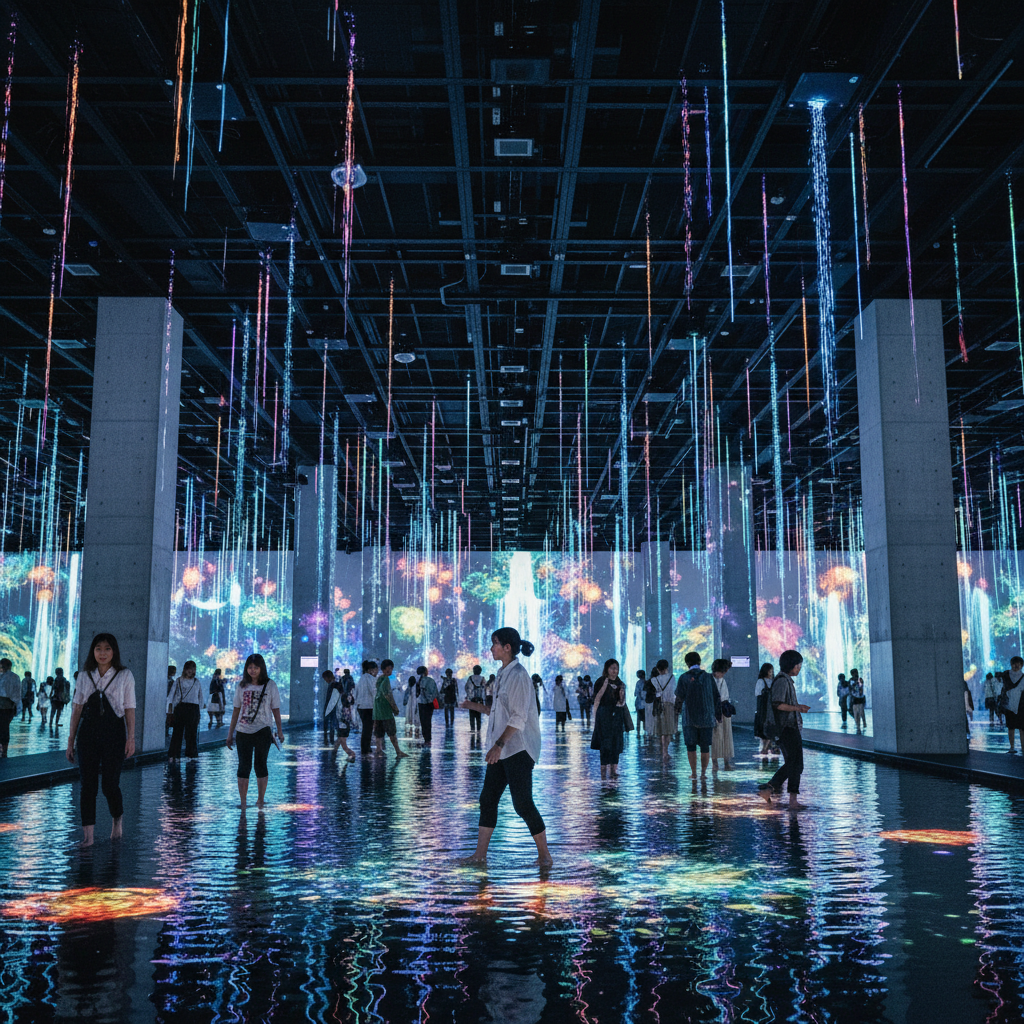
teamLab Planets Tokyo (planets.teamlab.art) in the Toyosu district is one of the most visited art venues in Japan and, by many measures, the most emotionally affecting art experience available anywhere in the world. Visitors wade through shallow water filled with digital koi that respond to human movement, stand in rooms where flowers bloom and fall in response to touch, and walk through spaces where their own bodies become part of the work. The technology is astonishing; more astonishing still is that it never feels like technology — it feels like magic, or like nature, or like a dream that you are sharing with a room full of strangers who have become, for the duration of the experience, fellow participants in something genuinely new.
teamLab Borderless (borderless.teamlab.art) — originally at Odaiba, now operating at Azabudai Hills — is the larger permanent installation, comprising 60-plus interconnected works across a labyrinthine building with no fixed routes, no beginning and no end.
Tickets for both venues should be booked well in advance at the respective websites. Weekend slots sell out weeks ahead.
**The Mori Art Museum**
On the 53rd floor of Roppongi Hills Mori Tower, the Mori Art Museum (mori.art.museum) presents the most consistently ambitious contemporary art programming in Asia. Its exhibitions have introduced Japanese audiences to major international artists and have given international audiences their most sustained engagement with Japanese and Asian contemporary art. The permanent collection is small but carefully chosen; the temporary exhibitions are consistently essential. The museum's location — accessible via the same ticket as the Tokyo City View observation deck — makes an evening visit, with Tokyo spread beneath you in every direction, extraordinarily memorable.
**The Broader Scene**
Tokyo's contemporary art scene extends well beyond these flagship destinations. Gallery Perrotin (perrotin.com/location/tokyo) and Pace Gallery (pacegallery.com/galleries/tokyo) operate significant spaces in the city; both represent artists of the very highest international calibre. The National Art Center Tokyo (nact.jp) in Roppongi — the largest exhibition space in Japan, with no permanent collection — presents major survey exhibitions on a scale unavailable elsewhere in Asia.
Azabudai Hills, the ambitious mixed-use development completed in 2023, has established itself as a new cultural hub: alongside teamLab Borderless, it houses the Judd Foundation's first Asian space, gallery programming from Glenstone and other institutions, and a public art programme of exceptional quality.
**The Tradition Behind the Innovation**
What makes teamLab's work particularly legible within Japanese culture is its relationship to traditional Japanese aesthetics — mono no aware (the pathos of impermanence), ma (the significance of negative space), and the Zen-influenced tradition of art as meditation. The digital flowers that bloom and fall in response to human presence are not merely spectacular; they are philosophical, rooted in a centuries-old understanding of nature, time, and the place of human beings within both.
Tokyo has always been a city in productive conversation with its own contradictions — ancient and ultramodern, rigorously traditional and radically experimental. Its art scene is the most visible expression of that conversation, and it is one of the most exciting cultural environments on earth.

Continue Reading