Culture
The Tate Modern: London's Cathedral of Contemporary Art
Housed in a converted 1947 power station on the south bank of the Thames, the Tate Modern opened in 2000 to become one of the world's largest museums of modern and contemporary art — and the most popular art gallery in the United Kingdom, with its free collection and legendary Turbine Hall.
If you want to understand how Britain learned to love modern art, go to the Tate Modern. Opened in 2000 in the converted Bankside Power Station on the south bank of the Thames, the Tate Modern is the United Kingdom's national collection of international modern and contemporary art — and one of the largest museums of modern art in the world. Its admission is free, its Turbine Hall installations are legendary, and it is now the most visited art gallery in the United Kingdom, drawing 4.5 million visitors a year.
**The Building**
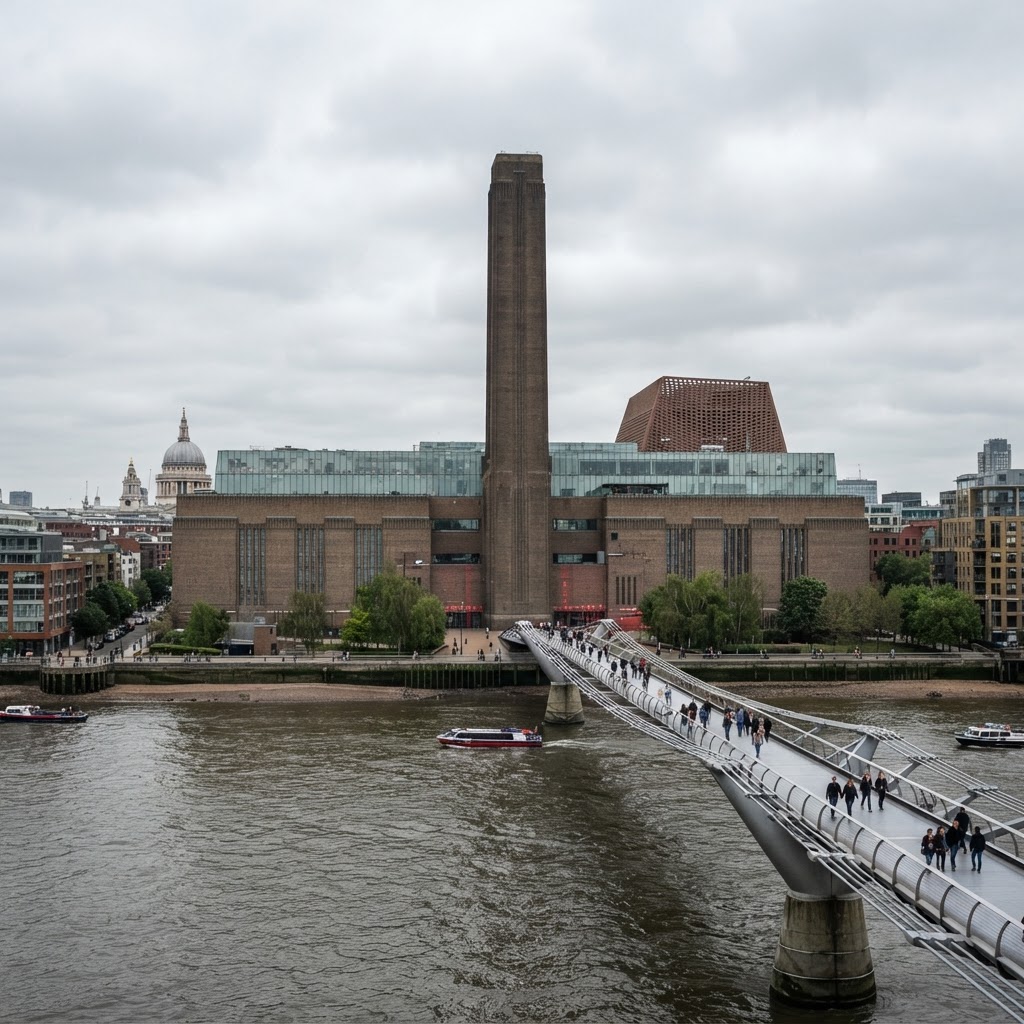
The Tate Modern occupies the former Bankside Power Station, a 660-foot-long brick-clad building designed by Sir Giles Gilbert Scott — the architect also of Battersea Power Station — and built in two stages between 1947 and 1963. As Wikipedia records, the power station closed in 1981, and for years it sat at risk of demolition until the Tate announced in April 1994 that Bankside would be the home of the new Tate Modern. An international competition was launched, and the Swiss architects Jacques Herzog and Pierre de Meuron of Herzog & de Meuron were chosen in January 1995. The 134-million-pound conversion began in June 1995 and was completed in January 2000.
The architects' genius was to preserve the building's industrial character while transforming it for art. The vast Turbine Hall — once housing the power station's turbines and retaining its overhead traveling crane — became the museum's dramatic entrance and the site of its monumental commissioned installations. The Switch House extension, completed in 2016, added a twisted brick tower with galleries and viewing platforms. The two-story glass lightbox on the roof, the museum's most visible signature, is visible across the Thames.
**The Collection**
The Tate Modern's collection consists of works of international modern and contemporary art dating from 1900 to the present, shown across the Boiler House and the Switch House in thematic and chronological displays. The galleries hold masterpieces of the modern canon — Picasso's *The Three Dancers*, Matisse's *The Snail*, Dali's *Lobster Telephone*, Warhol's *Marilyn* — alongside the work of contemporary artists including Yayoi Kusama, Agnes Martin, Louise Bourgeois, and Ai Weiwei. The Turbine Hall has hosted some of the most ambitious contemporary installations of the 21st century, from Olafur Eliasson's *The Weather Project* to Rachel Whiteread's *Embankment* and Ai Weiwei's *Sunflower Seeds*.
**Part of the Tate**
The Tate Modern is one of four galleries in the Tate group, alongside Tate Britain (the national collection of British art from 1500 to the present, at Millbank), Tate Liverpool, and Tate St Ives. Like the UK's other national galleries and museums, it charges no admission for access to the permanent collection displays, which take up the majority of the gallery space; tickets are sold only for the major temporary exhibitions.
**Why It Matters**
The Tate Modern proved that industrial buildings could be sublime homes for contemporary art, and that modern art — once a harder sell in Britain — could draw the crowds of a blockbuster. It transformed the South Bank, anchoring a regeneration of Bankside that now includes the Millennium Bridge to St Paul's Cathedral. And it confirmed that free admission and bold architecture could make a modern art museum one of the most popular cultural institutions in the world.
**References**
- Tate Modern: Plan your visit — https://www.tate.org.uk/visit/tate-modern
- Wikipedia: Tate Modern — https://en.wikipedia.org/wiki/Tate_Modern
- Bankside Power Station (history) — https://en.wikipedia.org/wiki/Bankside_Power_Station



Continue Reading


