Culture
The Smithsonian Institution: America's Attic and the World's Largest Museum Complex
Founded in 1846 with a bequest from British scientist James Smithson, the Smithsonian Institution encompasses 21 museums and the National Zoo. From the Star-Spangled Banner to the Apollo 11 command module, it preserves the artifacts that define the American story — and admission is free.
The Smithsonian Institution (si.edu) in Washington, D.C., is the world's largest museum, education, and research complex. Founded by an Act of Congress on 10 August 1846, the institution traces its origins to an extraordinary bequest: James Smithson (1765–1829), a British chemist and mineralogist who had never visited the United States, left his estate of 104,960 gold sovereigns (approximately $500,000, equivalent to about $15 million today) to the United States 'to found at Washington, under the name of the Smithsonian Institution, an establishment for the increase and diffusion of knowledge.'
Smithson's bequest was delivered to the United States in 1838 in the form of 11 boxes containing 105 bags of gold sovereigns. After years of debate in Congress about how to use the funds, the Smithsonian Institution was finally established in 1846, with the physicist Joseph Henry as its first Secretary.
The Castle
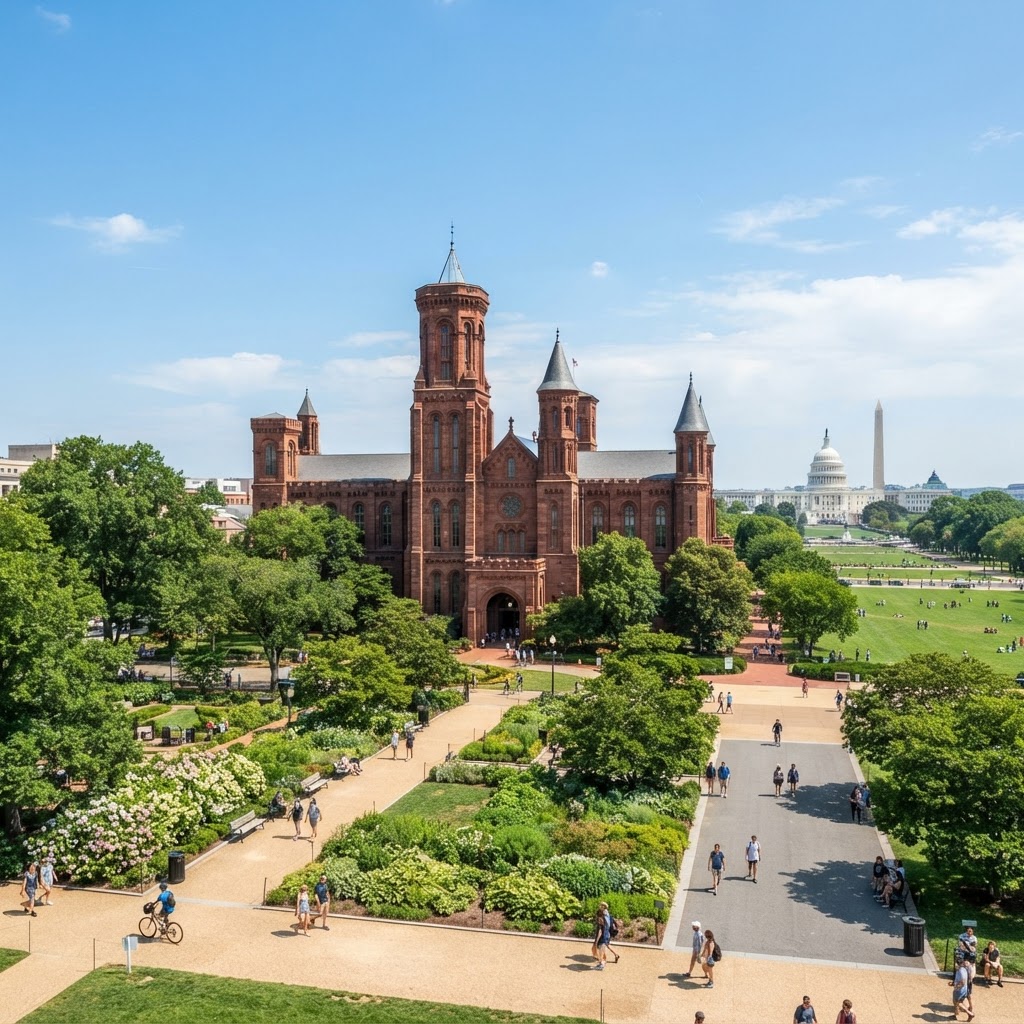
The institution's first building, the Smithsonian Institution Building — universally known as 'the Castle' — was designed by James Renwick Jr. in the Romanesque Revival style and completed in 1855. Built of distinctive red Seneca sandstone quarried in Maryland, the Castle sits on the National Mall and serves as the institution's information center and headquarters. The building was badly damaged by fire in 1865, destroying Smithson's own mineral collection and much of the early holdings.
Today, the Smithsonian encompasses 21 museums and the National Zoo, with 17 museums clustered along or near the National Mall in Washington, D.C. Admission to all Smithsonian museums is free, a principle that has been maintained since the institution's founding.
The National Mall Museums
The most visited museums on the National Mall include:
**The National Museum of American History** — home to the Star-Spangled Banner (the flag that inspired Francis Scott Key's anthem in 1814), the ruby slippers from 'The Wizard of Oz' (1939), Abraham Lincoln's top hat, and the Apollo 11 command module Columbia.
**The National Museum of Natural History** — the most visited natural history museum in the world, housing 146 million specimens and artifacts. Its centerpiece is the Hope Diamond, a 45.52-carat blue diamond mined in India and donated by Harry Winston in 1958. The museum's dinosaur collection, including a T. rex specimen, is among the finest in the world.
**The National Air and Space Museum** — the world's largest collection of historic aircraft and spacecraft, including the Wright Brothers' 1903 Flyer, Charles Lindbergh's Spirit of St. Louis, and the Apollo 11 command module.
**The National Museum of African American History and Culture** (NMAAHC) — the newest Smithsonian museum, opened on 24 September 2016. Designed by David Adjaye, the building's distinctive three-tiered bronze corona was inspired by Yoruba carved wood columns. The museum's collection spans the entire sweep of African American history from slavery to the present.
**The Smithsonian American Art Museum** (SAAM) and the **National Portrait Gallery** — housed together in the Old Patent Office Building, these two museums hold the largest collection of American art and portraiture in the world.
**The National Museum of the American Indian** — dedicated to the life, languages, literature, history, and arts of Native Americans, with collections spanning the Western Hemisphere from Tierra del Fuego to the Arctic.
The Research Mission
Beyond its museums, the Smithsonian operates nine research centers, including the Smithsonian Astrophysical Observatory (founded in 1890, now based in Cambridge, Massachusetts), the Smithsonian Tropical Research Institute in Panama, and the Smithsonian Environmental Research Center in Maryland. The institution's research output is enormous: Smithsonian scientists have described over 5,000 species new to science.
Practical Information
The Smithsonian museums are open daily (except 25 December) with free admission. The National Mall museums are within walking distance of each other, stretching from 3rd to 14th Streets between Constitution and Independence Avenues. The nearest Metro stations are Smithsonian and L'Enfant Plaza. Reference: [The Smithsonian Institution](https://www.si.edu)
Reference Links:
- The Smithsonian Institution: si.edu
- Museum Directory: si.edu/visit/museums
- Smithsonian History: si.edu/about/history
- Plan Your Visit: si.edu/visit
- National Mall (NPS): nps.gov/nama
- Washington.org: washington.org


Continue Reading