Culture
The Palais Garnier: Paris's Opulent Opera Palace and the Home of the Phantom
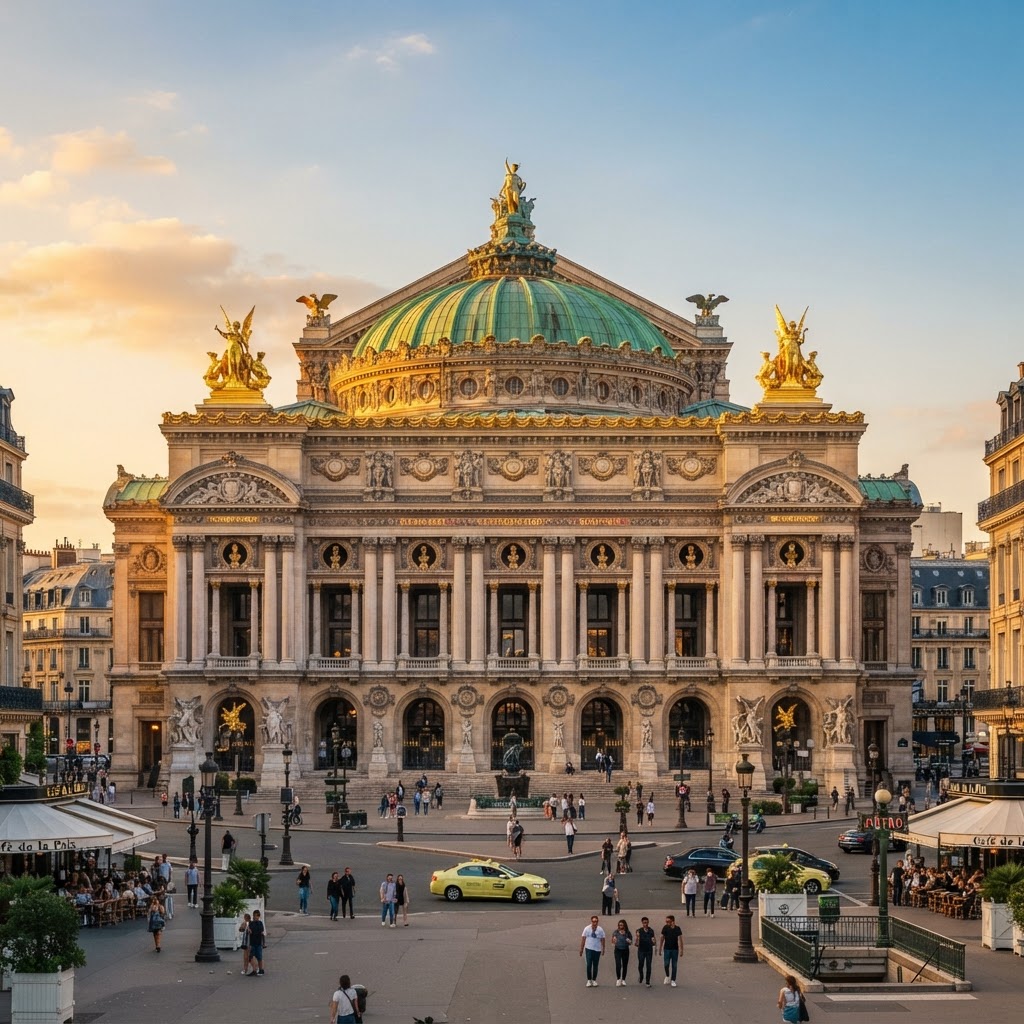
The Palais Garnier, completed in 1875 to designs by Charles Garnier, is probably the most famous opera house in the world. A masterpiece of Second Empire opulence, it inspired Gaston Leroux's 'The Phantom of the Opera' and remains the symbol of Parisian cultural grandeur.
The Palais Garnier (operadeparis.fr), also known as the Opéra Garnier, at the Place de l'Opéra in the 9th arrondissement of Paris, is probably the most famous opera house in the world. Completed in 1875 to the designs of the architect Charles Garnier (1825–1898), the 1,979-seat theatre has been called 'a symbol of Paris like Notre Dame Cathedral, the Louvre, or the Sacré-Cœur.' The building has been a listed monument historique of France since 1923.
Commission and Competition
The Palais Garnier was commissioned by Emperor Napoleon III as part of the great Haussmann renovation of Paris. The need for a new opera house became urgent on the night of 14 January 1858, when a group of Italian republicans attempted to assassinate the Emperor outside the old Salle Le Peletier. Napoleon III survived but decided that Paris needed a new, safer opera house.
An architectural competition was announced in 1860, attracting 171 submissions. The selection committee initially favored a design by the established architect Eugène Viollet-le-Duc, but the final decision was made by the Emperor himself, who selected the design by the relatively unknown 35-year-old Charles Garnier. Construction began in August 1861 and was completed in 1875 — 14 years and at a cost of 36 million francs (approximately 290 million euros in today's money).
The Building
The Palais Garnier is the supreme expression of the Napoleon III style — an exuberant blend of Renaissance, Baroque, and classical elements, characterized by rich polychrome decoration, gilding, and sculpture. The facade extends 172 metres along the Place de l'Opéra and features a grand colonnade, elaborate friezes, and groups of sculpture representing Poetry, Idyll, Recitation, Song, Drama, and Music. The roof is crowned by a gilded figure of Apollo and the Muses, while the two gilded groups at either end represent Harmony and Poetry.
The interior is even more lavish. The Grand Foyer, 154 metres long, 13 metres wide, and 18 metres high, was designed as a public promenade where Parisian society could see and be seen during intermissions. Its ceiling, painted by Paul Baudry, depicts themes from the history of music. The Grand Staircase, built of white marble from Saint-Béat, is one of the most celebrated architectural spaces in Paris — a 30-metre-high vestibule with a balustrade of green marble from the Pyrenees and red marble from Languedoc.
The Auditorium and the Chandelier
The auditorium seats 1,979 and is designed in the traditional Italian horseshoe shape. Its ceiling was originally painted by Jules Eugène Lenepveu, but in 1964 the French Minister of Culture, André Malraux, commissioned the artist Marc Chagall to paint a new ceiling depicting scenes from 14 operas and ballets by 14 great composers (Mussorgsky, Mozart, Wagner, Berlioz, Rameau, Debussy, Ravel, Stravinsky, Tchaikovsky, Adam, Bizet, Verdi, Beethoven, and Gluck). The Chagall ceiling, installed on a removable frame above the original Lenepveu ceiling, remains one of the most beloved works of art in Paris.
The auditorium's central chandelier — a 7-ton bronze-and-crystal fixture designed by Garnier himself — weighs 7 tonnes and provides the setting for the famous incident in Gaston Leroux's 1910 novel 'The Phantom of the Opera.' On 20 May 1896, one of the counterweights of the chandelier did in fact fall, killing a concierge named Madame Chomette. This real incident inspired the famous scene in Leroux's novel, and subsequently Andrew Lloyd Webber's 1986 musical, in which the Phantom drops the chandelier onto the audience.
The Phantom of the Opera
Gaston Leroux's novel 'Le Fantôme de l'Opéra' (1910) drew extensively on the real features and legends of the Palais Garnier. The novel's underground lake — a subterranean reservoir beneath the opera house — actually exists: during construction, Garnier discovered that the water table was too high, and he was forced to build a massive cistern to contain the water rather than pump it out. This reservoir, still maintained today, serves as a reservoir in case of fire and is used by the Paris Fire Brigade for training dives. The 'Box 5' reserved for the Phantom is a real box at the Palais Garnier, still occasionally referenced in tours.
Practical Information
The Palais Garnier is open daily for self-guided visits (10:00–17:00, last entry at 16:30) and offers guided tours. The Paris Opera (Opéra national de Paris) continues to present performances at the Palais Garnier, with the primary repertoire now focused on ballet and classical opera. The newer Opéra Bastille (opened 1989) hosts larger-scale productions. Reference: [Opéra national de Paris](https://www.operadeparis.fr)
Reference Links:
- Opéra national de Paris: operadeparis.fr
- Palais Garnier Visitor Information: operadeparis.fr/en/visit/palais-garnier-self-guided-visit
- Palais Garnier History: en.wikipedia.org/wiki/Palais_Garnier
- Paris Tourist Office: parisinfo.com
- Centre des Monuments Nationaux: monuments-nationaux.fr

Continue Reading