Culture
The National Museum of African American History and Culture: A People's Journey on the National Mall
Opened in 2016 as the Smithsonian's newest museum, the NMAAHC is the world's largest institution dedicated to African American history. David Adjaye's bronze-crowned building, rising on the National Mall, houses 40,000 artifacts tracing the American story from slavery through the Civil Rights Movement to the present.
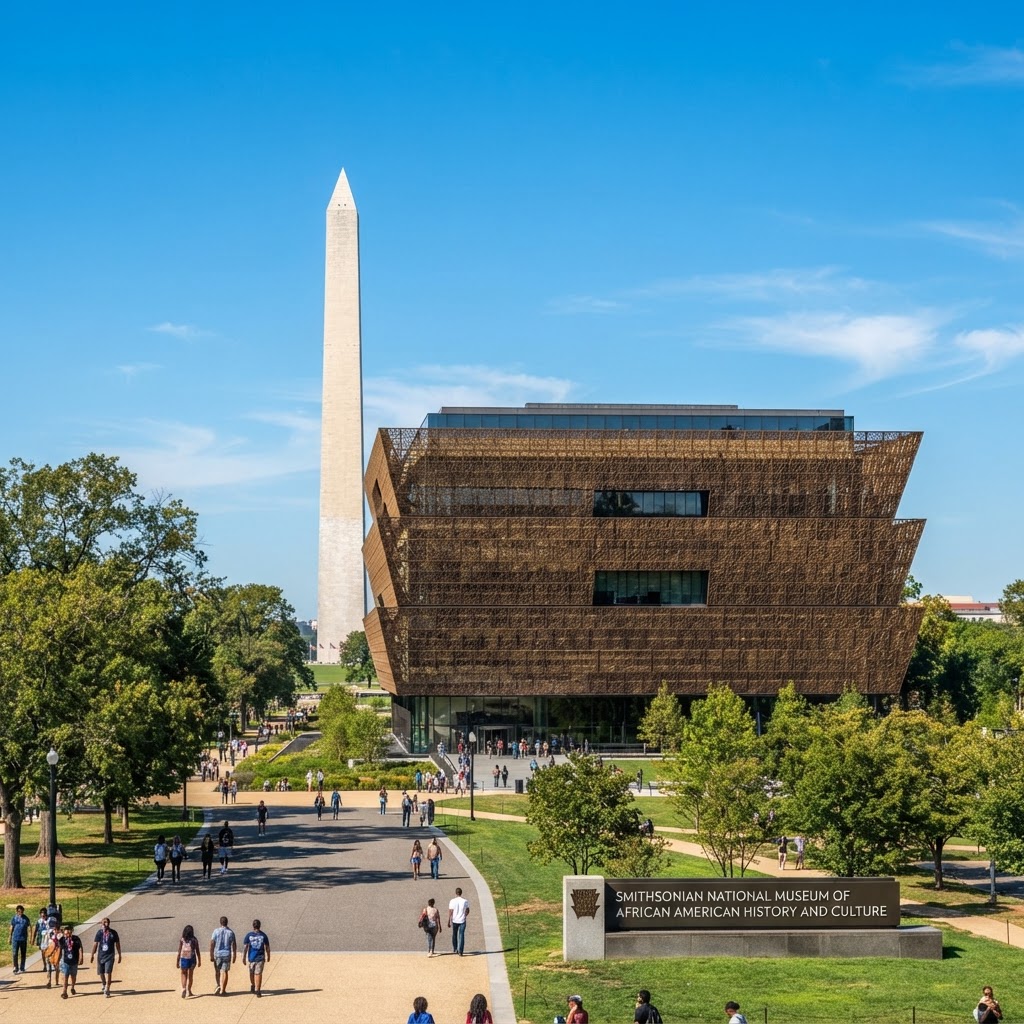
The National Museum of African American History and Culture (nmaahc.si.edu), colloquially known as the 'Blacksonian,' is the newest museum of the Smithsonian Institution and the world's largest museum dedicated to African American history and culture. Located on the National Mall in Washington, D.C., between the Washington Monument and the National Museum of American History, the museum opened on 24 September 2016 in a ceremony presided over by President Barack Obama — the first African American president of the United States.
Origins
The campaign for a national museum of African American history dates to 1915, when African American veterans of the Union Army proposed a memorial to celebrate the 50th anniversary of the end of the Civil War. Over the following decades, numerous proposals were introduced in Congress, but none succeeded until 2003, when President George W. Bush signed the National Museum of African American History and Culture Act, establishing the museum within the Smithsonian Institution.
The museum's founding director, Lonnie G. Bunch III — who later became the 14th Secretary of the Smithsonian Institution in 2019 — led the effort to build the collection from scratch. When the museum was established, it had no collection; by opening day, it had accumulated over 40,000 artifacts, many donated by families and individuals across the country.
The Building
The museum building was designed by the Tanzanian-British architect David Adjaye (b. 1966), in partnership with the architectural firms Philip Freelon (the lead architect of the National Center for Civil and Human Rights in Atlanta) and Davis Brody Bond. The building was completed in 2016 at a cost of $540 million, half of which was provided by the federal government and half by private donations.
The building's most distinctive feature is its 'corona' — a three-tiered exterior cladding of 3,600 bronze-colored cast-aluminum panels. The design was inspired by the carved wood columns of the Yoruba people of West Africa, particularly those of the traditional Yoruba ruler's crown, which feature a similar three-tiered form. The filigree pattern of the panels allows natural light to filter into the building while providing shade, and it creates a shimmering, sculptural facade that changes appearance throughout the day as the light changes.
The museum's above-ground floors (levels 3–5) are devoted to community, culture, and history, while the below-ground floors (levels B3–B1) house the history galleries, which descend chronologically from the origins of the transatlantic slave trade through slavery, segregation, the Civil Rights Movement, and the present day.
The History Galleries (Below Ground)
The below-ground galleries are organized chronologically, taking visitors on a journey from the 15th century to the present:
**Slavery and Freedom (1400–1877)** — begins with the transatlantic slave trade, the Middle Passage, and the experience of slavery in colonial America and the United States. Artifacts include a slave cabin from Edisto Island, South Carolina (c. 1853); a stone block used as an auction block in Hagerstown, Maryland; and the Bible owned by Nat Turner, who led the 1831 slave rebellion in Virginia.
**Defending Freedom, Defining Freedom: The Era of Segregation (1876–1978)** — covers the period from Reconstruction through Jim Crow segregation, the Great Migration, and the Civil Rights Movement. Highlights include the segregated railway car from the Southern Railway (c. 1922), a restored Greensboro lunch counter from the 1960 Woolworth's sit-in, and Emmett Till's glass-topped casket (Till's body was re-interred in 2005, and the casket was donated to the museum).
**A Changing America: 1968 and Beyond** — covers the period from the assassination of Martin Luther King Jr. in April 1968 through the present, including the election of Barack Obama, the Black Lives Matter movement, and contemporary African American culture, sports, and achievement.
The Culture Galleries (Above Ground)
The above-ground floors are organized thematically, celebrating African American contributions to American culture:
**Musical Crossroads** — traces the history of African American music from enslaved Africans' work songs and spirituals through blues, jazz, gospel, R&B, rock and roll, hip-hop, and beyond. Artifacts include Chuck Berry's red Cadillac convertible, Louis Armstrong's trumpet, Marian Anderson's outfit from her 1939 Lincoln Memorial concert, and Public Enemy's boombox.
**Sports: Leveling the Playing Field** — celebrates African American athletes who broke barriers and changed American sports, from Jack Johnson and Jesse Owens to Muhammad Ali, Arthur Ashe, Serena Williams, and LeBron James.
**Taking the Stage** — explores African American contributions to film, television, and theater, from minstrelsy to the present.
**Visual Art and the American Experience** — features works by African American artists from the 19th century to the contemporary period.
**Community Galleries** — explore African American life through the lenses of family, religion, education, and military service.
Practical Information
The NMAAHC is located at 1400 Constitution Avenue NW, Washington, D.C., on the National Mall. Admission is free, but timed-entry passes are required for all visitors. The museum is open daily (except 25 December) from 10:00 to 17:30. Reference: [NMAAHC](https://nmaahc.si.edu)
Reference Links:
- NMAAHC Official: nmaahc.si.edu
- Smithsonian Institution: si.edu/museums/african-american-museum
- Plan Your Visit: nmaahc.si.edu/visit
- National Mall (NPS): nps.gov/nama
- Washington.org: washington.org
Continue Reading