Culture
The Museum of Modern Art (MoMA): New York's Temple of Modernism
Founded in 1929 as the world's first museum devoted to modern art, the Museum of Modern Art in Midtown Manhattan assembled the canon of modernism — from Cezanne's bathers to Warhol's soup cans — and reshaped how the 20th century saw itself.
If you want to understand how the 20th century learned to see itself, go to the Museum of Modern Art. Founded in 1929 as the first museum in the world devoted exclusively to modern art, MoMA, in Midtown Manhattan, assembled the canon of modernism — the paintings, sculptures, photographs, designs, and films that defined how the modern world looked and felt. From Cezanne's bathers to Warhol's soup cans, the museum's collection is the syllabus of modern art.
**Origins**
MoMA was founded in the autumn of 1929 by three remarkable women: Abby Aldrich Rockefeller (wife of John D. Rockefeller Jr.), Lillie P. Bliss, and Mary Quinn Sullivan. As Wikipedia records, the museum was created in the same month as the Wall Street Crash, and its founders were inspired by a conviction that the art of their own time deserved a museum of its own, separate from the encyclopedic Metropolitan Museum. The founding director, Alfred H. Barr Jr., a 27-year-old scholar fresh from teaching at Wellesley, shaped the museum's intellectual ambition, organizing the collection by medium — painting and sculpture, drawings, prints, photography, architecture and design, film — a structure that treated modern art as an interconnected whole rather than a hierarchy of fine arts.
The museum first opened in rented rooms at the Heckscher Building on Fifth Avenue, with an inaugural exhibition of works by Cezanne, Seurat, Gauguin, and Van Gogh. The collection grew through extraordinary gifts: Lillie Bliss bequeathed masterworks including Van Gogh's *The Starry Night* (1889) and Cezanne's *The Bather*; Abby Rockefeller gave drawings; over the decades the museum acquired Picasso's *Les Demoiselles d'Avignon* (1907), Matisse's *Dance* (I), and the photographs and design objects that make MoMA uniquely comprehensive.
**The Building**
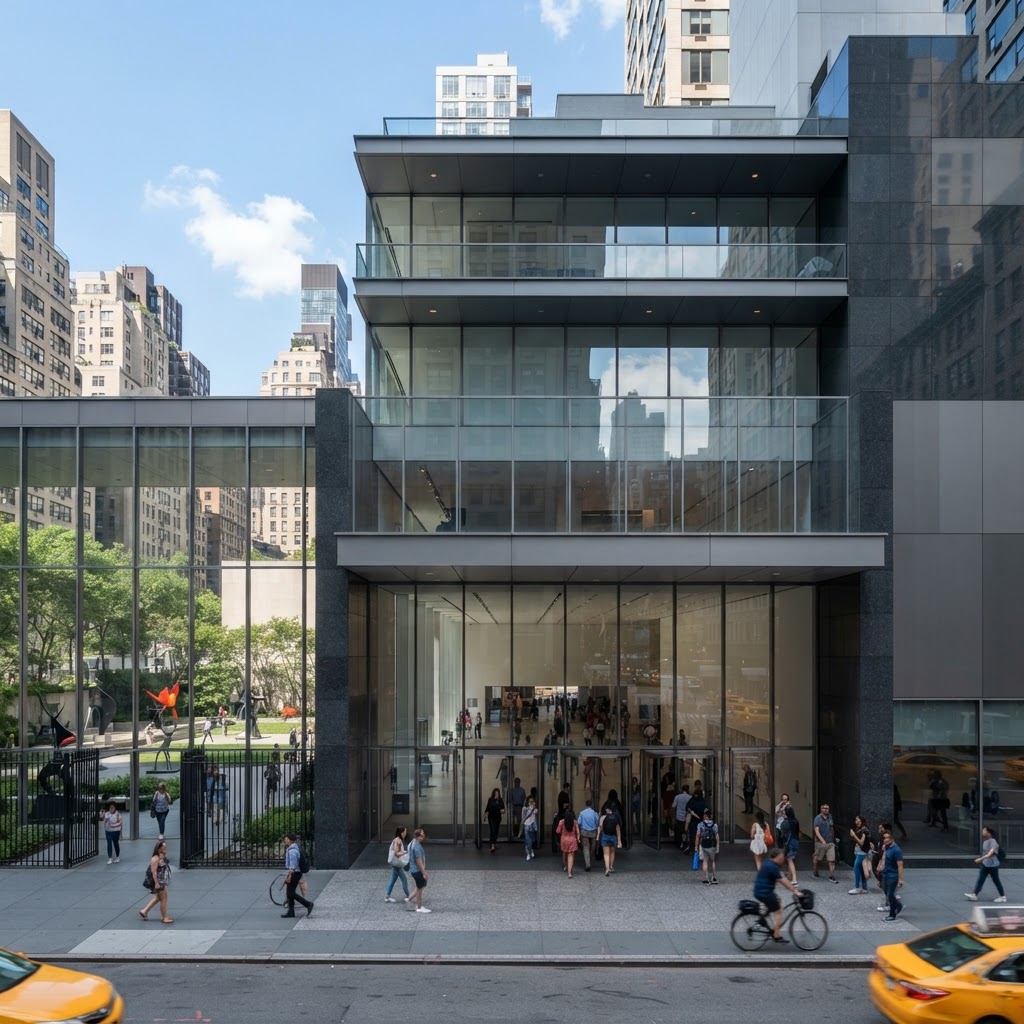
MoMA has been reshaped many times. The museum moved to its current site on West 53rd Street in 1939, in a building designed by Philip Goodwin and Edward Durell Stone. Major expansions followed by Philip Johnson (1964), Cesar Pelli (1984), and most recently the Japanese architect Yoshio Taniguchi, whose 2004 renovation doubled the gallery space and gave the museum its current serene, elegant character — clean glass and granite, soaring atriums, and the celebrated Abby Aldrich Rockefeller Sculpture Garden, designed by Johnson, at the heart of the complex.
**The Collection**
MoMA's collection is among the greatest of modern and contemporary art, encompassing roughly 200,000 works. Its holdings include the icons every visitor expects — Van Gogh's *The Starry Night*, Picasso's *Les Demoiselles d'Avignon*, Dalí's *The Persistence of Memory*, Matisse's *Dance* — alongside photography by Alfred Stieglitz, Henri Cartier-Bresson, and Diane Arbus; design objects from the Eames lounge chair to the Bell-Boy beeper; and the film collection that preserves the history of cinema from the Lumiere brothers to contemporary work. The museum's prints and illustrated books collection is the largest of any museum in the world.
**Why It Matters**
MoMA did not merely display modern art — it defined it. Barr's curatorial categories and his famous 1936 exhibition *Cubism and Abstract Art* established the genealogy of modernism that art history still teaches. The museum made the case that photography, film, architecture, and industrial design were arts equal to painting — a radical idea in 1929 that is now conventional. Walking through the galleries, you see the entire arc of the modern project: the liberation of color, the fracturing of form, the embrace of the everyday, the collapse of high and low. It is, in the end, a museum about how the modern world invented itself.
**References**
- Museum of Modern Art (MoMA) — moma.org — https://www.moma.org/
- Wikipedia: Museum of Modern Art — https://en.wikipedia.org/wiki/Museum_of_Modern_Art
- Alfred H. Barr Jr. and the founding of MoMA — https://en.wikipedia.org/wiki/Alfred_H._Barr_Jr.



Continue Reading


