Culture
The Library of Congress: America's Treasury of Knowledge on Capitol Hill
Founded in 1800 with $5,000 for books for Congress, rebuilt after the British burned it in 1814 with Thomas Jefferson's 6,487-volume library, the Library of Congress is the oldest federal cultural institution in the United States and one of the largest libraries on earth.
If you want to understand the American conviction that knowledge and democracy are inseparable, go to the Library of Congress. Founded in 1800 with a $5,000 appropriation 'for the purchase of such books as may be necessary for the use of Congress,' the Library is the oldest federal cultural institution in the United States and one of the largest libraries in the world, containing roughly 173 million items and employing more than 3,000 staff. It is the national library of the United States.
**Origins**
As the Library's own history records, in 1800, as part of an act of Congress providing for the removal of the new national government from Philadelphia to Washington, President John Adams approved an act providing $5,000 for books for the use of Congress — the beginning of the Library of Congress. The first books were ordered from London, forming a collection of 740 books and three maps housed in the new United States Capitol. In 1802, President Thomas Jefferson signed a bill allowing the president to appoint the Librarian of Congress and establishing a Joint Committee on the Library to oversee it.
The Library's great crisis — and its transformation — came during the War of 1812. In 1814, the British burned Washington, destroying the Capitol and the small congressional library in its north wing, which lost over 3,000 volumes. Within a month, the retired Jefferson, from Monticello, offered to sell his comprehensive personal library of 6,487 books to 'recommence' the congressional library. Congress accepted the offer in January 1815, appropriating $23,950. Jefferson's collection, gathered over 50 years and organized by Francis Bacon's classification of knowledge, covered subjects far beyond a legislative library — literature, science, philosophy, and languages — and transformed the Library from a specialist's collection into a general one. His belief in the universality of knowledge remains the rationale for the Library's comprehensive collecting policies today.
**The Thomas Jefferson Building**
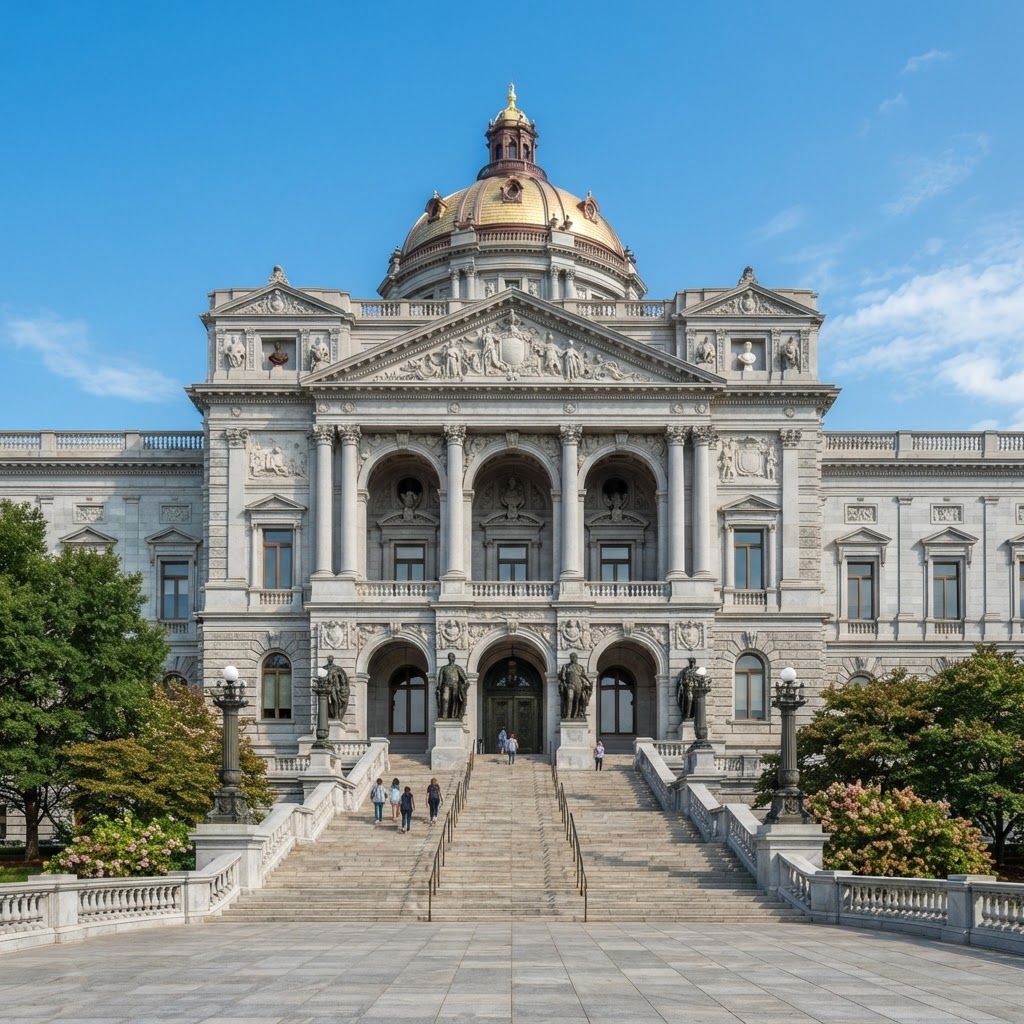
The Library's great monument is the Thomas Jefferson Building, constructed between 1890 and 1897 under Librarian Ainsworth Rand Spofford, who persuaded Congress that its Library deserved a grand, fireproof home. Designed in the Italian Renaissance style, it was the largest library in the world when it opened in 1897 — a soaring Beaux-Arts palace of marble, murals, and gilded ornament, with the magnificent Main Reading Room at its heart. The Library today comprises three buildings on Capitol Hill: the Jefferson Building (1897), the John Adams Building (1939), and the James Madison Memorial Building (1980).
**Growth and the National Library**
The Library's growth into a national institution was driven by the centralization of U.S. copyright registration and deposit at the Library in 1870, which funneled two copies of every copyrighted work into the collections. Librarian Herbert Putnam (1899-1939) built the Library's national services, establishing the Legislative Reference Service in 1914 and reaching out to support libraries across the nation. During World War II, Librarian Archibald MacLeish safeguarded the Declaration of Independence and the U.S. Constitution, shipping them to Fort Knox for the duration of the war. The Library of Congress Classification, developed under Putnam, organizes the collection and is now used by research libraries worldwide.
**Why It Matters**
The Library of Congress is not only a working library for the Congress — it is the memory of the nation. Its holdings include the papers of the founders, the Gutenberg Bible, the rough draft of the Declaration of Independence, the films of the National Film Registry, the world's largest map collection, and the recordings of the National Recording Registry. Jefferson's belief that there is 'no subject to which a member of Congress may not have occasion to refer' became the Library's philosophy of comprehensiveness — that a free people deserve access to everything ever written, filmed, recorded, or mapped. To walk through the Jefferson Building is to understand the scale of that ambition.
**References**
- Library of Congress: History of the Library — https://www.loc.gov/about/history-of-the-library/
- Wikipedia: Library of Congress — https://en.wikipedia.org/wiki/Library_of_Congress
- Thomas Jefferson's Library exhibit — https://www.loc.gov/exhibits/thomas-jeffersons-library/index.html



Continue Reading


