Culture
The Getty Center: Richard Meier's Hilltop Masterpiece Above Los Angeles
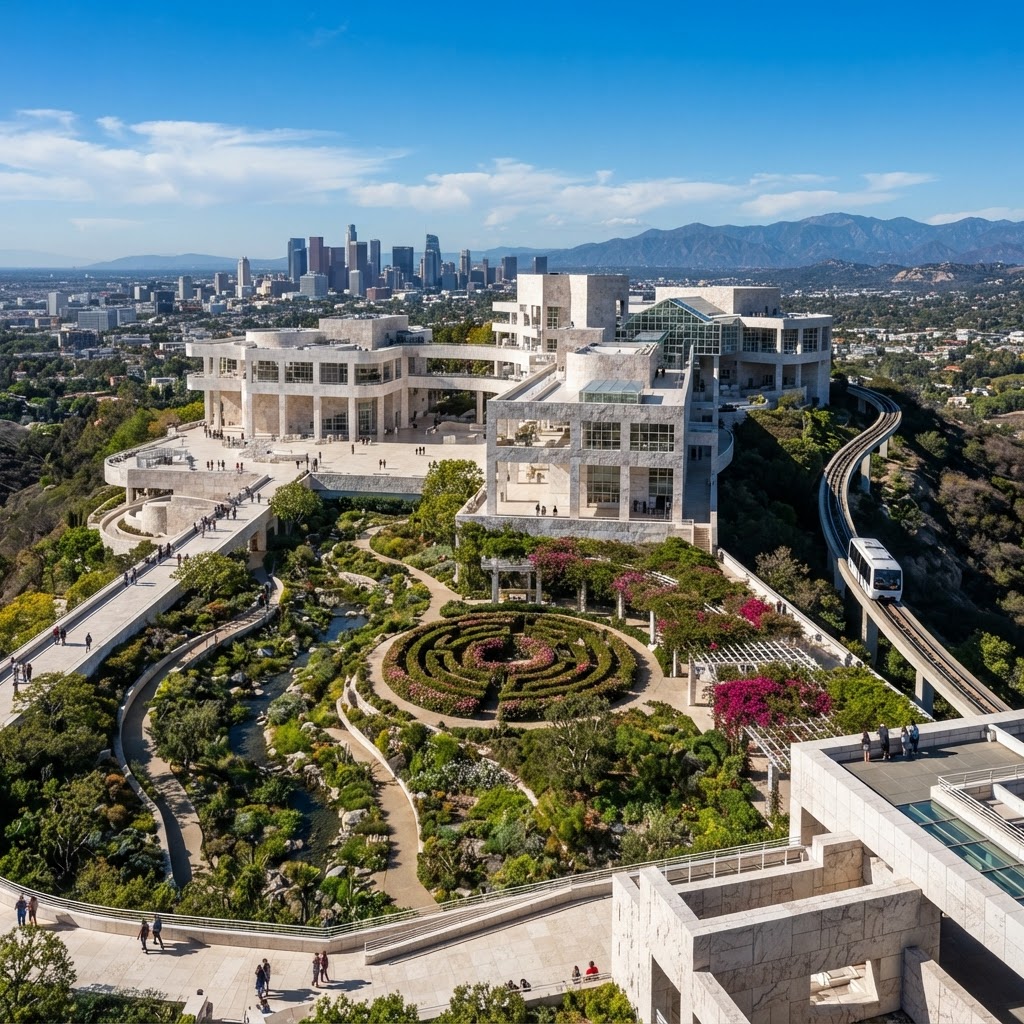
Opened in 1997 after 14 years of planning and construction, the Getty Center is Richard Meier's modernist hilltop campus housing the J. Paul Getty Museum, the Getty Research Institute, and the Getty Foundation. With its travertine cladding, panoramic city views, and Robert Irwin's Central Garden, it is one of America's great cultural destinations.
The Getty Center (getty.edu) in Los Angeles, California, is one of the most ambitious and successful cultural institutions in the United States. Perched on a 110-acre hilltop in the Santa Monica Mountains above the Brentwood neighborhood, the Getty Center houses the J. Paul Getty Museum, the Getty Research Institute, the Getty Conservation Institute, the Getty Foundation, and the Getty Trust — the world's wealthiest arts institution, with an endowment of approximately $8 billion.
Origins
The Getty Center was conceived in the early 1980s, when the J. Paul Getty Trust — established by the oil magnate J. Paul Getty (1892–1976), who left approximately $700 million to the Trust upon his death — decided that it needed a new facility to house its administrative offices and cultural programs. The Trust purchased the 110-acre site and in 1982 launched an architectural competition, inviting responses from 80 architects. After an 18-month selection process, the American architect Richard Meier (b. 1934) — a Pritzker Prize laureate known for his geometric, white, light-filled modernist buildings — was chosen in October 1984.
Design and Construction
The Getty Center was designed over 14 years and built between 1989 and 1997, opening to the public on 16 December 1997. The complex comprises six principal buildings arranged across the 24-acre hilltop campus, connected by courtyards, terraces, and gardens. Visitors arrive at a base-level entrance plaza and ascend to the campus via a three-car electric tramway — a two-minute ride that provides a dramatic transition from the city below to the hilltop retreat above.
The campus is organized along two natural ridges. The eastern ridge contains the Museum cluster — five interconnected pavilions arranged around a central courtyard — and the Getty Trust's administrative offices. The western ridge houses the Getty Research Institute, with its circular reading room, and a building containing a public restaurant, a cafeteria, and private dining rooms for staff. A ravine between the two ridges accommodates the entrance plaza, a grand staircase, and outdoor terraces.
Materials and Architecture
Meier's design for the Getty Center is characterized by his characteristic white enamel panels, extensive glazing, and — most controversially — the use of 1.2 million square feet of rough-cleft Italian travertine, quarried in Tivoli near Rome. The travertine was cut into 30-inch blocks using a specially invented guillotine apparatus, and the blocks are suspended on metal plates with open seams, creating a facade that denies the weight and massing of traditional masonry.
The campus exhibits Meier's geometric vocabulary: a 72-degree grid (the angle of the site's relationship to the street grid and the Santa Monica Mountains) organizes the buildings, with circular forms (the Museum entrance hall, the Research Institute) playing against rectilinear volumes. The buildings reference Le Corbusier, Rudolph Schindler, and Frank Lloyd Wright, while creating a distinctly Californian sense of light, space, and views.
The Central Garden
The Central Garden, located in the ravine between the Museum and the Research Institute, was designed by the artist Robert Irwin (1928–2023) — a pioneer of the Light and Space movement. Irwin's garden is a living work of art, designed to change with the seasons and evolve over time. The garden features a tree-lined walkway descending to a circular azalea pool surrounded by 400 trees, with a cascade of water running through the garden. Over 500 plant varieties are arranged by Irwin's precise aesthetic vision, creating a constantly changing composition of color, texture, and form.
The Collection
The J. Paul Getty Museum at the Getty Center displays European paintings, drawings, sculpture, illuminated manuscripts, decorative arts, and European and American photographs. Highlights include Vincent van Gogh's 'Irises' (1889), one of the most expensive paintings ever sold when the Getty acquired it in 1990; Rembrandt's 'The Abduction of Europa' (1632); works by Titian, Rubens, Veronese, Manet, Monet, Cézanne, and Renoir; the Getty's renowned collection of Greek and Roman antiquities (though many are displayed at the Getty Villa in Malibu, the Getty's original location); and one of the world's great photography collections, including works by Nadar, Man Ray, and Diane Arbus.
The museum's five pavilions are arranged around a central courtyard, allowing visitors to create their own path through the collection. The pavilions are connected by walkways and outdoor terraces that frame spectacular views of Los Angeles, the Pacific Ocean, and the mountains.
Practical Information
The Getty Center is located at 1200 Getty Center Drive, Los Angeles. Admission is free, but parking costs $25 per car ($15 after 3:00 PM). The Center is open Tuesday through Sunday (closed Mondays and major holidays), with extended hours on Saturdays. The Center is accessible via the Getty tramway from the parking garage. Reference: [The Getty Center](https://www.getty.edu/visit/center/)
Reference Links:
- The Getty Center: getty.edu
- Plan Your Visit: getty.edu/visit/center
- The Getty Collection: getty.edu/art/collection
- Central Garden: getty.edu/visit/center/gardens
- Los Angeles Tourism: discoverlosangeles.com
Continue Reading