Culture
The Forbidden City: Beijing's Imperial Palace and the Heart of China
Built between 1406 and 1420 by the Ming emperor Zhu Di, the Forbidden City was the seat of supreme power in China for over five centuries and the residence of 24 Ming and Qing emperors. With nearly 10,000 rooms, it is the largest surviving wooden palace complex on earth.
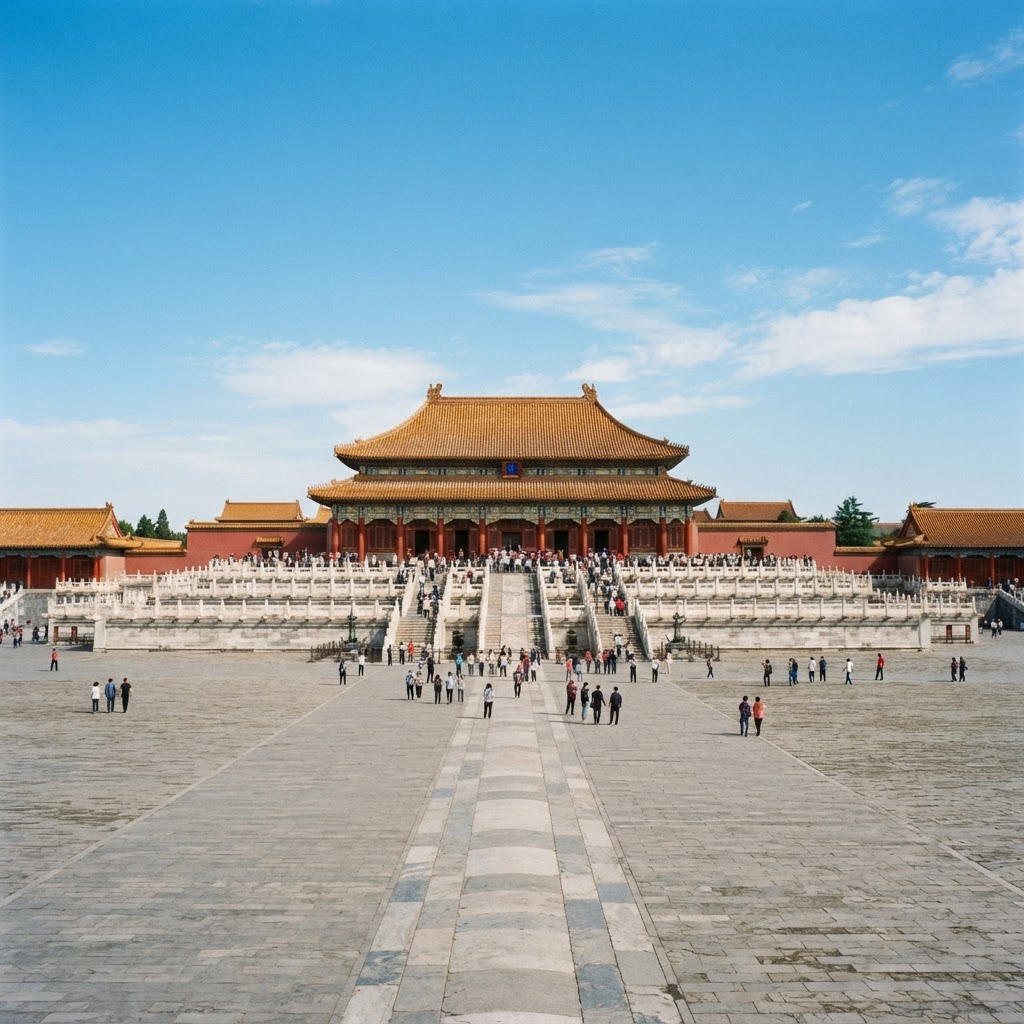
If you want to understand the imperial civilization of China, go to Beijing. The Forbidden City — Zǐjìnchéng, the 'Purple Forbidden City' — is the vast imperial palace complex at the center of Beijing, the residence of 24 Ming and Qing dynasty emperors over 505 years, and the largest surviving wooden palace complex in the world. Built between 1406 and 1420, it is now a UNESCO World Heritage Site and the home of the Palace Museum, and it remains the symbolic heart of the Chinese state.
**Origins**
As UNESCO records, the Imperial Palace of the Ming and Qing Dynasties in Beijing — known as the Forbidden City — was constructed between 1406 and 1420 by the Ming emperor Zhu Di (the Yongle Emperor), who moved the capital from Nanjing to Beijing and built the palace as the seat of his power. The Forbidden City witnessed the enthronement of 14 Ming and 10 Qing emperors over the following 505 years, from 1416 until the fall of the Qing dynasty in 1911. It is, in UNESCO's words, 'the supreme model in the development of ancient Chinese palaces,' and 'the exemplar of ancient architectural hierarchy, construction techniques and architectural art,' influencing official buildings across China for three centuries.
**The Layout**
The Forbidden City covers 720,000 square meters — roughly 178 acres — and contains nearly 10,000 rooms across 980 surviving buildings, laid out along a central north-south axis that runs through the heart of Beijing. The complex is divided into the Outer Court, the ceremonial and public space where the emperor held audiences and state rituals, and the Inner Court, the private residence of the emperor, empress, and concubines. The great halls of the Outer Court — the Hall of Supreme Harmony, the Hall of Central Harmony, and the Hall of Preserving Harmony — are among the most magnificent timber-frame structures in the world, with their golden glazed-tile roofs rising above vermillion walls and white marble platforms. The whole complex is surrounded by a 52-meter-wide moat and a 10-meter-high wall, with gates at the south (the Meridian Gate) and the north.
**From Palace to Museum**
The Forbidden City remained the seat of imperial power until 1912, when the last emperor, Puyi, abdicated. Puyi continued to live in the Inner Court until 1924, when he was expelled. On October 10, 1925, the Forbidden City was opened to the public as the Palace Museum, with the imperial collections of painting, calligraphy, ceramics, jade, and bronzes at its core — a collection that had been assembled over five centuries of imperial patronage. Many of its treasures were evacuated south during the Japanese invasion and the Chinese Civil War, with a portion eventually making its way to the National Palace Museum in Taipei.
**A World Heritage Site**
The Imperial Palaces of the Ming and Qing Dynasties in Beijing and Shenyang were inscribed on the UNESCO World Heritage List in 1987 (with the Shenyang palace added in 2004). UNESCO cites the complex as 'a priceless testimony to Chinese civilization during the Ming and Qing dynasties,' preserving 'the outstanding embodiment of Chinese hierarchical culture in the layout, design and decoration of the building complex.'
**Why It Matters**
The Forbidden City is the great architectural expression of imperial China — a city within a city, ordered by ritual and hierarchy, that embodied the doctrine of the Mandate of Heaven and the place of the emperor at the center of the world. For five centuries it was closed to all but the emperor, his court, and his servants; today it is visited by millions. To walk from the Meridian Gate through the great ceremonial courts to the Inner Court is to traverse the architecture of absolute power and to understand the civilization that produced it.
**References**
- UNESCO: Imperial Palaces of the Ming and Qing Dynasties in Beijing and Shenyang — https://whc.unesco.org/en/list/439/
- Wikipedia: Forbidden City — https://en.wikipedia.org/wiki/Forbidden_City
- The Palace Museum (Beijing) — https://en.dpm.org.cn/
Continue Reading