Culture
The Country Music Hall of Fame and Museum: Nashville's Smithsonian of Country Music
If you want to understand America's music, go to Nashville. The Country Music Hall of Fame and Museum — the 'Smithsonian of country music' — is the world's largest repository of country music artifacts, from Hank Williams's guitar to Elvis's gold Cadillac.
If you want to understand America's music, go to Nashville. The Country Music Hall of Fame and Museum, in the heart of downtown, is the world's largest and most comprehensive institution dedicated to the preservation and interpretation of country music history. Chartered by the state of Tennessee in 1964 and first opened on April 1, 1967, the museum has been called the "Smithsonian of country music" for its broad cultural impact, educational mission, and unrivaled collection of historically important artifacts. In 2024, the museum was awarded the prestigious National Medal of Arts by President Joe Biden.
**Origins**
The museum's origins lie in the Country Music Association (CMA), the trade organization founded in 1958 to promote country music. In the early 1960s, as the CMA's campaign to publicize country music accelerated, CMA leaders determined that a new nonprofit organization was needed to operate a museum beyond the scope of a trade association. The nonprofit Country Music Foundation (CMF) was chartered by the state of Tennessee in 1964, and the museum's first building — a barn-shaped structure on Nashville's Music Row — opened on April 1, 1967, with Jo Walker-Meador as its founding executive director.
**The Country Music Hall of Fame**
The Hall of Fame itself was created by the CMA in 1961, predating the museum by six years. The first three inductees — Hank Williams, Jimmie Rodgers, and Fred Rose — were announced in 1961. Roy Acuff, the first living artist to be inducted, joined in 1962. Over the Hall of Fame's history, the number of new members inducted each year has varied from one to twelve. The museum exhibits the bronze plaques commemorating Hall of Fame membership in a dedicated space.
**The Current Building**
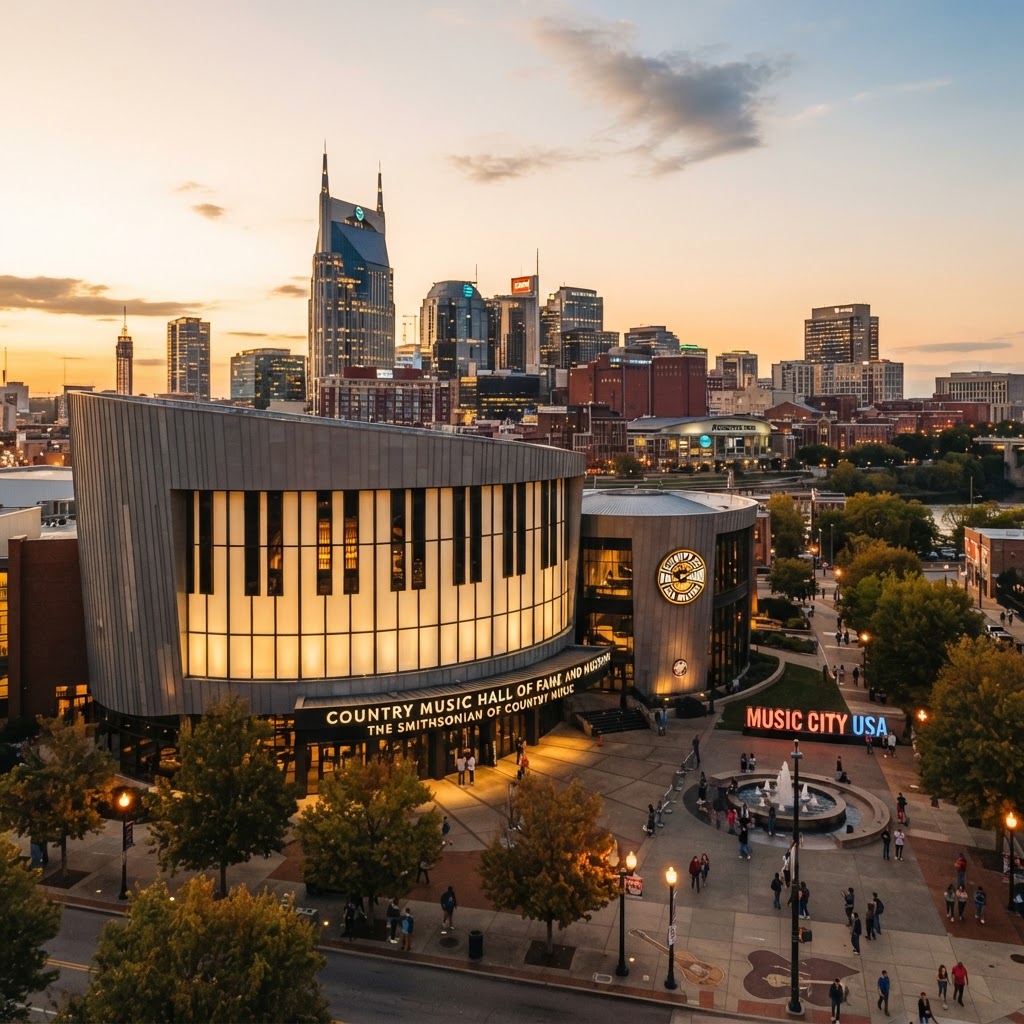
In May 2001, the museum moved from its Music Row location to a new, 140,000-square-foot facility in the heart of downtown Nashville's arts and entertainment district. The building, designed by Tuck-Hinton Architects, features distinctive design elements that reference country music's heritage: the tall windows are arranged to resemble piano keys, and the design incorporates elements reminiscent of a radio tower and the diamond-shaped clef symbol.
In 2014, the museum unveiled a $100 million expansion that doubled its size to 350,000 square feet of galleries, archival storage, education classrooms, retail stores, and event space, making it one of the largest museum complexes in the American South.
**The Collection**
The museum's collection is the most extensive in the world of country music artifacts, encompassing over 2.5 million items:
**Instruments** — the guitars of Hank Williams, Maybelle Carter, Chet Atkins, and Johnny Cash; Bill Monroe's mandolin; Earl Scruggs's banjo; and the Martin D-28 guitar that became the standard instrument of the genre.
**Costumes and Stage Wear** — including the gold Cadillac that Elvis Presley purchased for his manager Colonel Tom Parker; Hank Williams's Nudie suit; the elaborate, rhinestone-studded stage costumes of Porter Wagoner, Dolly Parton, and George Jones; and the black clothing that became Johnny Cash's signature.
**Recordings and Archives** — the museum's Frist Library and Archive holds over 200,000 sound recordings, 500,000 photographs, and extensive collections of sheet music, songbooks, business documents, and oral histories. The recorded sound collection traces the history of country music from its earliest commercial recordings in the 1920s to the present.
**Vehicles** — including Elvis Presley's solid-gold 1960 Cadillac Series 75 Fleetwood (one of the museum's most photographed objects), Webb Pierce's elaborately decorated convertible with its silver-dollar-studded dashboard and horseshoe upholstery, and a Nudie-mobile customized by the legendary tailor Nudie Cohn.
**Exhibits and Programming**
The museum's core exhibit, "Sing Me Back Home: A Journey Through Country Music History," traces the evolution of country music from its folk, gospel, and Appalachian roots through the Grand Ole Opry era, the Nashville sound, the outlaw movement, and into the contemporary era. Rotating exhibits showcase individual artists, eras, and themes. The museum also operates the historic RCA Studio B — where Elvis Presley, Dolly Parton, Roy Orbison, and more than 35,000 songs were recorded — and the Hatch Show Print shop, a letterpress poster shop that has been printing concert posters since 1879.
**Why It Matters**
The Country Music Hall of Fame and Museum isn't just a museum about music. It's a museum about America — about migration, storytelling, poverty, resilience, and the way a sound born in the Appalachian hills became a global phenomenon. Walking through the galleries, you understand that country music has always been more than entertainment. It's a record of who we are.
**References**
- Country Music Hall of Fame and Museum — https://www.countrymusichalloffame.org/
- Wikipedia: Country Music Hall of Fame and Museum — https://en.wikipedia.org/wiki/Country_Music_Hall_of_Fame_and_Museum
- Nashville Convention & Visitors Corp — https://www.visitmusiccity.com/things-to-do/attractions/country-music-hall-of-fame
- CMT: Country Music Hall of Fame History — https://www.cmt.com/news/country-music-hall-of-fame-history


Continue Reading