Culture
The Centre Pompidou: Paris's Inside-Out Cultural Machine
When it opened in 1977, the Centre Pompidou scandalized Paris with its exposed color-coded pipes and inside-out architecture by Renzo Piano and Richard Rogers. Nearly half a century later, it is one of the most beloved and most photographed monuments in the city — a 'culture factory' in the heart of the Marais.
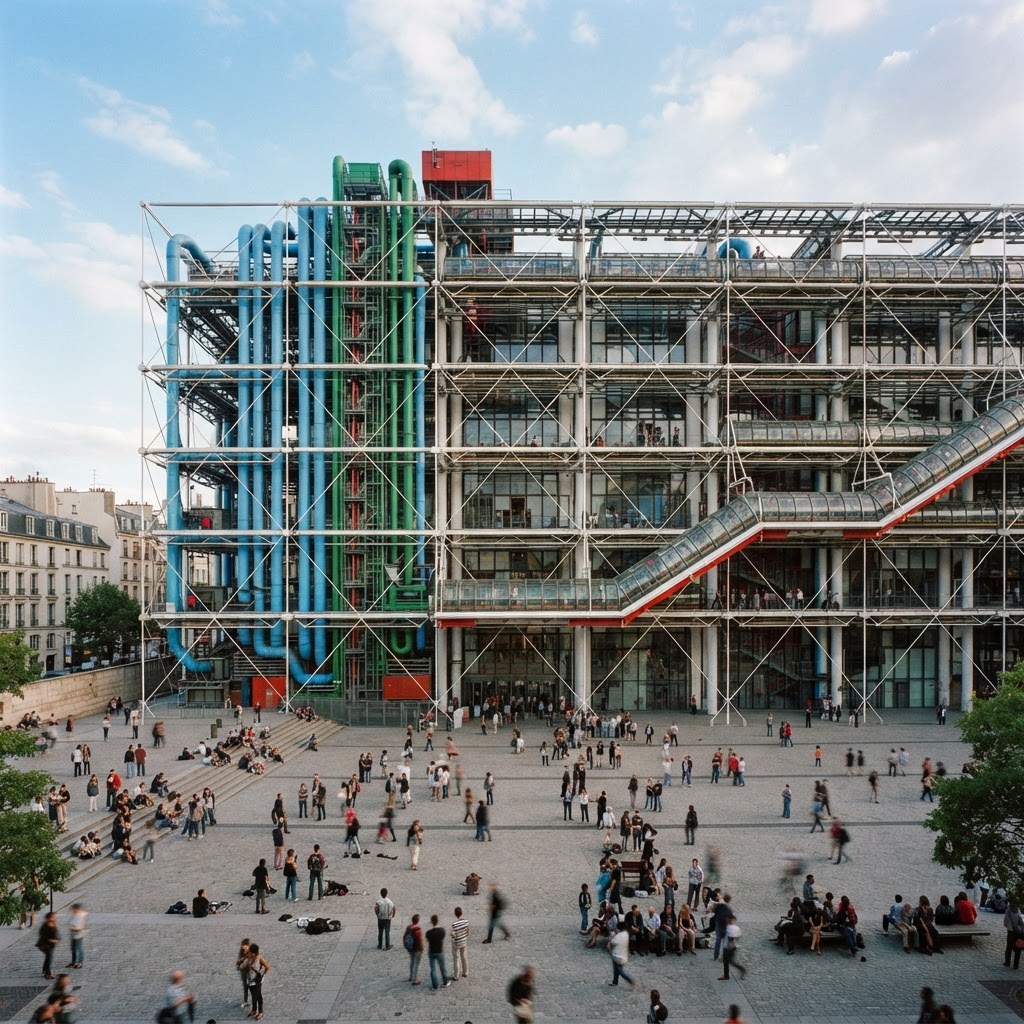
If you want to understand how radical architecture can become beloved, go to the Centre Pompidou. When it opened in 1977 in the heart of the Marais, the building scandalized Paris — a glass and steel structure with all its structural and mechanical elements exposed on the outside, color-coded pipes climbing its facades, escalators zig-zagging up transparent tubes. Critics nicknamed it 'Notre Dame of the Pipes.' Nearly half a century later, it is one of the most photographed monuments in the city and the most visited cultural institution in France outside of the Louvre.
**Origins**
The Centre national d'art et de culture Georges-Pompidou was conceived in 1969 by the then French President, Georges Pompidou, who wanted a multidisciplinary cultural institution — a 'culture factory' where art, design, literature, music, and cinema would intermingle. An international competition was launched by the French Ministry of Culture in 1971. As the Renzo Piano Building Workshop records, the competition was won by two then-unknown architects: the Italian Renzo Piano and the British Richard Rogers, whose proposal was unique in occupying only half the site and devoting the rest to a public piazza that sloped down to a transparent lower-ground entrance hall, binding the institution to the city.
The architects conceived the building as a genuinely living organism — a huge spaceship of glass, steel, and colored tubing that 'landed unexpectedly in the heart of Paris,' as Piano put it. The entire ten-floor structure (seven above ground, three below) is steel, with huge 48-meter warren trusses spanning the full width, connected by die-cast steel 'gerberettes' that remove the need for internal support and create vast, flexible interior plateaus. To maximize the flexibility of these internal spaces, the services and circulation were placed outside: lifts and escalators run along the piazza facade, and the color-coded utilities — blue for air, green for water, yellow for electricity, red for vertical circulation — climb the street-side facade along the Rue Beaubourg. Nothing is concealed; all the inner workings are visible from the outside.
**The Musee National d'Art Moderne**
The Centre Pompidou is home to the Musee National d'Art Moderne, one of the largest museums of modern and contemporary art in the world, whose collection spans the 20th and 21st centuries from cubism, fauvism, and surrealism to the present — including masterpieces by Picasso, Matisse, Kandinsky, Duchamp, Warhol, and Beuys. The institution also houses a vast public library (the Bibliotheque publique d'information), centers for industrial design and music, a cinema, and spaces for performance and debate. The Piazza in front, open to the city, has become one of the great public spaces of Paris — a place to meet, to stroll, to rest, and to watch street performers.
**Renovation and Legacy**
In October 1997, the Centre Pompidou undertook major redevelopment works, reopening on January 1, 2000, with the modern art collection fully occupying the upper levels. The institution is now undergoing a further transformation for the years 2025 to 2030, closing for major renovation while a satellite, the Bourse de Commerce, continues its mission in central Paris.
**Why It Matters**
The Centre Pompidou was the architectural statement of its age — a deliberate rejection of the austere, impenetrable monument in favor of a building that is transparent, flexible, and alive. It proved that a modern building could be as much a Paris landmark as Notre-Dame, and that a cultural institution could be a place of joy and encounter rather than solemn pilgrimage. The escalators rising through their glass tubes over the rooftops of Paris remain one of the great urban experiences of the 20th century.
**References**
- Centre Pompidou: An iconic architecture — https://www.centrepompidou.fr/en/centre-pompidou-is-transforming-itself/an-iconic-architecture
- Renzo Piano Building Workshop: Centre Georges Pompidou — https://www.rpbw.com/project/centre-georges-pompidou
- Wikipedia: Centre Pompidou — https://en.wikipedia.org/wiki/Centre_Pompidou



Continue Reading


