Culture
The British Museum: London's 1753 Treasure House and the World's First Public Museum
The British Museum, founded in 1753 and opened to the public in 1759, was the first national public museum in the world. From the Rosetta Stone to the Parthenon Marbles, its collection of over eight million objects spans two million years of human history — and entry has been free since the day it opened.
The British Museum (britishmuseum.org) in Bloomsbury, London, is the world's first national public museum and one of the greatest cultural institutions on earth. Founded by an Act of Parliament in 1753 and opened to the public on 15 January 1759, it was established to house the collection of Sir Hans Sloane, a physician and naturalist who had assembled over 71,000 objects — books, manuscripts, natural specimens, and antiquities — and bequeathed them to the nation for the sum of £20,000 (a fraction of their value), on the condition that they be made freely available to the public.
The museum's founding principle — that the collection should be accessible to all, free of charge — was revolutionary for its time and remains the museum's policy to this day. The British Museum was the first museum to cover all fields of human knowledge, and it became the model for the great national museums of Europe and the world.
The Building
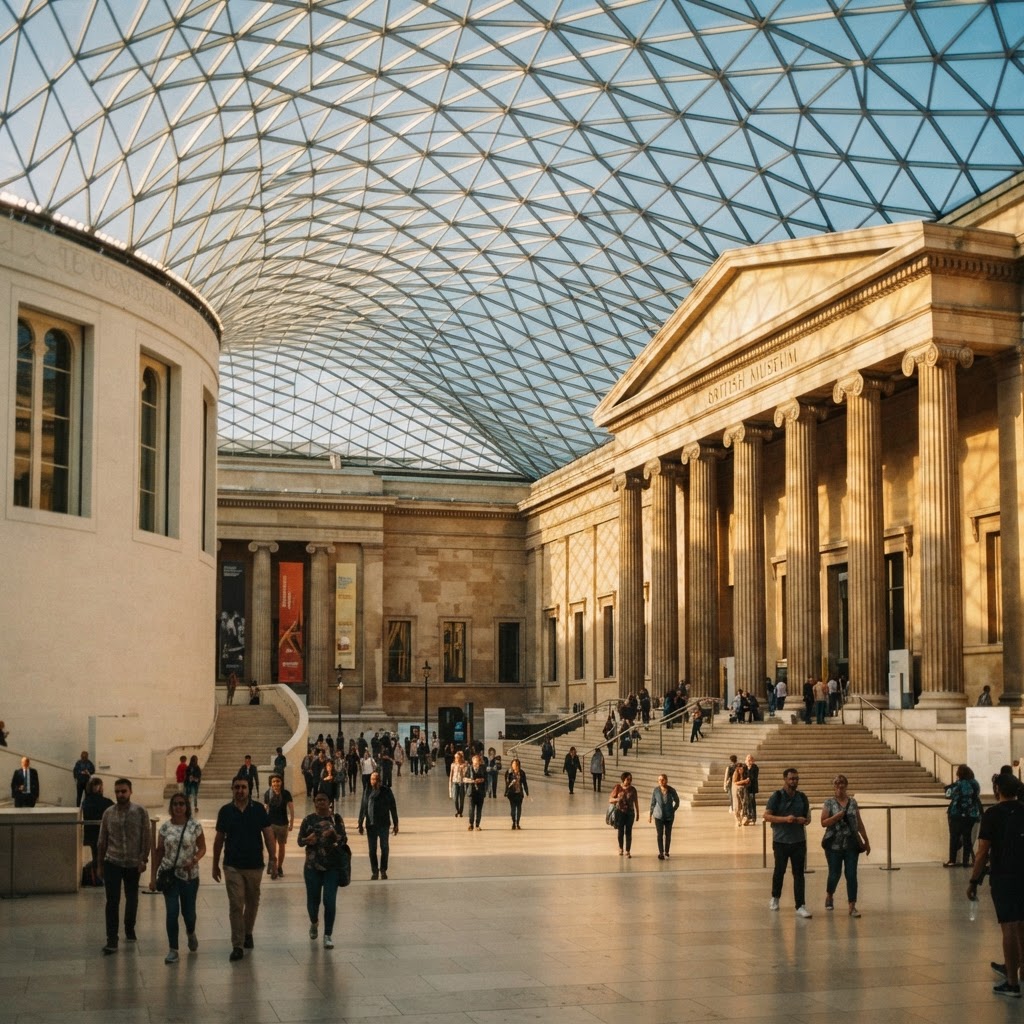
The museum's current home, a magnificent Greek Revival building designed by Sir Robert Smirke, was begun in 1823 and completed in 1852. The imposing south entrance, with its 44 Ionic columns inspired by the Temple of Athena Polias at Priene, is one of the most recognised museum façades in the world. The building was extended in the 19th century with the circular Reading Room (1857) at the centre of the quadrangle — where Karl Marx wrote 'Das Kapital' and where Lenin, George Bernard Shaw, and Bram Stoker all worked.
In 2000, the Great Court — the magnificent glass-and-steel roof designed by Norman Foster and Partners — was opened, transforming the museum's central quadrangle into the largest covered public square in Europe. The Reading Room, restored to its original 1857 splendour, sits at the heart of the Great Court.
The Collection
The British Museum's collection encompasses over eight million objects spanning two million years of human history. Only a fraction (approximately 80,000 objects) is on display at any one time across 94 permanent galleries.
**The Rosetta Stone** — the key to deciphering Egyptian hieroglyphs. Discovered by French soldiers in 1799 in the Egyptian port city of Rosetta (Rashid) and surrendered to the British under the Treaty of Alexandria in 1801, the basalt stele carries a decree issued in 196 BC in three scripts: hieroglyphic, demotic, and Greek. It was the French scholar Jean-François Champollion who, in 1822, used the Greek text to crack the hieroglyphic code, unlocking the entire field of Egyptology. Room 4.
**The Parthenon Marbles** (the 'Elgin Marbles') — the sculptural decoration of the Parthenon in Athens, removed by Thomas Bruce, 7th Earl of Elgin, between 1801 and 1812 when he was British ambassador to the Ottoman Empire, and acquired by the British Museum in 1816. The marbles — including 75 metres of the Parthenon frieze, 15 metopes, and 17 pedimental figures — are among the finest surviving works of classical Greek sculpture (created under the direction of the sculptor Phidias, c. 447–432 BC). Their presence in London remains a subject of ongoing diplomatic debate between the British Museum and the Greek government, which has requested their return to Athens. Room 18.
**The Egyptian Mummies** — the British Museum holds one of the finest collections of Egyptian mummies and funerary objects outside Cairo, including the mummy of Katebet (a Chantress of Amun, c. 1300 BC) and the extensive collection from the tomb-chapels of Thebes. Rooms 62–63.
**The Sutton Hoo Ship Burial** — the greatest archaeological discovery in British history. In 1939, archaeologists excavated an Anglo-Saxon ship burial at Sutton Hoo in Suffolk, dating to the early 7th century AD. The ship — 27 metres long — contained an extraordinary treasure including a ceremonial helmet, a sword, gold and garnet jewellery, and Byzantine silverware, believed to be the burial of Rædwald, King of East Anglia. Room 41.
Practical Information
The British Museum is open daily, 10:00–17:00, with extended hours on Fridays. Admission is free, though special exhibitions require tickets. The museum is located on Great Russell Street, London WC1, with the nearest Underground stations at Tottenham Court Road (Northern and Central Lines) and Holborn (Central and Piccadilly Lines). Reference: [The British Museum Official](https://www.britishmuseum.org)
Reference Links:
- The British Museum: britishmuseum.org
- The British Museum Story: britishmuseum.org/about-us/british-museum-story
- The Rosetta Stone: britishmuseum.org/collection/object/Y_EA24
- The Parthenon Marbles: britishmuseum.org/about-us/british-museum-story/contemporary-debates/parthenon-sculptures
- Sutton Hoo: britishmuseum.org/learn/schools/ages-7-11/young-explorers-find-out-about/who-was-buried-sutton-hoo
- Visit Britain: visitbritain.com
- Transport for London: tfl.gov.uk



Continue Reading


