Culture
The Bolshoi Theatre: Moscow's Legendary Stage and the Soul of Russian Ballet
Since its founding in 1776, the Bolshoi Theatre has been the beating heart of Russian performing arts. From Tchaikovsky's premieres to the legendary Bolshoi Ballet, this neoclassical landmark on Theatre Square has defined Russian cultural identity for nearly 250 years.
The Bolshoi Theatre (bolshoi.ru) in Moscow, Russia, is one of the most legendary performing arts institutions in the world. Founded in 1776, the Bolshoi — whose name means simply 'Grand' or 'Big' in Russian — has been the home of Russian ballet and opera for nearly 250 years, and the Bolshoi Ballet is widely regarded as one of the two greatest classical ballet companies in the world, alongside the Paris Opera Ballet.
Origins
The Bolshoi Theatre traces its origins to March 1776, when Prince Pyotr Urusov, a provincial prosecutor turned theatre entrepreneur, received a government licence to maintain a theatre company in Moscow. Urusov partnered with the English entrepreneur Michael Maddox, and the company initially performed in a private house on Petrovka Street. The first stone theatre building, designed by the architect Christian Rosberg, was completed in 1780 and named the Petrovsky Theatre. It was destroyed by fire in 1805.
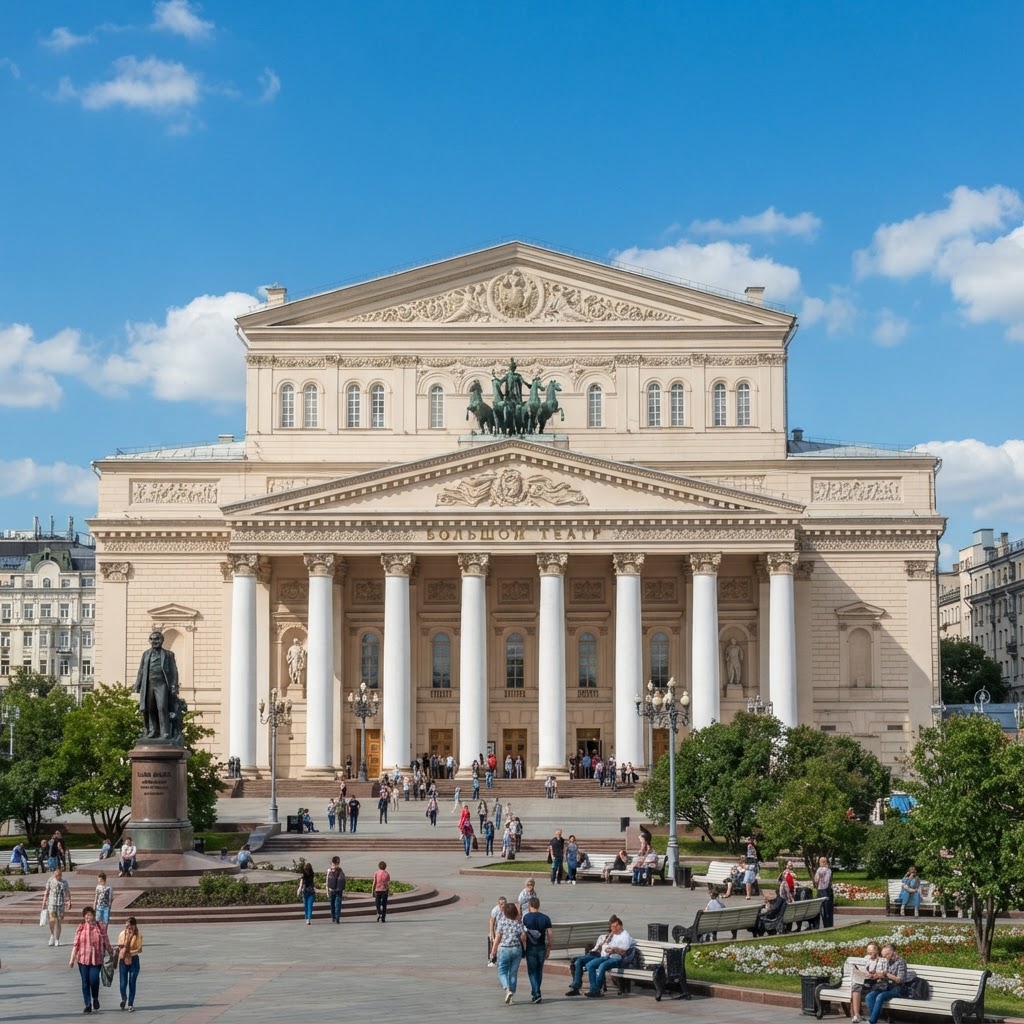
The current building — the sixth theatre on or near the site — was designed by the architect Joseph Bové (1784–1834) and opened on 6 January 1825 with a performance of the prologue 'The Triumph of the Muses.' The neoclassical building, with its eight-columned portico and Apollo statue atop the pediment, was one of the grandest theatres in Europe, seating 2,200 spectators. This building too was destroyed by fire, in 1853, and was rebuilt by the architect Alberto Cavos, reopening in 1856.
The Building
The Bolshoi Theatre that stands today on Teatralnaya (Theatre) Square is Bové and Cavos's building, extensively renovated between 2005 and 2011 in a restoration that cost approximately 21 billion rubles (about $680 million). The renovation restored the original 19th-century acoustics, rebuilt the stage machinery, and uncovered painted decorations that had been hidden under layers of Soviet-era paint. The building seats 1,740.
The facade features an eight-columned portico in the Doric order, topped by a statue of Apollo driving a chariot with four horses — a copy of the original, which was destroyed in the 1853 fire. The interior is lavishly decorated in crimson and gold, with a five-tiered auditorium and a ceiling painting by the Venetian artist Giovanni Battista Lampi depicting Apollo and the Muses.
The Bolshoi Ballet
The Bolshoi Ballet is the oldest ballet company in Russia and one of the oldest in the world. Its distinctive style — characterised by athletic technique, dramatic intensity, and a grand, sweeping quality — was forged in the 19th century under the choreographer Marius Petipa (1818–1910), a Frenchman who spent 60 years in Russia and created over 50 ballets, including 'Swan Lake,' 'The Sleeping Beauty,' and 'The Nutcracker' (in collaboration with Lev Ivanov).
Pyotr Ilyich Tchaikovsky composed three ballets for the Imperial Theatres: 'Swan Lake' (1877, premiered at the Bolshoi), 'The Sleeping Beauty' (1890, premiered at the Mariinsky), and 'The Nutcracker' (1892, premiered at the Mariinsky). The Bolshoi also premiered several of Tchaikovsky's operas, including 'Eugene Onegin' (1879) and 'The Maid of Orleans' (1881).
In the 20th century, the Bolshoi Ballet produced legendary dancers including Galina Ulanova, Maya Plisetskaya, Vladimir Vasiliev, Ekaterina Maximova, and Yuri Grigorovich, who served as the company's artistic director from 1964 to 1995 and choreographed definitive versions of 'Spartacus,' 'Ivan the Terrible,' and 'The Golden Age.'
The Bolshoi Opera
The Bolshoi Opera, while often overshadowed by the ballet, is one of the world's great opera companies. It has premiered many of the most important works in the Russian operatic repertoire, including Modest Mussorgsky's 'Boris Godunov' (1874), which was written for the Bolshoi and premiered there. The company also gave the Russian premieres of Verdi's 'Aida' and Wagner's 'Lohengrin.'
The Soviet Era and Beyond
During the Soviet era, the Bolshoi was a showcase institution, heavily funded by the state and sent on prestigious international tours as cultural ambassadors. The Bolshoi's tours to London (1956) and the United States (1959) were landmark cultural events of the Cold War, introducing Western audiences to the power and passion of Russian ballet.
After the collapse of the Soviet Union in 1991, the Bolshoi faced financial difficulties and administrative turmoil, but it has since regained its position as one of the world's pre-eminent performing arts institutions. In 2002, a second stage — the New Stage — was opened adjacent to the historic building, allowing the company to continue performing during the 2005–2011 renovation of the historic theatre.
Practical Information
The Bolshoi Theatre is located at Teatralnaya Square 1, Moscow. The nearest Metro station is Teatralnaya. Performances are held on both the Historic Stage and the New Stage. Tickets can be purchased through the official website. Reference: [The Bolshoi Theatre](https://www.bolshoi.ru/en/)
Reference Links:
- The Bolshoi Theatre (Official): bolshoi.ru/en
- Bolshoi Ballet and Opera Tickets: bolshoirussia.com
- Wikipedia Bolshoi Theatre: en.wikipedia.org/wiki/Bolshoi_Theatre
- Visit Russia: visit-russia.org
- Moscow Tourism: moscovery.com


Continue Reading