Culture
The Apollo Theater: Harlem's Legendary Stage Where American Music Was Born
Since 1934, the Apollo Theater on 125th Street has been the premier launchpad for African American musical talent. From Ella Fitzgerald's Amateur Night debut to James Brown's electrifying performances, the Apollo is where soul, jazz, R&B, and hip-hop were forged in front of the world's most demanding audience.
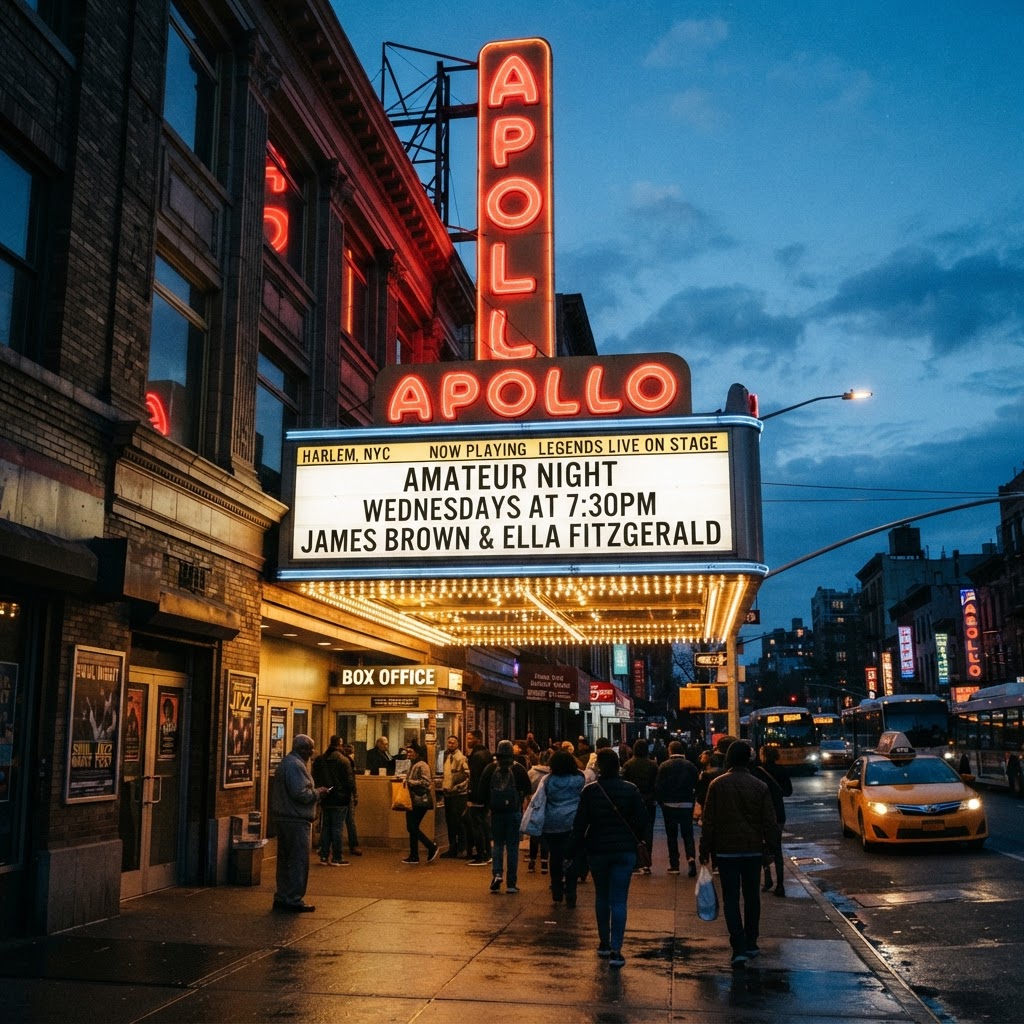
The Apollo Theater (apollotheater.org) at 253 West 125th Street in Harlem, New York City, is arguably the most influential cultural venue in American music history. Since 1934, when Amateur Night was introduced by Ralph Cooper, the Apollo has served as the premier showcase for African American musical talent — a place where a 15-year-old Ella Fitzgerald made her debut, where James Brown recorded 'Live at the Apollo' in 1962, and where a young Stevie Wonder, Michael Jackson, and Lauryn Hill all took the stage before they became legends.
The theater's story begins in 1913, when it opened as Hurtig and Seamon's New Burlesque Theater — a whites-only venue in a neighborhood that was rapidly becoming the capital of Black America. In 1934, under new ownership by Sidney Cohen and Morris Sussman, the theater was reopened to African American audiences and performers, and Ralph Cooper's Amateur Night was born. The Apollo became the first major New York theater to welcome Black patrons and performers, at a time when segregation was the law of the land.
Amateur Night at the Apollo
Amateur Night, introduced on 21 January 1934, is the theater's signature institution — the longest-running talent competition in America. The format is deceptively simple: performers compete before the famously demanding Apollo audience, and those who fail to impress are literally dragged off the stage by 'the Executioner,' a man carrying a broom. Those who win over the crowd go on to compete in the weekly shows, culminating in a grand finale with a cash prize.
Ella Fitzgerald was 15 years old when she won Amateur Night on 21 November 1934, intending to dance but switching to singing at the last moment. The Apollo's audiences have launched the careers of countless artists: James Brown, who first performed there in 1953; Stevie Wonder; The Jackson 5, who won Amateur Night in 1967; Lauryn Hill, who performed as a child; D'Angelo; Jazmine Sullivan; H.E.R.; and Machine Gun Kelly.
The Legends
The Apollo's stage has hosted virtually every major figure in African American music. James Brown's 'Live at the Apollo' (1962), recorded at his own expense when his label refused to fund it, became one of the greatest live albums ever made and cemented the theater's reputation as the ultimate proving ground. The Supremes, Aretha Franklin, Stevie Wonder, Marvin Gaye, Gladys Knight, and Prince all performed at the Apollo during their careers. The theater was also a center of Black comedy: Richard Pryor, Bill Cosby, and Redd Foxx all honed their craft on its stage.
The Building
The Apollo's building, designed by architect George Keister in the neo-classical style, has been designated a New York City Landmark and is listed on the National Register of Historic Places. The 1,506-seat theater retains its original configuration, with a relatively intimate auditorium that gives every seat a close view of the stage. The Apollo was designated a not-for-profit organization in 1991, and in 2025 the historic theater underwent a major renovation.
The Cultural Legacy
The Apollo Theater is more than a music venue — it is a cornerstone of African American cultural history. It was designated a New York City Landmark in 1983 and received a National Historic Landmark designation in 2024. The theater's influence on American music cannot be overstated: it is where gospel met rhythm and blues, where soul was born, where hip-hop found its first major audience, and where the tradition of Black musical excellence has been passed from generation to generation for over 90 years.
Reference Links:
- The Apollo Theater: apollotheater.org
- Apollo History: apollotheater.org/history
- Amateur Night: apollotheater.org/amateur-night
- New York City Landmarks Preservation Commission: nyc.gov/site/lpc
- National Register of Historic Places: nps.gov/subjects/nationalregister
- Visit Harlem: visitharlem.com
Continue Reading