Culture
Teatro alla Scala: Milan's Legendary Opera House and the Art of the Italian Evening
Since 1778, La Scala has been the most important opera stage in the world. An evening here is not just a concert — it is a ritual, a tradition, and one of the great cultural experiences of European civilisation.
There are great opera houses, and then there is La Scala. The Teatro alla Scala in Milan has been, since its inauguration on 3 August 1778, the supreme tribunal of operatic art — the house where careers are made or destroyed, where the public is the most knowledgeable and the most demanding in the world, and where the greatest singers, conductors, and composers have tested their finest work.
The list of world premieres at La Scala reads as a history of opera itself: Verdi's *Otello* (1887), *Falstaff* (1893), and *Nabucco* (1842); Puccini's *Madama Butterfly* (1904); Donizetti's *Lucia di Lammermoor* (1835) in its revised version; Rossini's *La gazza ladra* (1817). The singers associated with its greatest eras include Enrico Caruso, Maria Callas (whose career was defined and partly broken at La Scala), Joan Sutherland, Renata Tebaldi, Luciano Pavarotti, Mirella Freni, and Roberto Alagna. The conductors: Arturo Toscanini, who shaped the house's performing standards between 1898 and 1929; Claudio Abbado; Riccardo Muti, whose 19-year tenure (1986–2005) is the house's most recent golden age; and Riccardo Chailly, the current music director. Reference: teatroallascala.org
**The Building**
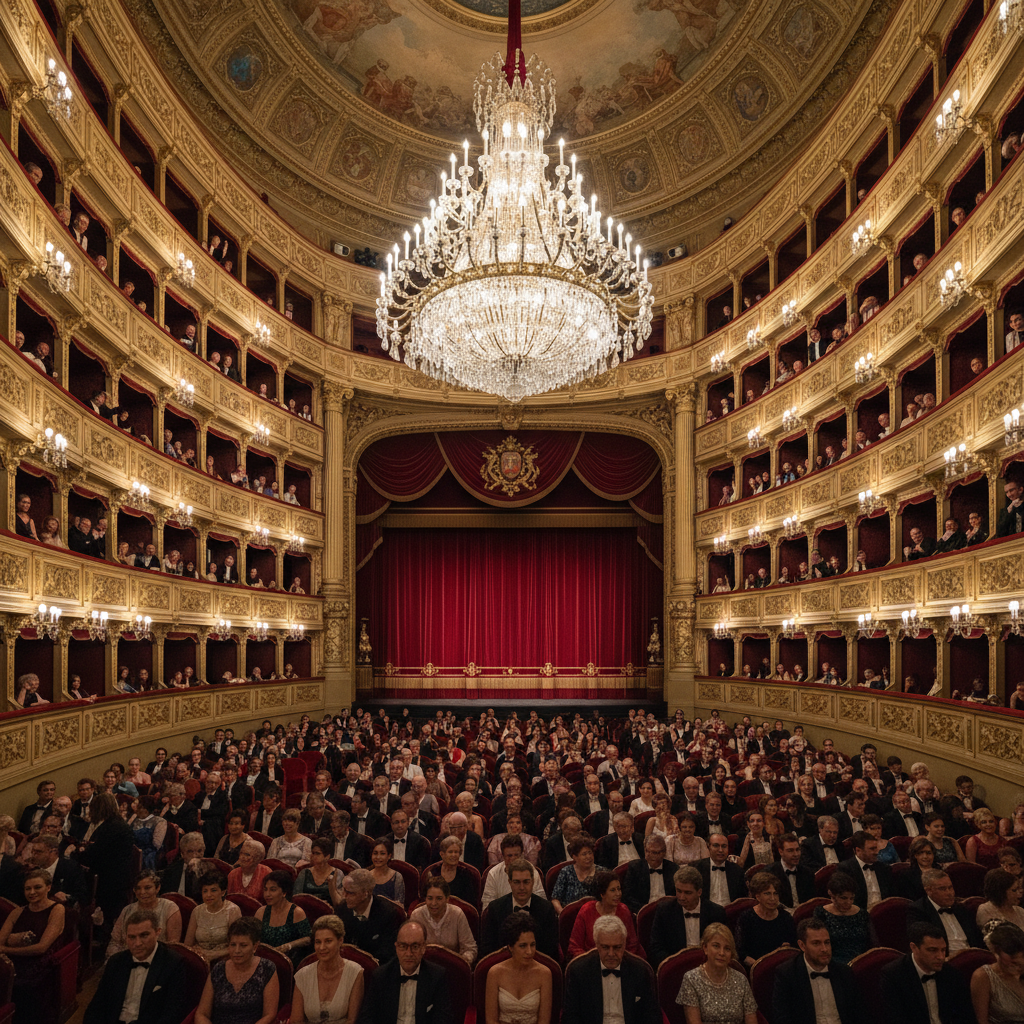
The theatre was built by the architect Giuseppe Piermarini on the site of the church of Santa Maria alla Scala — from which it takes its name. The exterior is a model of Milanese neoclassicism: restrained, elegant, and deliberately unprepossessing relative to the grandeur within. The auditorium, with its horseshoe plan, five tiers of boxes, and a final gallery, seats 2,030 — a relatively intimate house for its historical significance. The red velvet, the gilded balconies, the enormous crystal chandelier (installed in the 1920s and containing 365 light bulbs, one for each day of the year) are exactly as you imagine them.
The theatre was extensively damaged by Allied bombing in August 1943 and rebuilt under the direction of architect Luigi Lorenzo Secchi; it reopened on 11 May 1946 with a historic concert conducted by Arturo Toscanini. A further major renovation — including new fly tower, backstage facilities, and restoration of the historic auditorium — was completed in 2004.
**The 2025/26 Season**
The current season, opening on 7 December 2025 (the feast of Sant'Ambrogio, Milan's patron saint, and the traditional opening night of La Scala's season) with Beethoven's *Fidelio* conducted by Riccardo Chailly, presents thirteen opera titles spanning the Baroque to the 20th century. The season runs through July 2026. For the complete programme and ticket availability: teatroallascala.org/en/season/2025-2026.
**Tickets**
Tickets are sold through La Scala's official website (teatroallascala.org) from approximately three months before each performance. Prices range from €15 (upper gallery, limited sightlines) to €250+ for prime stalls and boxes on opening nights. The December 7th opening night — one of the great events in Italian cultural life, attracting the President of the Republic, leading industrialists, and the fashion world — carries premium prices and typically sells out within hours of release.
For standing room and last-minute tickets, a small number of seats are released on the day of performance at the box office in Piazza della Scala from 12pm.
**The Museo Teatrale alla Scala**
The museum (museoscala.org), accessible via the theatre's main foyer, houses two centuries of operatic history: costumes, original scores, instruments, portraits, and theatrical memorabilia. The stage tours — conducted before evening performances — allow visitors to see the stage itself, the machinery beneath it, and the extraordinary backstage infrastructure that supports 300+ productions a year. Tours must be booked in advance at museoscala.org.
**Before and After the Performance**
Milan's pre-theatre tradition centres on the Galleria Vittorio Emanuele II, directly adjacent to La Scala in Piazza del Duomo — one of the world's great shopping arcades, containing the Prada flagship, the historic Savini restaurant (savinimilano.it), and the Bar Camparino (camparino.it), where the Campari Spritz was perfected. After the performance, Via Brera and the Navigli canal district offer the city's finest late-night dining and bars.



Continue Reading


